Millions of ecommerce products compete for visibility on Google every day.
Yet many online stores never appear when potential customers search for products they are ready to buy.
This creates a major challenge. Even if you have great products, competitive pricing, and a well-designed website, customers cannot purchase what they cannot find.
Without Google Merchant Center:
- Products may not appear in Google Shopping results
- Visibility opportunities across Google’s ecosystem are missed
- Qualified traffic becomes harder to acquire
- Ecommerce growth can slow despite strong products
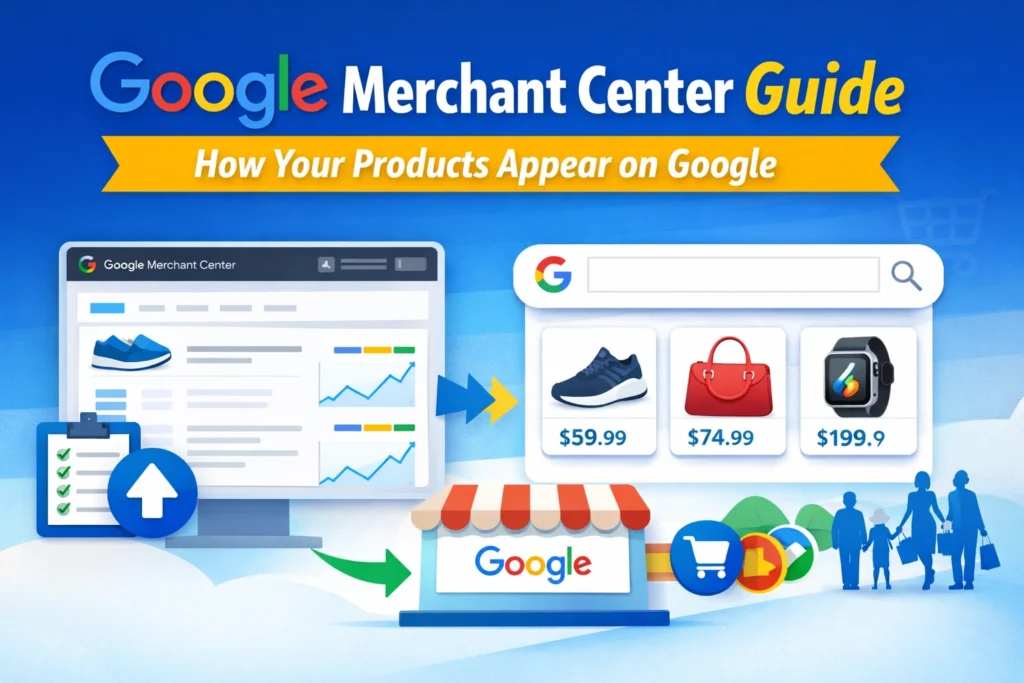
Google Merchant Center helps solve this problem by connecting your product data with Google’s shopping and discovery platforms. It allows businesses to showcase products across Google Shopping, Search, Images, YouTube, and other surfaces where buyers actively look for products.
For ecommerce businesses, Merchant Center is more than a technical platform. It is a visibility engine that helps products reach potential customers at the moment purchase intent exists.
In this guide, we’ll explore the key benefits of Google Merchant Center, how it supports ecommerce growth, and why many successful online stores treat it as an essential part of their marketing strategy.
What Is Google Merchant Center?
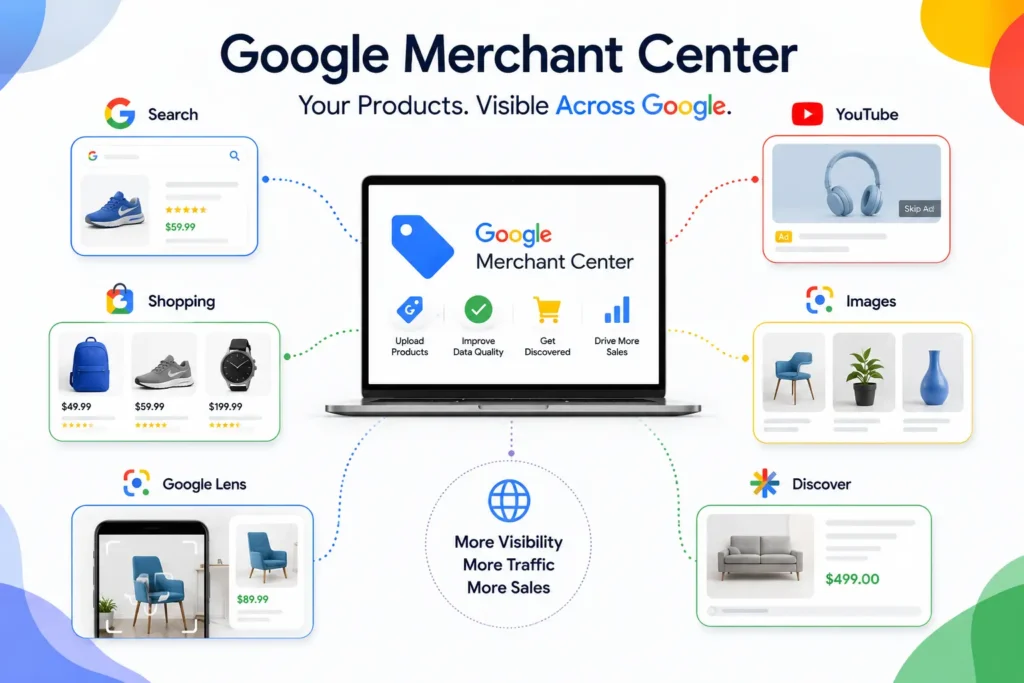
Google Merchant Center Explained
Google Merchant Center is a free platform that allows ecommerce businesses to upload, manage, and distribute product information across Google’s shopping ecosystem, helping products appear in Google Shopping, Search results, Images, YouTube, and other discovery experiences.
Merchant Center acts as the bridge between your online store and Google.
Instead of Google trying to guess product details from your website, Merchant Center provides structured product information directly to Google. This includes:
- Product titles
- Descriptions
- Pricing
- Availability
- Product images
- Brand information
- GTINs and identifiers
- Shipping details
Google uses this information to determine where and when products can appear across its various platforms.
For businesses new to the platform, understanding what is Google Merchant Center is the first step toward improving product visibility and building a stronger ecommerce presence.
Why Google Merchant Center Matters for Ecommerce Businesses
How Consumers Discover Products on Google
Online shopping behavior has changed significantly over the past decade.
Customers rarely visit a store homepage and browse randomly. Instead, they search for specific products, compare options, review images, and evaluate prices before making purchasing decisions.
Common searches include:
- Running shoes for flat feet
- Stainless steel water bottle
- Wireless gaming headset
- Organic dog food
Google’s goal is to show the most relevant products as quickly as possible.
Merchant Center helps ecommerce businesses participate in these product discovery moments by supplying Google with accurate product information.
When product data is optimized properly, products have a better chance of appearing in front of customers actively looking to buy.
Google’s Product Ecosystem
Many store owners associate Merchant Center only with Google Shopping.
In reality, Google uses Merchant Center data across multiple platforms.
Google Search
Product information can appear directly within search results, helping users discover products without navigating through multiple websites.
Google Shopping
Shopping listings provide product-focused search experiences that include images, prices, ratings, and seller information.
Google Images
Products can appear within image-based searches, creating additional visibility opportunities.
Google Maps
Local inventory and store information can be connected to help nearby customers discover products.
YouTube
Shopping integrations allow products to be surfaced alongside video content and creator recommendations.
Google Lens
Consumers can search using images rather than text. Merchant Center data helps Google match products with visual searches.
This broad ecosystem means a single optimized product feed can support visibility across multiple Google properties.
The Role of Product Data
One of the most overlooked aspects of ecommerce growth is product data quality.
Google relies heavily on structured product information to understand:
- What the product is
- Who it is for
- Whether it is available
- How relevant it is to a search query
When product information is incomplete or inaccurate, visibility often suffers.
During Merchant Center audits, a common pattern appears repeatedly:
- Poor titles reduce relevance
- Missing identifiers limit product matching
- Incorrect pricing creates disapprovals
- Weak descriptions reduce discoverability
In contrast, stores with well-structured product data often achieve stronger visibility and attract more qualified traffic.
Merchant Center gives businesses direct control over this critical information.
Top Benefits of Google Merchant Center
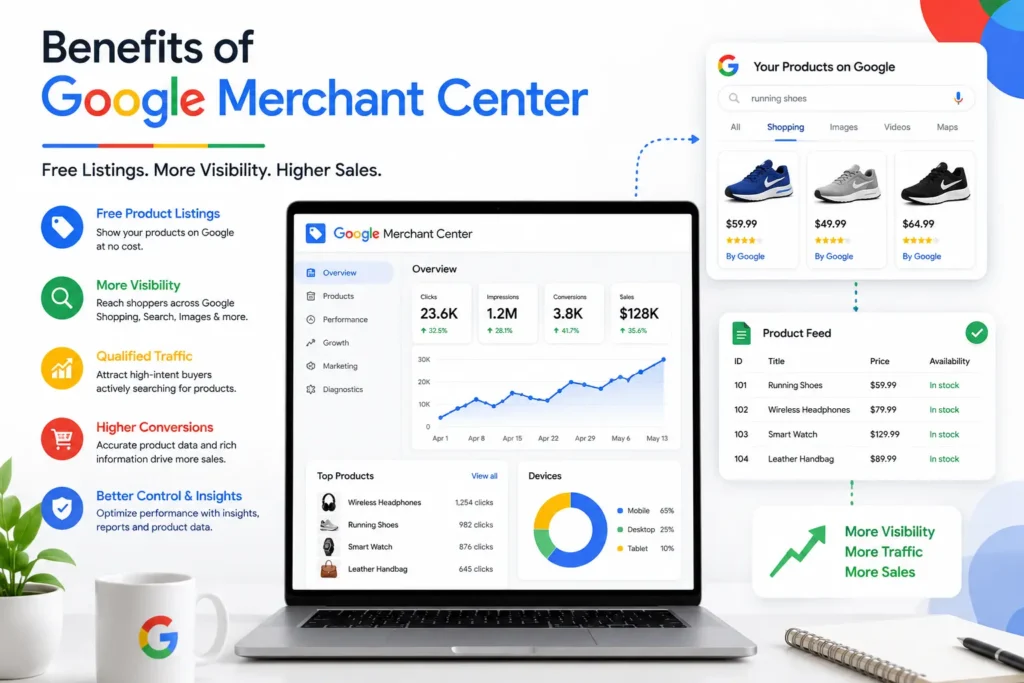
The benefits of Google Merchant Center extend far beyond simply uploading products.
Here are the primary advantages ecommerce businesses gain:
- Increased product visibility across Google
- Access to free product listings
- Higher-quality traffic from buyers
- Better Google Shopping performance
- Centralized product feed management
- Improved product data quality
- Valuable performance insights
- Competitive advantages in search results
- Better conversion opportunities
- Long-term ecommerce growth support
Each of these benefits contributes to a larger objective: helping customers find the right products at the right time.
Increased Product Visibility Across Google
Visibility is often the first challenge ecommerce businesses must solve.
Traffic, conversions, and sales all depend on whether products are discoverable in the first place.
Visibility in Google Shopping
Google Shopping remains one of the most valuable product discovery channels available to ecommerce brands.
Unlike standard search results, Shopping listings display:
- Product images
- Pricing
- Brand information
- Seller details
- Promotions
These visual elements help products stand out and attract attention from shoppers already researching purchase options.
For many stores, Shopping visibility becomes a major source of qualified ecommerce traffic.
Visibility in Search Results
Merchant Center also supports product visibility within traditional Google Search experiences.
When product information is accurate and complete, Google can better match listings with relevant search queries.
This increases opportunities for products to appear when customers search for specific items.
Visibility in Google Images
Image-based discovery continues to grow.
Consumers frequently browse products visually before making decisions.
High-quality product images connected through Merchant Center can help products appear in image search experiences, creating additional traffic opportunities.
Visibility Through Google Lens
Google Lens allows users to search using photos instead of keywords.
A customer can take a picture of a product and Google attempts to find similar products available online.
Merchant Center product data helps improve matching accuracy in these visual search experiences.
Visibility on YouTube Shopping Experiences
YouTube increasingly influences purchasing decisions.
Product integrations connected through Google’s ecosystem can help shoppers discover products while consuming video content.
For ecommerce brands, this creates another touchpoint between product discovery and purchase intent.
The key takeaway is simple:
Merchant Center helps products appear across multiple Google surfaces rather than relying on a single traffic source. That expanded visibility often becomes one of the most valuable Google Merchant Center benefits for growing ecommerce businesses.
Benefits of Free Product Listings
One of the most valuable Google Merchant Center benefits is access to free product listings.
Many ecommerce businesses assume product visibility on Google always requires advertising spend. While paid Shopping campaigns remain important, Merchant Center also enables products to appear organically through free listings.
This creates opportunities for stores of all sizes to gain visibility and attract potential customers.
Reach Customers Without Ad Spend
Free product listings allow businesses to showcase products across Google without paying for every click.
For smaller stores with limited marketing budgets, this can be particularly valuable.
Instead of relying solely on paid traffic channels, businesses can:
- Increase product exposure
- Generate additional website visits
- Build brand awareness
- Test product demand organically
While free listings do not guarantee traffic, they provide an additional channel for product discovery.
Appear in Google Shopping for Free
Google introduced free Shopping listings to help merchants reach customers more easily.
Eligible products can appear within Shopping experiences even when advertisers are not actively running campaigns.
This means:
- New stores can gain visibility earlier
- Seasonal products can receive exposure
- Growing businesses can supplement paid campaigns
For many ecommerce brands, free listings become an important source of incremental traffic.
Improve Organic Product Discovery
Consumers often begin their purchasing journey by researching products.
Free listings help products appear during these early research stages.
This improves opportunities for:
- Product discovery
- Brand exposure
- Customer engagement
- Future conversions
Even if customers do not purchase immediately, visibility can influence later buying decisions.
Why Free Listings Matter for Small Stores
Large retailers often dominate advertising budgets.
Smaller businesses may not have the resources to compete aggressively through paid campaigns alone.
Free listings help level the playing field by allowing smaller merchants to:
- Showcase niche products
- Reach targeted audiences
- Compete on relevance rather than budget
- Build visibility gradually
For startups and small ecommerce businesses, Merchant Center often provides one of the most accessible paths to product exposure on Google.
Higher Quality Traffic and Buyer Intent
Not all website traffic is equally valuable.
A common mistake in ecommerce marketing is focusing solely on visitor volume rather than visitor quality.
Merchant Center helps businesses attract users who are actively searching for products.
Reaching Customers Ready to Purchase
Product-focused searches often indicate strong commercial intent.
Consider the difference between:
- “best office chair”
- “ergonomic office chair under $300”
The second search demonstrates a much clearer buying intention.
Merchant Center helps products appear during these high-intent searches, increasing the likelihood of attracting qualified visitors.
Product-Based Searches Have Strong Intent
Many Shopping searches include:
- Specific brands
- Product models
- Product categories
- Price ranges
- Product attributes
Examples:
- Nike Air Zoom Pegasus 42
- Blue ceramic coffee mug
- Gaming laptop under $1000
- Waterproof hiking backpack
These users are typically closer to making purchasing decisions than general information seekers.
Why Shopping Traffic Converts Better
During feed optimization projects, one recurring observation appears frequently:
Traffic generated through product-focused discovery channels often converts at higher rates than broader awareness traffic.
This happens because shoppers already know what they want.
They are:
- Comparing products
- Evaluating sellers
- Reviewing prices
- Looking for availability
Merchant Center helps place products directly into these decision-making moments.
As a result, businesses often see:
- Better engagement
- Lower bounce rates
- Stronger purchase intent
- More efficient customer acquisition
Better Performance for Google Shopping Ads
Merchant Center is not simply an optional addition to Google Shopping campaigns.
It is the foundation that powers them.
Without Merchant Center, Shopping ads cannot function properly.
Foundation for Shopping Campaigns
Google Shopping campaigns rely on product feed data.
Unlike traditional text ads, advertisers do not manually create individual Shopping ads for every product.
Instead, Google automatically generates listings using Merchant Center information.
This makes feed quality a critical factor in campaign performance.
Improved Product Matching
Google uses product attributes to determine:
- Which searches trigger products
- Which products appear together
- Which audiences see listings
Accurate product feeds improve matching accuracy.
Examples include:
- Relevant product titles
- Complete descriptions
- Proper categorization
- Accurate identifiers
The better Google understands a product, the better it can match it to potential buyers.
Enhanced Product Visibility
Strong feed optimization often improves visibility because Google receives clearer signals regarding:
- Product relevance
- Availability
- Product attributes
- Search intent alignment
Many businesses focus heavily on bid strategies while overlooking feed quality.
In practice, feed optimization frequently becomes one of the most impactful improvements available for Shopping performance.
This is one reason many ecommerce teams invest time learning how GMC powers Google Shopping Ads before increasing advertising budgets.
Product Feed Management Advantages
Managing hundreds or thousands of products manually can become difficult.
Merchant Center provides a centralized system for organizing and maintaining product information.
Centralized Product Data Management
Merchant Center acts as a central hub for product information.
Instead of updating information across multiple systems separately, businesses can maintain product data in one structured environment.
This helps improve consistency across Google surfaces.
Product Feed Optimization Benefits
Product feeds directly influence visibility.
Optimized feeds often result in:
- Better product matching
- Increased impressions
- More qualified clicks
- Improved Shopping performance
Common feed optimization improvements include:
- Better titles
- More detailed descriptions
- Enhanced product attributes
- Accurate categorization
These adjustments help Google understand products more effectively.
Faster Product Updates
Ecommerce stores constantly change.
Prices update.
Inventory changes.
New products launch.
Merchant Center enables faster synchronization of these updates, helping ensure Google displays current information.
Inventory Synchronization
Nothing frustrates customers more than clicking a product that is unavailable.
Accurate inventory synchronization helps reduce:
- Customer dissatisfaction
- Wasted clicks
- Policy issues
- Conversion barriers
Many ecommerce platforms automate inventory updates, making feed management more efficient.
Price Accuracy Improvements
Price mismatches are one of the most common issues identified during Merchant Center audits.
If prices displayed in Merchant Center differ from website pricing, products may become disapproved.
Regular synchronization helps maintain consistency and reduce compliance risks.
Product Approval Improvements
Product approval is essential for visibility.
Feeds containing:
- Accurate information
- Complete attributes
- Proper identifiers
- Compliant data
typically experience fewer approval issues.
Improved approval rates often translate into stronger product coverage and better visibility opportunities.
Want to maximize these benefits? Explore our Google Merchant Center services.
Professional feed optimization, diagnostics management, and compliance monitoring can help businesses unlock additional visibility and performance improvements.
Better Product Data Quality and Accuracy
Google’s ability to understand products depends on the quality of information provided.
Merchant Center encourages businesses to maintain structured, accurate product data.
Rich Product Attributes
Detailed product information helps Google understand exactly what is being sold.
Examples include:
- Brand
- Color
- Size
- Material
- Condition
- Gender
- Age group
Additional attributes improve relevance and matching opportunities.
GTIN and Product Identifiers
Global Trade Item Numbers (GTINs) play an important role in product recognition.
When available, GTINs help Google:
- Verify products
- Improve matching accuracy
- Compare listings across merchants
- Enhance Shopping experiences
Many visibility issues can be traced back to missing or incorrect identifiers.
Structured Product Information
Structured data creates consistency.
Instead of relying on interpretation, Google receives clearly defined information.
This reduces ambiguity and improves product understanding.
Better Matching in Google Results
Accurate product information increases the likelihood that products appear for relevant searches.
When feeds are optimized properly, businesses often experience:
- Greater impression volume
- Improved relevance
- More qualified traffic
- Better Shopping visibility
Product data quality remains one of the most overlooked drivers of Merchant Center success.
Performance Tracking and Data Insights
Visibility alone is not enough.
Successful ecommerce businesses continuously analyze product performance and make improvements based on real data.
Google Merchant Center provides valuable insights that help merchants understand how products perform across Google’s ecosystem.
Product Performance Metrics
Merchant Center provides visibility into how products are performing.
Businesses can evaluate:
- Product impressions
- Click activity
- Visibility trends
- Product engagement
These insights help identify which products are gaining traction and which may need optimization.
For example, if a product receives thousands of impressions but very few clicks, the issue may involve:
- Weak product titles
- Uncompetitive pricing
- Low-quality images
- Poor product positioning
Click Analysis
Clicks reveal whether shoppers find a product attractive enough to visit the store.
Analyzing click trends helps merchants understand:
- Which products attract interest
- Which categories perform best
- Seasonal buying behavior
- Product demand shifts
This information can guide future merchandising and optimization decisions.
Impression Analysis
Impressions indicate how often products appear in Google’s ecosystem.
Low impressions often point to:
- Poor feed optimization
- Missing attributes
- Weak product relevance
- Approval limitations
When impressions increase after feed improvements, it is often a sign that Google better understands the product catalog.
Feed Diagnostics
Feed Diagnostics is one of the most useful Merchant Center features.
During account audits, diagnostics frequently uncover visibility problems that merchants were unaware of.
Common issues include:
- Missing GTINs
- Price mismatches
- Image problems
- Policy violations
- Invalid attributes
- Shipping inconsistencies
Ignoring diagnostics can lead to reduced visibility or product disapprovals.
Optimization Opportunities
Merchant Center data often highlights opportunities such as:
- Improving product titles
- Adding missing attributes
- Updating images
- Fixing identifier issues
- Improving category accuracy
Businesses that regularly review Merchant Center insights typically make better optimization decisions than those relying on assumptions alone.
Competitive Advantages of Google Merchant Center
Competition in ecommerce continues to increase.
Thousands of businesses may sell similar products.
Merchant Center helps merchants compete more effectively by improving product discoverability.
Stand Out Against Competitors
When multiple stores sell similar products, Google evaluates product information to determine relevance.
Optimized feeds often help products stand out through:
- Better titles
- Accurate attributes
- Strong product data
- Improved relevance
Small improvements in feed quality can influence visibility outcomes.
Increased Market Visibility
Many ecommerce businesses still underutilize Merchant Center.
Some merchants:
- Upload incomplete feeds
- Ignore diagnostics
- Fail to optimize titles
- Miss important product attributes
Businesses that actively manage Merchant Center often gain visibility advantages over competitors that neglect feed optimization.
More Product Coverage
A common challenge for growing stores is incomplete product coverage.
Some products appear on Google while others remain invisible.
Well-managed Merchant Center accounts generally achieve:
- Higher product approval rates
- Better catalog coverage
- Greater search visibility
- Increased discovery opportunities
The more products Google understands, the more opportunities exist for customer discovery.
Stronger Brand Presence
Visibility influences brand recognition.
Even when users do not click immediately, repeated exposure can strengthen brand awareness.
Products appearing consistently across:
- Search
- Shopping
- Images
- YouTube
help reinforce brand presence throughout the customer journey.
Ecommerce Growth Benefits
Merchant Center ultimately contributes to business growth by improving product discoverability and helping buyers find relevant products.
Increased Website Traffic
Improved visibility often results in more opportunities for clicks.
As product coverage expands across Google’s ecosystem, businesses typically experience increased traffic potential.
The key factor is quality.
Relevant traffic usually creates more value than large volumes of untargeted visitors.
Higher Conversion Opportunities
Conversion opportunities increase when products appear in front of buyers who are actively shopping.
Merchant Center supports this process by helping Google connect products with relevant searches.
When traffic arrives with purchase intent, conversion potential often improves.
Better Revenue Potential
Revenue growth typically follows a sequence:
- Better visibility
- More qualified traffic
- Increased product engagement
- Higher conversion opportunities
- More sales potential
Merchant Center primarily influences the first stages of this process by improving discoverability.
Improved Customer Acquisition
Customer acquisition costs continue rising across many advertising channels.
Free listings and improved Shopping visibility can help businesses attract customers more efficiently.
This is particularly valuable for stores seeking long-term growth without relying exclusively on paid advertising.
Benefits for Shopify Stores
Shopify Integration Advantages
Many Shopify merchants use Merchant Center because integration is relatively straightforward.
Benefits include:
- Automated product syncing
- Inventory updates
- Price synchronization
- Simplified catalog management
This reduces manual work while helping maintain accurate product data.
Automatic Feed Synchronization
As products change inside Shopify, updates can often be pushed automatically to Merchant Center.
This helps minimize:
- Pricing discrepancies
- Availability issues
- Outdated listings
Accurate synchronization supports both visibility and compliance.
Easier Product Management
Shopify merchants can manage products from their ecommerce platform while maintaining visibility across Google.
This creates a more efficient workflow and reduces operational complexity.
Benefits for WooCommerce Stores
WooCommerce Feed Benefits
WooCommerce stores can also leverage Merchant Center effectively through feed management tools and integrations.
Benefits include:
- Product feed automation
- Attribute mapping
- Inventory updates
- Structured product data
Product Catalog Automation
Automation helps WooCommerce merchants maintain large product catalogs without constant manual updates.
This becomes increasingly important as product inventories grow.
Shopping Ads Readiness
Proper WooCommerce feed integration prepares businesses for Google Shopping campaigns by ensuring product data is organized and accessible.
Stores with strong feed foundations often launch Shopping campaigns more efficiently.
Benefits for Small Businesses
Affordable Customer Acquisition
Small businesses often operate with limited marketing budgets.
Merchant Center offers opportunities to gain visibility through both free listings and Shopping campaigns.
This provides flexibility as businesses scale.
Free Product Exposure
Many small merchants view free product listings as one of the most attractive Merchant Center advantages.
Products can gain exposure without requiring significant advertising investment.
Scalability Advantages
Merchant Center grows with the business.
Whether a store sells:
- 20 products
- 200 products
- 20,000 products
the platform can support catalog expansion and increasing visibility needs.
Benefits for Large Ecommerce Brands
Managing Large Product Catalogs
Large retailers often manage thousands of SKUs.
Merchant Center provides centralized control over extensive product inventories.
This improves consistency and operational efficiency.
Advanced Feed Segmentation
Enterprise merchants frequently segment product feeds based on:
- Brands
- Categories
- Margins
- Seasonal products
- Inventory levels
This allows more strategic management of product visibility and advertising initiatives.
Performance Optimization at Scale
Large catalogs create large amounts of performance data.
Merchant Center helps brands identify:
- High-performing products
- Underperforming categories
- Visibility gaps
- Feed issues
These insights support ongoing optimization efforts across large ecommerce operations.
Common Mistakes Businesses Make With Google Merchant Center
Even experienced ecommerce teams can encounter Merchant Center challenges.
Poor Product Data
Incomplete or inaccurate product information remains one of the most common visibility barriers.
Missing GTINs
Missing identifiers can reduce Google’s ability to understand and match products effectively.
Policy Violations
Policy issues may restrict visibility or trigger account problems.
Businesses should regularly review compliance requirements.
Disapproved Products
Disapprovals prevent products from appearing across Google’s shopping ecosystem.
Common causes include:
- Price mismatches
- Missing information
- Restricted products
- Landing page inconsistencies
Feed Errors
Feed errors often accumulate over time if diagnostics are ignored.
Regular monitoring helps prevent larger visibility problems.
Ignoring Diagnostics
Many merchants only check Merchant Center when something goes wrong.
Successful accounts usually monitor diagnostics proactively and resolve issues quickly.
How to Maximize Google Merchant Center Benefits
Simply creating a Merchant Center account is not enough.
The businesses that achieve the strongest results actively optimize their product data, monitor account health, and continuously improve feed quality.
Optimize Product Titles
Product titles are among the most influential feed attributes.
Google uses titles to understand product relevance and determine when listings should appear.
Effective product titles typically include:
- Brand name
- Product type
- Key features
- Size or model information
- Important differentiators
Weak Example:
Running Shoes
Better Example:
Men’s Nike Air Zoom Pegasus 42 Running Shoes Blue Size 10
Clear, descriptive titles often improve visibility and click potential.
Improve Product Descriptions
Descriptions provide additional context that helps Google understand products.
Strong descriptions should:
- Clearly explain the product
- Highlight important features
- Include relevant attributes naturally
- Answer common buyer questions
Avoid keyword stuffing or repetitive wording.
Use High-Quality Images
Images play a major role in Shopping performance.
Products with clear, professional images typically attract more engagement.
Best practices include:
- High resolution images
- Clean backgrounds when appropriate
- Accurate product representation
- Multiple image angles
Poor-quality images can reduce click-through rates even when products rank well.
Maintain Accurate Inventory
Inventory accuracy is critical.
Nothing damages customer trust faster than discovering a product is unavailable after clicking a listing.
Ensure:
- Stock levels remain updated
- Out-of-stock products sync correctly
- Inventory feeds refresh regularly
Monitor Feed Diagnostics
Merchant Center diagnostics should be reviewed routinely.
Diagnostics help identify:
- Product errors
- Warnings
- Policy issues
- Feed processing problems
Many visibility issues can be resolved before they become significant problems.
Regular Feed Audits
Feed audits help uncover optimization opportunities.
A typical audit evaluates:
- Product titles
- Descriptions
- GTIN coverage
- Product categories
- Image quality
- Feed errors
- Approval rates
Businesses that conduct regular audits often maintain stronger Shopping visibility over time.
For a deeper understanding of optimization strategies, merchants should explore a complete Google Merchant Center guide, and learn how to properly set up Google Merchant Center from the beginning.
Google Merchant Center vs Google Ads: Understanding the Difference
Many business owners confuse Google Merchant Center and Google Ads.
While they work closely together, they serve different purposes.
Different Roles
| Google Merchant Center | Google Ads |
| Stores product data | Manages advertising campaigns |
| Processes product feeds | Controls campaign budgets |
| Handles approvals and diagnostics | Controls bidding strategies |
| Powers free listings | Powers paid advertising |
| Maintains product information | Drives ad delivery |
How They Work Together
Merchant Center provides the product information.
Google Ads uses that information to create and deliver Shopping campaigns.
The relationship is simple:
Merchant Center supplies the products.
Google Ads promotes the products.
Without Merchant Center, Shopping ads cannot function because Google has no structured product data to use.
Why Both Matter
Businesses often achieve the best results when Merchant Center and Google Ads work together.
Merchant Center provides:
- Product visibility
- Feed management
- Product data quality
- Free listing opportunities
Google Ads provides:
- Paid traffic
- Campaign control
- Audience targeting
- Budget management
Understanding the difference between GMC and Google Ads helps businesses build a more effective ecommerce marketing strategy.
When Should You Consider Professional Google Merchant Center Management?
Many stores can successfully launch Merchant Center on their own.
However, as catalogs grow and visibility challenges increase, professional management often becomes valuable.
Signs Your Account Needs Expert Help
Consider seeking professional assistance if you experience:
Product Disapprovals
Frequent disapprovals can significantly reduce visibility and sales opportunities.
Feed Errors
Large numbers of feed errors often indicate deeper data-quality issues.
Low Visibility
If products rarely appear in Shopping results despite being approved, feed optimization may be required.
Poor Shopping Performance
Weak click-through rates or low impression volume may suggest optimization opportunities.
Account Suspensions
Account suspensions can completely eliminate visibility until issues are resolved.
Professional guidance is often helpful during recovery processes.
Benefits of Professional Management
Experienced Merchant Center specialists can assist with:
Feed Optimization
Improving product titles, descriptions, attributes, and categorization.
Error Resolution
Identifying and correcting feed issues that limit visibility.
Compliance Management
Reducing policy risks and maintaining account health.
Visibility Improvements
Helping products appear more frequently across Google’s ecosystem.
Performance Monitoring
Tracking diagnostics, approvals, and optimization opportunities continuously.
Businesses struggling with feed issues, policy violations, product disapprovals, or account suspensions often benefit from professional Google Merchant Center management to maintain visibility and performance.
FAQs
What is Google Merchant Center used for?
Google Merchant Center is used to upload, manage, and distribute product data across Google’s shopping ecosystem.
Is Google Merchant Center free?
Yes. Creating and using a Merchant Center account is free.
What are free product listings?
Free product listings allow eligible products to appear across Google Shopping and other Google surfaces without paying for clicks.
Does Merchant Center increase sales?
Merchant Center can increase visibility and qualified traffic, which may lead to more sales opportunities.
Is Merchant Center required for Shopping Ads?
Yes. Shopping campaigns require product data from Merchant Center.
Can Shopify connect to Merchant Center?
Yes. Shopify offers integrations that synchronize product information with Merchant Center.
Can WooCommerce connect to Merchant Center?
Yes. Various plugins and feed tools support WooCommerce integration.
Why do products get disapproved?
Common reasons include policy violations, pricing mismatches, missing attributes, and inaccurate product information.
What is a product feed?
A product feed is a structured file containing information about products such as titles, prices, availability, and images.
How often should feeds be updated?
Feeds should be updated whenever product information changes and reviewed regularly for accuracy.
Why are GTINs important?
GTINs help Google identify products accurately and improve matching within Shopping results.
What is feed optimization?
Feed optimization is the process of improving product data to increase visibility, relevance, and performance.
Can small businesses benefit from Merchant Center?
Yes. Small businesses can use free listings and Shopping visibility to reach potential customers.
How do I monitor Merchant Center health?
Regularly review diagnostics, approvals, warnings, and product performance reports.
Should I hire a Merchant Center expert?
If you face disapprovals, feed errors, suspensions, or low visibility, professional assistance can often accelerate improvements.
Conclusion
Google Merchant Center has become an essential tool for ecommerce businesses seeking stronger product visibility across Google’s ecosystem.
Its value extends beyond Shopping ads.
Merchant Center helps businesses:
- Increase product visibility
- Access free product listings
- Attract qualified traffic
- Improve Shopping performance
- Manage product feeds efficiently
- Maintain accurate product data
- Gain valuable performance insights
- Support long-term ecommerce growth
Businesses that invest in feed quality, product accuracy, and ongoing optimization often create stronger foundations for sustainable growth.
Whether you’re a small Shopify store, a growing WooCommerce business, or a large ecommerce brand managing thousands of products, Merchant Center provides opportunities to connect products with customers actively searching to buy.
If your business is experiencing feed errors, product disapprovals, policy challenges, low visibility, or account suspensions, professional Google Merchant Center management can help improve performance while protecting valuable product visibility across Google.

Mandeep Wraich
Digital Marketing Specialist and Content Strategist focused on data-driven growth, SEO, and performance-led content. At AIPulseInsights.com, articles explore how AI, analytics, and emerging digital trends influence marketing strategies, brand visibility, and business decision-making. With a strong foundation in content analysis, paid media, and strategic storytelling, the work shared on this platform converts complex industry shifts into practical insights that support marketers and businesses in achieving consistent, measurable growth. The goal is to simplify innovation and empower readers to stay ahead in a rapidly changing digital landscape.