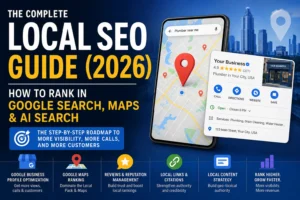
Local SEO (Local Search Engine Optimization) is the process of improving your online presence so your business appears in local search results on Google Search, Google Maps, and other search platforms when nearby customers look for the products or services you offer. It combines Google Business Profile optimization, website improvements, reviews, local citations, and trust signals to help businesses attract more local customers.
Key Takeaways
- Local SEO helps businesses appear in Google Search, Google Maps, and Local Pack results.
- It is essential for businesses serving customers in specific cities or service areas.
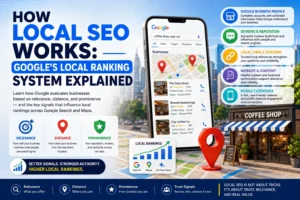
- Google ranks local businesses primarily based on Relevance, Distance, and Prominence.
- A well-optimized Google Business Profile is one of the most important Local SEO assets.
- Reviews, website quality, consistent business information, and local authority all influence rankings.
- Local SEO drives qualified traffic, phone calls, store visits, and leads from people already looking for your services.
- Common mistakes include ignoring Google Business Profile, inconsistent business details, weak local content, and poor review management.
- Consistent optimization delivers better long-term results than quick ranking tactics.
What Is Local SEO?
For most small businesses, success depends on being found by people nearby who are ready to buy. Someone searching for “best dentist near me”, “coffee shop in Chandigarh”, or “emergency plumber open now” is not casually browsing. They usually need a solution immediately.
This is where Local SEO makes the difference.
Instead of trying to rank for broad national keywords, Local SEO helps your business become visible to customers searching within your service area. It improves your chances of appearing in Google Search, Google Maps, and the Local Pack, where many buying decisions begin.
Unlike traditional advertising, Local SEO connects you with people who already have purchase intent. These users are actively searching for businesses like yours, making local traffic far more valuable than untargeted visitors.
Whether you own a restaurant, dental clinic, law firm, gym, salon, retail store, or home service company, Local SEO helps you compete where it matters most: in your local market.
Local SEO Definition
Local SEO is a specialized branch of search engine optimization focused on increasing a business’s visibility in geographically relevant searches.
It helps Google understand:
- What your business does
- Where your business is located
- Which customers you serve
- Why your business deserves to appear ahead of competitors
Imagine two plumbers operating in the same city.
Both have professional websites.
One has:
- A complete Google Business Profile
- Hundreds of genuine customer reviews
- Consistent business information across directories
- Helpful location-specific service pages
- Strong local backlinks
The other has only a basic website with little additional information.
Even if both provide similar services, Google is far more likely to recommend the first business because it has stronger trust signals and clearer evidence of serving local customers.
That is the core purpose of Local SEO.
It helps search engines confidently recommend your business when nearby customers are looking for exactly what you offer.
Local SEO vs Traditional SEO
Although they share many optimization principles, Local SEO and traditional SEO pursue different goals.
Traditional SEO focuses on improving visibility across wider geographic areas. A software company may target searches nationwide because customers can purchase online regardless of location.
Local SEO focuses on attracting customers within a defined service area.
For example:
- A bakery wants customers within 10 kilometers.
- A dentist serves patients from nearby neighborhoods.
- A roofing company targets homeowners in specific cities.
- A gym primarily attracts members living close to its location.
Because the search intent differs, Google uses additional ranking signals for local searches, including Google Business Profile information, customer reviews, business proximity, local authority, and Maps engagement.
This makes Local SEO a distinct discipline rather than simply adding a city name to website pages.
Learn how all these elements work together in our Complete Local SEO Guide, where you’ll explore advanced strategies, ranking factors, and implementation techniques.
Why Is Local SEO Important?
Consumer behavior has changed dramatically over the past few years.
People no longer browse lengthy business directories or flip through phone books. Instead, they open Google, type a question, and often choose one of the first businesses they see.
Searches such as:
- “pizza near me”
- “best physiotherapist in Mohali”
- “car mechanic open today”
- “emergency electrician”
typically signal immediate buying intent.
For small businesses, appearing in those results can directly influence daily revenue.
One observation from working with local businesses is that many invest significant time and money building an attractive website but pay very little attention to their Google Business Profile. As a result, they miss opportunities to appear in Google Maps and Local Pack results, where many customers make their decisions before even visiting a website.
Google increasingly rewards businesses that demonstrate genuine real-world trust through accurate business information, consistent customer engagement, positive reviews, and helpful local content.
Local Search Reflects Real Buying Intent
Local searches often happen just before someone takes action.
A person searching for:
- “coffee shop near me”
is usually looking for somewhere to visit within minutes.
Someone searching:
- “family lawyer in Chandigarh”
is actively comparing legal services.
Likewise, a homeowner searching:
- “roof repair company”
often needs immediate assistance.
Because these searches indicate strong commercial intent, businesses appearing prominently in local results receive highly qualified traffic.
Google Maps Has Become a Decision-Making Platform
Many users now make decisions without ever clicking a website.
They compare businesses directly inside Google Maps by looking at:
- Reviews
- Ratings
- Photos
- Opening hours
- Services
- Questions and answers
- Business descriptions
If your profile provides complete, trustworthy information, potential customers may call, request directions, or book an appointment immediately.
For many local businesses, Google Business Profile generates more customer interactions than the website itself.
AI Search Is Changing Local Visibility
Modern search experiences are becoming more conversational.
Instead of typing short keywords, people increasingly ask detailed questions such as:
- “Who is the highest-rated dentist near me?”
- “Which restaurant has outdoor seating?”
- “Best gym for beginners nearby”
AI-powered search systems evaluate multiple trust signals before recommending businesses.
Rather than relying only on keywords, they consider:
- Business reputation
- Review quality
- Website authority
- Structured business information
- Entity consistency
- Customer engagement
This shift means Local SEO is becoming less about keyword repetition and more about demonstrating that your business is genuinely trusted within its community.
How Does Local SEO Work?
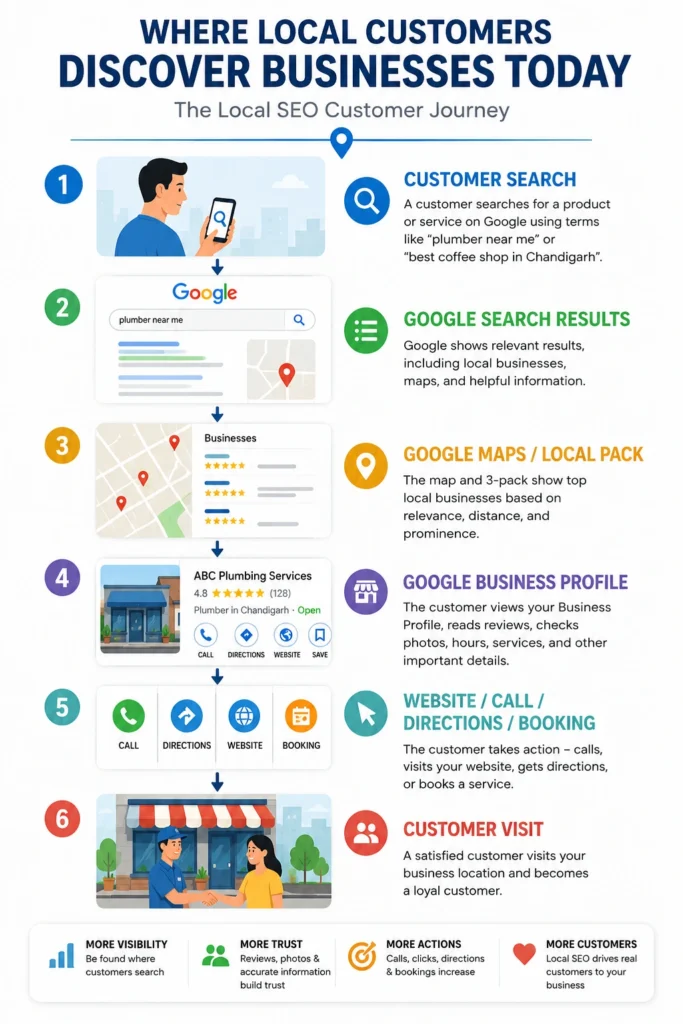
Many business owners think Local SEO is simply adding their city name to a few web pages. In reality, Google’s local ranking system evaluates dozens of signals to determine which businesses deserve to appear in local search results.
When someone searches for a local service, Google tries to answer four questions:
- Is this business relevant to the search?
- Is it close enough to the searcher?
- Is it trustworthy and well-known?
- Will it provide a good experience for the customer?
To answer these questions, Google analyzes information from your website, Google Business Profile, customer reviews, local directories, backlinks, structured data, and user engagement signals.
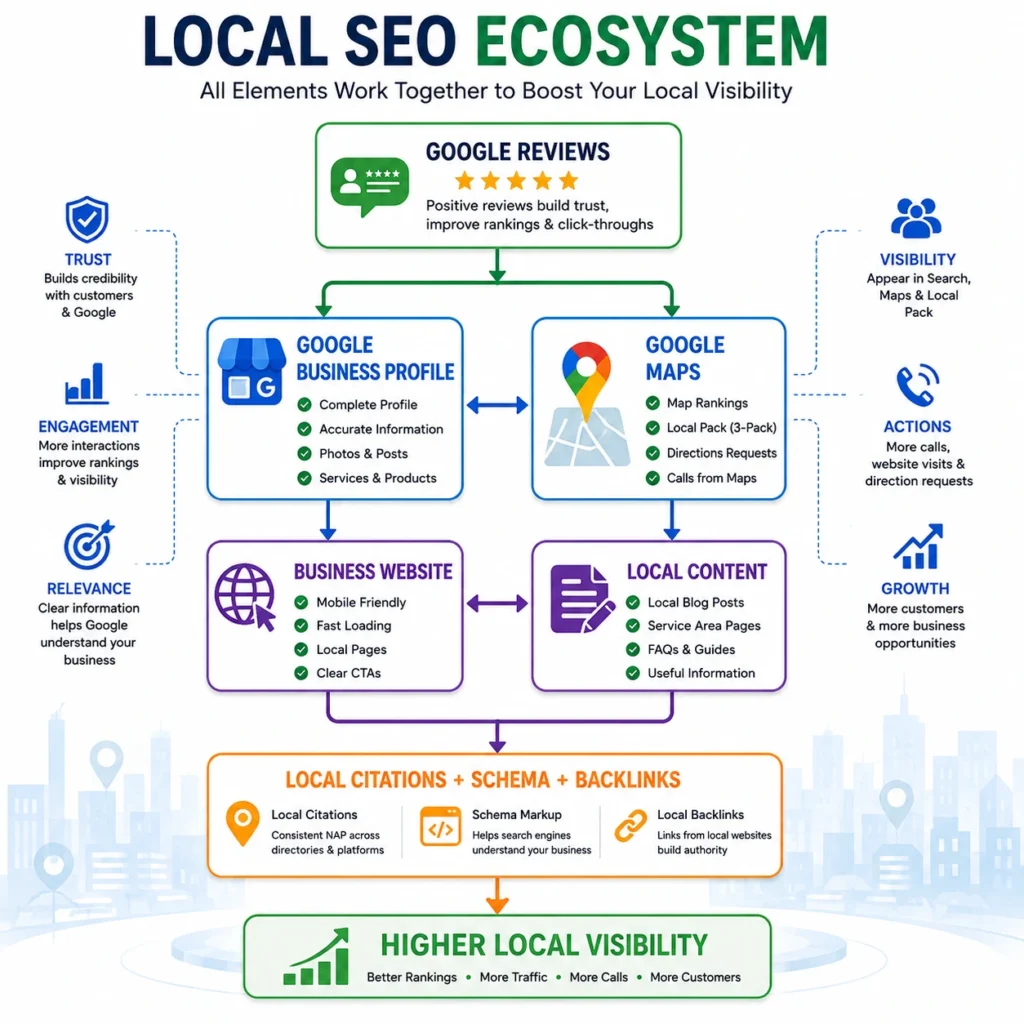
Think of Local SEO as a connected ecosystem rather than a single ranking factor. Each component strengthens the others, helping Google build confidence in your business.
Google Business Profile
Your Google Business Profile (GBP) is the foundation of Local SEO.
It is the business listing that appears in Google Search and Google Maps, displaying your:
- Business name
- Address
- Phone number
- Website
- Business hours
- Services
- Products
- Reviews
- Photos
- Questions and Answers
For many local businesses, this profile generates more phone calls and direction requests than their website.
One pattern seen across many Local SEO campaigns is that businesses often spend months improving their websites while leaving their Google Business Profile incomplete. Missing categories, outdated business hours, or low-quality photos can significantly reduce visibility, even if the website itself is well optimized.
To strengthen your profile:
- Complete every available field.
- Choose the most accurate primary and secondary categories.
- Keep business hours updated.
- Add high-quality photos regularly.
- Publish Google Posts.
- Respond to customer reviews.
- Monitor and answer customer questions.
A complete and actively managed profile sends strong trust signals to Google.
Read our Google Business Profile Guide to learn how to optimize every section of your profile for better local visibility.
Google Maps Optimization
Appearing in Google Maps is one of the biggest goals of Local SEO.
When users search for nearby businesses, Google often displays a map with three highlighted businesses, commonly called the Local Pack.
These businesses receive a significant share of clicks, calls, and direction requests because they appear before the traditional organic search results.
Google evaluates several factors before placing a business in the Maps results, including:
- Business relevance
- Distance from the searcher
- Review quality and quantity
- Profile completeness
- Website authority
- Local citations
- Customer engagement
Businesses that consistently update their profiles and earn positive customer interactions often perform better than competitors with outdated listings.
Learn proven optimization techniques in our Google Maps SEO Guide.
Website Optimization
Although Google Business Profile is extremely important, your website still plays a major role in Local SEO.
Google uses your website to better understand:
- What services you provide
- Which locations you serve
- Your expertise
- Your credibility
An optimized local website should include:
- Clear service pages
- Location-specific pages where appropriate
- Fast loading speeds
- Mobile-friendly design
- Easy navigation
- Helpful, original content
- Clear contact information
- Embedded Google Maps
- Internal links between related pages
Instead of repeating city names excessively, focus on creating genuinely useful pages that answer local customer questions.
Helpful content consistently outperforms pages created only for search engines.
Customer Reviews
Reviews are among the strongest trust signals in Local SEO.
They help potential customers evaluate your business while also providing Google with evidence that real people interact with your company.
Quality matters more than simply collecting large numbers of reviews.
Healthy review profiles usually include:
- Recent reviews
- Detailed customer experiences
- Owner responses
- A steady flow of new feedback
- Reviews mentioning products or services naturally
Avoid purchasing reviews or asking everyone to leave identical comments. Authentic feedback builds far more trust with both customers and search engines.
A practical approach is to request reviews shortly after completing a successful job or service while the experience is still fresh.
Local Citations
A local citation is any online mention of your business information.
This typically includes your:
- Business name
- Address
- Phone number
You may also see this referred to as NAP information.
Examples include:
- Local business directories
- Industry-specific directories
- Chamber of Commerce websites
- Business associations
- Local community websites
The most important principle is consistency.
If one directory lists:
ABC Plumbing
while another lists:
ABC Plumbing Services Ltd.
and a third shows an outdated phone number, Google may have less confidence in your business information.
Consistent citations help reinforce your business identity across the web.
Local Content
Publishing useful local content helps Google understand both your expertise and your connection to the community you serve.
Examples include:
- Local service guides
- Community event coverage
- Area-specific maintenance tips
- Neighborhood service pages
- Frequently asked questions from local customers
- Seasonal advice relevant to your city
For example, a roofing company serving Chandigarh might publish articles about preparing roofs before the monsoon season, while a dental clinic could answer common questions from families in nearby neighborhoods.
Content that reflects real customer needs generally performs better than generic articles written only to target keywords.
Local Backlinks
Backlinks remain an important ranking signal, but Local SEO places greater value on links that demonstrate community relevance.
Examples include links from:
- Local news websites
- Chamber of Commerce organizations
- Business associations
- Local charities
- Community events
- Sponsorship pages
- Educational institutions
- Industry organizations
A few trusted local links often provide more value than dozens of unrelated directory links.
Google increasingly evaluates the quality and relevance of backlinks rather than simply counting them.
Schema Markup
Schema markup is structured code added to your website that helps search engines better understand your business information.
For local businesses, schema can clarify details such as:
- Business name
- Address
- Phone number
- Opening hours
- Service area
- Reviews
- Geographic coordinates
- Website
- Social profiles
Although visitors never see this code, it helps search engines interpret your website more accurately and may improve eligibility for enhanced search features.
Adding Local Business Schema is one of the simpler technical improvements that can strengthen your Local SEO foundation.
By combining an optimized Google Business Profile, a helpful website, consistent citations, strong reviews, relevant backlinks, and structured data, you create multiple trust signals that work together to improve local visibility.
Local SEO vs Traditional SEO
While both strategies aim to improve search visibility, they target different audiences and rely on different ranking signals.
| Feature | Local SEO | Traditional SEO |
|---|---|---|
| Primary Audience | Customers in a specific geographic area | National or global audience |
| Search Intent | Local services and nearby businesses | Informational, commercial, or transactional searches |
| Geographic Focus | City, neighborhood, or service area | Broad or location-independent |
| Google Business Profile | Essential | Usually not required |
| Google Maps Visibility | Major objective | Not typically relevant |
| Primary Ranking Signals | Relevance, Distance, Prominence, Reviews, GBP | Content quality, backlinks, topical authority, technical SEO |
| Keywords | Location-based searches | General topic keywords |
| Competition | Local businesses | National or international websites |
| Typical Goal | Calls, visits, bookings, direction requests | Website traffic, leads, sales, subscriptions |
Businesses that rely on local customers should treat Local SEO as a dedicated marketing strategy rather than a small extension of traditional SEO.
Explore a detailed comparison in our guide on Local SEO vs Traditional SEO.
Who Needs Local SEO?
A common misconception is that Local SEO only benefits restaurants or retail stores. In reality, almost any business that serves customers in a specific geographic area can benefit from stronger local visibility.
If customers search for your services using location-based terms or expect to find you on Google Maps, Local SEO should be part of your marketing strategy.
Below are examples of how different industries benefit from Local SEO and how customers typically search for their services.
Restaurants
Restaurants rely heavily on local searches because customers are often looking for somewhere to eat immediately.
Common searches include:
- Best Italian restaurant near me
- Family restaurant in Chandigarh
- Breakfast café open now
- Pizza delivery near me
Customers usually compare businesses by reviewing ratings, photos, menus, operating hours, and recent customer reviews before deciding where to dine.
For restaurants, a well-maintained Google Business Profile with updated photos, accurate opening hours, and positive reviews can significantly increase reservations, takeaway orders, and walk-in traffic.
Restaurant Local SEO Guide
Dentists
Dental patients typically search for trusted professionals close to home or work.
Examples include:
- Dentist near me
- Emergency dentist
- Pediatric dentist in Mohali
- Teeth whitening clinic nearby
Patients often evaluate:
- Reviews
- Qualifications
- Office photos
- Appointment availability
- Website professionalism
Local SEO helps dental clinics build credibility before a patient even makes contact.
Dental Local SEO Guide
Lawyers
Legal services involve high-value decisions, making trust one of the most important ranking factors.
Potential clients commonly search for:
- Divorce lawyer near me
- Criminal attorney in Chandigarh
- Property lawyer nearby
A strong local presence supported by informative practice area pages, client reviews, and a complete Google Business Profile helps law firms attract qualified inquiries.
Doctors and Healthcare Clinics
Healthcare searches often involve urgency and convenience.
Patients frequently search for:
- Family doctor near me
- Orthopedic clinic
- Child specialist nearby
- Skin specialist in Chandigarh
Google often displays healthcare providers directly within Maps results, making profile completeness, reviews, and accurate business information especially important.
Plumbers
Plumbing searches usually happen during emergencies.
Examples include:
- Emergency plumber near me
- Pipe leak repair
- Water heater repair
- Drain cleaning services
Since customers often need immediate assistance, businesses appearing in the Local Pack receive a significant advantage.
Fast response times, positive reviews, and clear service areas help improve visibility.
Electricians
Electricians benefit from Local SEO because customers generally hire professionals operating nearby.
Typical searches include:
- Electrician near me
- Home electrical repair
- Ceiling fan installation
- Electrical contractor
Businesses with strong local authority and consistent customer feedback often outperform competitors with larger websites but weaker local signals.
Roofers
Roof replacement and repair projects usually begin with online research.
Customers search for:
- Roofing company near me
- Roof repair specialists
- Metal roofing contractor
- Roof inspection
Publishing helpful local content, showcasing completed projects, and earning reviews from homeowners all contribute to stronger local visibility.
Gyms and Fitness Centers
People usually choose gyms based on proximity.
Common searches include:
- Gym near me
- Fitness center in Mohali
- Personal trainer nearby
- Yoga classes
Updated photos, class schedules, member reviews, and Google Business Profile optimization help fitness businesses attract new memberships.
Real Estate Agencies
Home buyers and sellers often begin their journey with location-specific searches.
Examples include:
- Real estate agent near me
- Property dealer in Chandigarh
- Homes for sale nearby
Local content covering neighborhoods, schools, and housing trends can strengthen both website authority and local relevance.
Hotels
Travelers frequently rely on Google Maps when comparing hotels.
Important decision factors include:
- Reviews
- Photos
- Nearby attractions
- Amenities
- Check-in information
Maintaining an accurate business profile and encouraging guest reviews helps improve both visibility and bookings.
Multi-Location Businesses
Businesses with multiple branches require a structured Local SEO strategy.
Examples include:
- Dental chains
- Restaurant franchises
- Retail stores
- Fitness brands
- Healthcare groups
Each location should have:
- Its own Google Business Profile
- Dedicated location page
- Unique business information
- Local reviews
- Location-specific content
Avoid publishing duplicate location pages with only city names changed. Each page should provide genuinely useful information for customers in that area.
Multi-Location Local SEO Guide
How Google Ranks Local Businesses
When someone performs a local search, Google’s goal is simple: recommend the businesses most likely to satisfy the user’s needs.
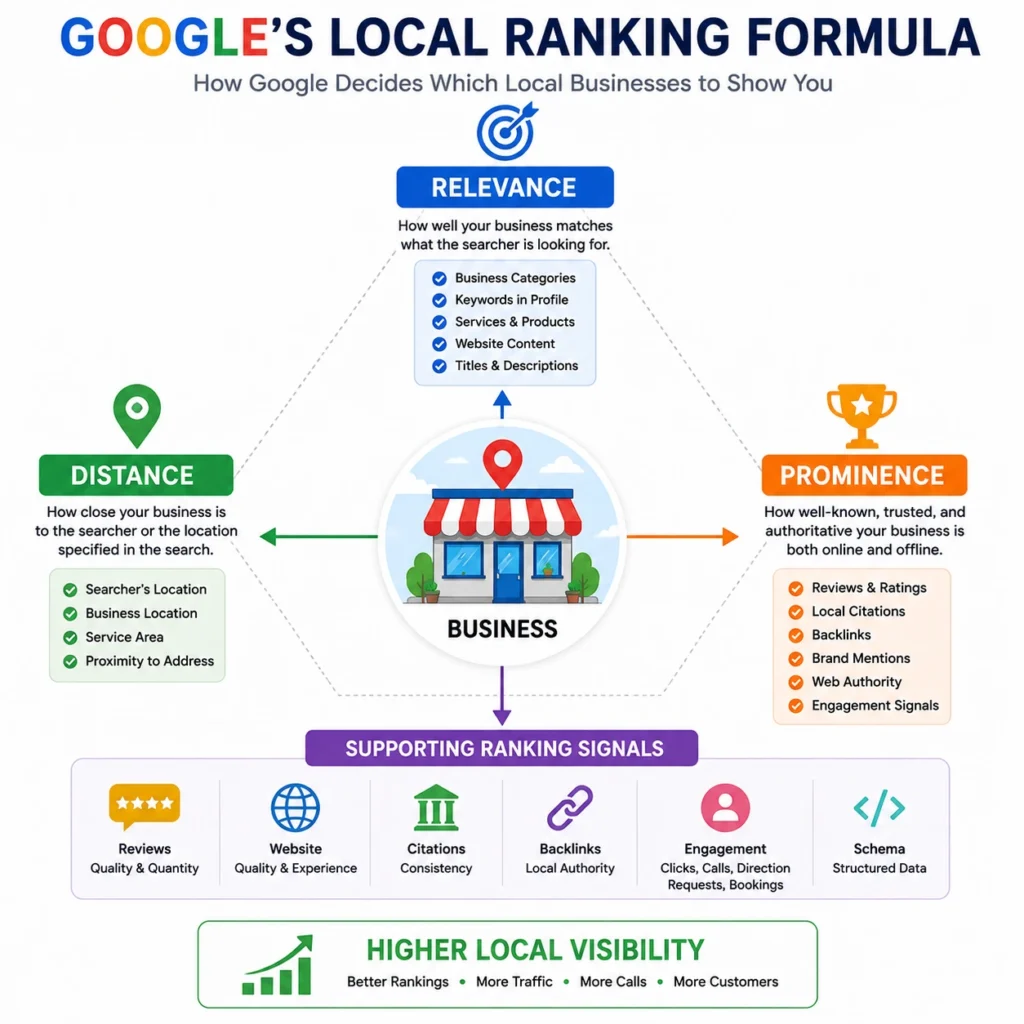
According to Google’s own guidance, local rankings are primarily determined by three core factors:
- Relevance
- Distance
- Prominence
Let’s look at each one.
Relevance
Relevance measures how closely your business matches the user’s search.
For example, if someone searches for:
“Italian restaurant”
Google looks for businesses whose categories, descriptions, services, menus, and website content clearly indicate they serve Italian food.
Improving relevance involves:
- Selecting the correct primary business category
- Choosing accurate secondary categories
- Writing detailed service descriptions
- Creating helpful website content
- Keeping business information updated
The clearer your business information is, the easier it is for Google to understand when your business should appear.
Distance
Distance refers to how close your business is to the searcher or the location mentioned in the search.
Someone searching:
“coffee shop near me”
will usually see businesses located nearby.
If a user searches:
“best hotel in Chandigarh”
Google evaluates businesses within that city instead of relying solely on the user’s current location.
Although you cannot change your physical location, you can clearly define your service area through your Google Business Profile and website.
Prominence
Prominence reflects how well-known and trusted your business appears to be online and offline.
Google evaluates signals such as:
- Customer reviews
- Business reputation
- Local backlinks
- Brand mentions
- Website authority
- Business longevity
- Media coverage
- Overall online presence
A business with consistent positive reviews, an informative website, and strong local recognition is generally considered more prominent than one with limited online activity.
Prominence is often the ranking factor businesses have the greatest ability to improve over time.
Supporting Local Ranking Signals
Beyond the three primary factors, Google evaluates many additional signals that influence local visibility.
Customer Reviews
High-quality, authentic reviews help establish trust and demonstrate positive customer experiences.
Businesses should focus on earning reviews consistently rather than seeking large numbers all at once.
Website Quality
Google evaluates your website to understand:
- Your expertise
- Service offerings
- User experience
- Mobile usability
- Page speed
- Helpful content
A strong website supports your Google Business Profile rather than replacing it.
Local Backlinks
Links from respected local organizations help confirm your connection to the community.
Examples include:
- Chamber of Commerce websites
- Local news publications
- Community organizations
- Sponsorship pages
- Industry associations
Behavioral Signals
Although Google doesn’t disclose every ranking signal, user behavior appears to play an important role.
Examples include:
- Direction requests
- Phone calls
- Website visits
- Click-through rates
- Review engagement
- Driving direction requests
- Repeat customer interactions
Businesses that consistently satisfy customer expectations often generate stronger engagement signals over time.
Business Information Accuracy
Google wants confidence that your information is reliable.
Always keep your:
- Business name
- Address
- Phone number
- Website
- Business hours
- Categories
- Services
consistent across every platform.
Helpful Content
Publishing useful local content helps Google understand both your expertise and your relevance to the communities you serve.
Instead of creating pages only for search engines, answer real customer questions, explain your services clearly, and provide information that helps people make informed decisions.
The Biggest Benefits of Local SEO
Local SEO is more than a way to improve rankings. When done consistently, it helps businesses attract customers who are already searching for the products or services they offer. These visitors often have a higher intent to take action, whether that means calling, booking an appointment, requesting a quote, or visiting a physical location.
Rather than looking at the benefits as a simple list, let’s explore how Local SEO creates value for small businesses over time.
More Phone Calls
For many service-based businesses, a phone call is the first step toward becoming a customer.
When your business appears in Google Search or Google Maps, users can call you directly from your Google Business Profile without visiting your website.
For example:
- A homeowner with a burst pipe searches for “emergency plumber near me.”
- A parent searches for “pediatric dentist open today.”
- Someone traveling searches for “hotel near airport.”
In each case, customers often contact one of the first trustworthy businesses they find.
Businesses with complete Google Business Profiles, accurate business hours, positive reviews, and clear contact information generally receive more direct calls from local search results.
More Qualified Website Traffic
Not all website visitors are equally valuable.
A person searching “digital marketing tips” may simply be researching.
A person searching “SEO agency in Chandigarh” is much closer to making a buying decision.
Local SEO helps attract visitors who are actively looking for businesses within a specific location. These users typically spend more time exploring services and are more likely to contact the business.
Because local searches often reflect immediate needs, the traffic generated through Local SEO tends to convert better than broad informational traffic.
More Qualified Leads
One of the biggest advantages of Local SEO is the quality of leads.
Instead of advertising to everyone, you reach people already searching for your services.
Examples include:
- Someone needing emergency plumbing repairs
- A family searching for a nearby dental clinic
- A homeowner looking for roofing estimates
- A business owner seeking a local accountant
These searches usually indicate strong purchase intent.
As a result, Local SEO often delivers leads that require less convincing compared to traditional outbound marketing methods.
Better Google Maps Visibility
Google Maps has become one of the most influential discovery platforms for local businesses.
Many customers never browse beyond the map results.
Instead, they compare businesses based on:
- Ratings
- Reviews
- Photos
- Business hours
- Distance
- Services
- Directions
Improving your Local SEO increases the likelihood of appearing in Google Maps for relevant searches, helping more customers discover your business naturally.
Learn how to improve map rankings in our Google Maps SEO Guide.
Increased Customer Trust
Trust influences almost every buying decision.
Before contacting a business, people often evaluate:
- Average review rating
- Number of reviews
- Business photos
- Website quality
- Response to customer feedback
- Accuracy of business information
A business with an active Google Business Profile, recent reviews, and helpful website content immediately appears more trustworthy than one with outdated information or little online presence.
Local SEO strengthens these trust signals, making customers more confident in choosing your business.
Higher Conversion Rates
Because Local SEO attracts users with strong purchase intent, conversion rates are often higher than many other digital marketing channels.
For example:
A user searching:
“best chiropractor near me”
is much closer to booking an appointment than someone casually reading an article about back pain.
This means businesses often see more:
- Calls
- Appointment requests
- Quote submissions
- Store visits
- Direction requests
from local search traffic compared to broader online audiences.
Strong Long-Term Return on Investment
Unlike paid advertising, Local SEO continues generating visibility after the initial optimization work.
A well-maintained Google Business Profile, helpful website content, positive customer reviews, and strong local authority can continue attracting customers for months or even years.
Although Local SEO requires ongoing maintenance, it builds a sustainable marketing asset rather than producing results only while advertising budgets remain active.
Discover additional growth opportunities in our Benefits of Local SEO guide.
Common Local SEO Mistakes
Many businesses invest time in Local SEO but overlook the fundamentals that Google uses to evaluate local trust and relevance.
Avoiding these common mistakes can often produce faster improvements than chasing advanced ranking techniques.
Ignoring Google Business Profile
A surprising number of businesses either never claim their Google Business Profile or leave it incomplete after creating it.
Common issues include:
- Missing categories
- Incorrect business hours
- Outdated phone numbers
- No business description
- Few or no photos
- Unanswered reviews
Since Google Business Profile is central to Local SEO, neglecting it limits your visibility regardless of how good your website is.
Inconsistent NAP Information
NAP stands for:
- Name
- Address
- Phone Number
Your business information should remain consistent across:
- Website
- Google Business Profile
- Business directories
- Social media profiles
- Industry listings
Small differences such as abbreviating a street name on one platform and spelling it out on another may seem minor, but widespread inconsistencies can reduce Google’s confidence in your business information.
Poor Review Strategy
Some businesses never ask satisfied customers for reviews.
Others only request reviews once or twice each year.
Healthy review profiles grow gradually over time.
Best practices include:
- Request reviews after successful projects
- Respond professionally to every review
- Thank customers for positive feedback
- Address negative reviews constructively
- Never purchase fake reviews
Consistency matters more than sudden spikes in review activity.
Thin Location Pages
Businesses serving multiple cities sometimes create dozens of nearly identical location pages with only the city name changed.
These pages usually provide little value for users.
Instead, each location page should include:
- Local service information
- Area-specific content
- Customer testimonials
- Driving directions
- Frequently asked questions
- Photos relevant to that location
Unique, helpful pages perform much better over the long term.
Duplicate Content
Copying the same service description across multiple city pages makes it difficult for Google to determine which page provides the most value.
Each page should answer questions specific to that location while demonstrating your expertise naturally.
Original content also improves the user experience.
Missing Local Business Schema
Structured data helps search engines understand your business details more accurately.
Without Local Business Schema, Google relies solely on visible content to interpret important information.
Adding structured data improves clarity and supports your overall Local SEO strategy.
No Local Content Strategy
Many businesses publish occasional blog posts but never create content focused on local customer needs.
Useful examples include:
- Seasonal service advice
- Community events
- Local buying guides
- Neighborhood-specific FAQs
- Area maintenance tips
Publishing helpful local content reinforces your relevance within the communities you serve.
Weak Internal Linking
Internal links help search engines understand how your website is organized.
For example, your homepage should naturally connect to:
- Service pages
- Location pages
- Helpful blog articles
- Contact page
- Google Business Profile resources
A logical internal linking structure distributes authority throughout your website while helping visitors find related information.
Learn how to identify and fix these issues in our Local SEO Mistakes guide.
Beginner Mistakes Scorecard
| Mistake | Impact on Local SEO | Priority to Fix |
|---|---|---|
| Google Business Profile incomplete | Very High | ⭐⭐⭐⭐⭐ |
| Inconsistent NAP information | Very High | ⭐⭐⭐⭐⭐ |
| Few customer reviews | High | ⭐⭐⭐⭐ |
| Thin location pages | High | ⭐⭐⭐⭐ |
| Duplicate content | Medium to High | ⭐⭐⭐⭐ |
| Missing Local Business Schema | Medium | ⭐⭐⭐ |
| No local content | Medium | ⭐⭐⭐ |
| Weak internal linking | Medium | ⭐⭐⭐ |
A good Local SEO strategy isn’t about finding shortcuts. It’s about consistently improving the signals that help Google understand your business, earn customer trust, and recommend you when local buyers are ready to take action.
How to Get Started with Local SEO
If you’re new to Local SEO, it’s easy to feel overwhelmed by terms like citations, schema, local backlinks, and Google Business Profile optimization.
The good news is that you don’t need to do everything at once.
The most successful Local SEO campaigns are built step by step. By focusing on the fundamentals first and improving consistently over time, you create a strong foundation that supports long-term visibility in Google Search, Google Maps, and AI-powered search experiences.
Below is a beginner-friendly roadmap you can follow.
Step 1: Create and Optimize Your Google Business Profile
Estimated Time: 2–4 hours
Difficulty: ⭐ Easy
Expected Outcome: Improved visibility in Google Search and Google Maps
Your Google Business Profile should be your first priority because it is one of Google’s primary sources of local business information.
Make sure you:
- Verify your business
- Select the correct business category
- Add accurate business hours
- Upload high-quality photos
- Write a clear business description
- Add your services and products
- Include your website and phone number
- Enable messaging if appropriate
Many businesses stop after verification, but regular updates help keep your profile active and trustworthy.
Follow our detailed Google Business Profile Guide for a complete optimization checklist.
Step 2: Research Local Keywords
Estimated Time: 2–3 hours
Difficulty: ⭐⭐ Easy
Expected Outcome: Better alignment with customer searches
Instead of targeting broad keywords, identify the phrases people in your service area actually use.
For example:
Instead of:
- Dentist
Target:
- Dentist in Chandigarh
- Emergency dentist near me
- Family dental clinic Mohali
Think about how your customers naturally search.
Useful keyword ideas often come from:
- Google Autocomplete
- “People Also Ask”
- Google Business Profile insights
- Customer questions
- Search Console data
- Professional keyword research tools
Focus on keywords that reflect real buying intent rather than simply high search volume.
Step 3: Optimize Your Website
Estimated Time: 1–2 days
Difficulty: ⭐⭐⭐ Moderate
Expected Outcome: Stronger local relevance and improved user experience
Your website should clearly explain:
- What you do
- Where you operate
- Why customers should trust you
Key improvements include:
- Service pages
- Location-specific content
- Fast page loading
- Mobile-friendly design
- Clear contact information
- Internal linking
- Local Business Schema
- Embedded Google Map
Remember, every page should help visitors solve a problem instead of simply targeting keywords.
Step 4: Build Consistent Local Citations
Estimated Time: 1–2 weeks
Difficulty: ⭐⭐⭐ Moderate
Expected Outcome: Greater business trust and consistency
Submit your business information to reputable directories and local organizations.
Examples include:
- Local business directories
- Industry associations
- Chamber of Commerce listings
- Professional organizations
- Trusted citation platforms
Always keep your:
- Business Name
- Address
- Phone Number
consistent across every listing.
Small inconsistencies can create confusion for both users and search engines.
Step 5: Generate Customer Reviews
Estimated Time: Ongoing
Difficulty: ⭐⭐ Easy
Expected Outcome: Increased trust and improved local visibility
Customer reviews influence both rankings and purchasing decisions.
Build a simple review process:
- Ask satisfied customers shortly after completing a service.
- Make leaving a review easy by sharing a direct review link.
- Respond professionally to every review.
- Learn from constructive feedback.
- Thank customers for positive experiences.
A steady stream of genuine reviews is more valuable than collecting many reviews in a short period.
Step 6: Publish Helpful Local Content
Estimated Time: Ongoing
Difficulty: ⭐⭐⭐ Moderate
Expected Outcome: Increased topical authority and local relevance
Helpful local content demonstrates both expertise and community involvement.
Ideas include:
- Local buying guides
- Service area FAQs
- Seasonal maintenance tips
- Community event updates
- Customer success stories
- Neighborhood-specific advice
Rather than publishing frequently for the sake of publishing, focus on answering questions your local customers genuinely ask.
This type of content also creates natural opportunities for internal linking across your website.
Step 7: Track Your Performance
Estimated Time: 30–60 minutes per month
Difficulty: ⭐⭐ Easy
Expected Outcome: Better decision-making and continuous improvement
Local SEO is an ongoing process.
Regularly monitor:
- Google Business Profile Insights
- Website traffic
- Phone calls
- Direction requests
- Contact form submissions
- Keyword rankings
- Google Search Console
- Google Analytics
Tracking performance helps you identify what’s working and where improvements are needed.
Small monthly improvements often produce significant long-term growth.
Local SEO Checklist
Use this checklist as a starting point for your Local SEO strategy.
Google Business Profile
☐ Business verified
☐ Correct business categories selected
☐ Business hours updated
☐ Website linked
☐ Services added
☐ Products added (if applicable)
☐ High-quality photos uploaded
☐ Business description completed
☐ Questions & Answers reviewed
Website
☐ Mobile-friendly design
☐ Fast loading pages
☐ Clear contact information
☐ Service pages created
☐ Location pages created where appropriate
☐ Internal links added
☐ Local Business Schema implemented
☐ Google Map embedded
Local Authority
☐ NAP information consistent
☐ Local citations created
☐ Customer reviews requested regularly
☐ Reviews answered professionally
☐ Local backlinks earned
Content
☐ Local blog articles published
☐ FAQs answered
☐ Community-focused content created
☐ Service pages updated
☐ Helpful resources added
Tracking
☐ Google Search Console configured
☐ Google Analytics installed
☐ Google Business Profile Insights monitored
☐ Monthly ranking reports reviewed
☐ Leads and phone calls tracked
Download our complete Local SEO Checklist for a printable version and ongoing optimization guidance.
Local SEO in the AI Search Era
Local SEO is no longer limited to ranking in Google’s traditional search results. Today, businesses also need to be visible in AI-generated answers, voice assistants, and conversational search experiences.
When someone asks:
- “Who is the best family dentist near me?”
- “Recommend a reliable plumber in Chandigarh.”
- “Which gym has the best reviews nearby?”
AI-powered search systems don’t simply look for pages with matching keywords. They evaluate whether a business appears trustworthy, well-established, and relevant based on information collected from multiple sources.
This shift makes Local SEO more focused on building a strong digital business identity rather than optimizing individual keywords.
AI Overviews Are Changing Local Search
Google’s AI Overviews aim to provide direct answers by combining information from multiple trusted sources.
For local businesses, this means Google may analyze:
- Your Google Business Profile
- Website content
- Customer reviews
- Business directories
- Local news mentions
- Industry websites
- Structured data
- Overall online reputation
Businesses with accurate, consistent, and trustworthy information across these sources are more likely to be referenced in AI-generated responses.
Instead of asking, “How do I rank #1?” businesses should increasingly ask, “How can I become the most trusted answer?”
AI Assistants Depend on Trusted Business Information
Modern AI assistants are designed to recommend businesses that appear reliable.
When evaluating local businesses, they may consider factors such as:
- Business legitimacy
- Consistent contact information
- Positive customer feedback
- Relevant service pages
- Geographic relevance
- Authoritative mentions from other websites
If your business information is inconsistent or incomplete, AI systems may have less confidence in recommending it.
Voice Search Is Becoming More Conversational
People rarely speak the way they type.
Instead of searching:
plumber Chandigarh
they are more likely to ask:
“Who can fix a leaking pipe near me today?”
or
“Which electrician is open right now?”
Voice searches tend to be:
- Longer
- More conversational
- Question-based
- Action-oriented
To improve visibility, create content that answers real customer questions in natural language.
FAQ sections, service pages, and Google Business Profile Q&A can all support voice search optimization.
Entity SEO Matters More Than Keyword Density
Google increasingly understands businesses as entities, not just websites.
An entity is a clearly identifiable business with consistent information across multiple trusted sources.
For example, Google connects information from:
- Google Business Profile
- Your website
- Social media profiles
- Business directories
- Customer reviews
- Local news
- Industry associations
When all of these sources reinforce the same business identity, Google has greater confidence in recommending your business.
This is why consistency is so important.
Local Intent Is Stronger Than Ever
AI systems are becoming better at understanding user intent.
For example:
Search:
“Best pizza”
may trigger completely different results depending on where the user is located.
Someone in Mohali and someone in Delhi are likely to receive different recommendations because the intent is clearly local.
Businesses should therefore focus on serving their local audience exceptionally well rather than trying to rank everywhere.
Behavioral Signals Continue to Grow in Importance
Although Google doesn’t reveal every ranking signal, user engagement provides valuable feedback about business quality.
Positive signals may include:
- Calls from Google Business Profile
- Direction requests
- Website visits
- Appointment bookings
- Review activity
- Repeat customer interactions
Businesses that consistently satisfy customers tend to generate stronger engagement over time.
These real-world interactions help reinforce online trust.
The Future of Local SEO
Successful Local SEO campaigns will increasingly focus on:
- Accurate business information
- Helpful website content
- Strong customer relationships
- High-quality reviews
- Local authority
- Structured data
- Community involvement
Rather than trying to manipulate rankings, businesses should invest in becoming genuinely valuable to local customers.
That approach aligns with both Google’s evolving algorithms and customer expectations.
Myths vs Facts About Local SEO
Misunderstandings often prevent businesses from investing in the right improvements.
The table below addresses some of the most common misconceptions.
| Myth | Fact |
|---|---|
| Google Business Profile is enough. | A strong profile is important, but your website, reviews, citations, and local authority also influence rankings. |
| Reviews are the only ranking factor. | Reviews matter, but Google also evaluates relevance, distance, website quality, backlinks, structured data, and business information. |
| Local SEO is only for physical stores. | Service-area businesses, professionals, and companies that visit customers also benefit from Local SEO. |
| Local SEO is a one-time project. | Business information, reviews, content, and customer behavior change continuously. Regular optimization is necessary. |
| More keywords always improve rankings. | Helpful content and genuine relevance are far more important than repeating keywords. |
| Ranking first guarantees more customers. | Visibility matters, but trust signals, reviews, photos, and user experience strongly influence whether people contact your business. |
| More directory listings always mean better rankings. | Quality and consistency matter much more than submitting your business to hundreds of low-quality directories. |
| Anyone can copy a competitor’s strategy exactly. | Every business has different customers, locations, competition, and opportunities. Local SEO should reflect your unique market. |
Do You Need Local SEO?
If you’re unsure whether Local SEO is right for your business, this simple decision tree can help.
Decision Tree
Do you serve customers in a specific city, town, or region?
                     │
          ┌──────────┴──────────┐
          │                     │
         Yes                    No
          │                     │
   Do customers search      Is your business
   online before buying?    completely online?
          │                     │
     ┌────┴────┐             ┌──┴──┐
     │         │             │     │
    Yes        No           Yes    No
     │         │             │      │
 Local SEO   Consider      Traditional
 is highly   improving      SEO may
 recommended local          be your
             visibility     primary focus
Service Businesses
If you travel to customers or provide services within a defined area, Local SEO is essential.
Examples include:
- Electricians
- Plumbers
- HVAC companies
- Cleaning services
- Landscapers
- Roofing contractors
Businesses With Physical Locations
Retail stores, restaurants, clinics, gyms, hotels, and offices should invest heavily in Local SEO because nearby customers often discover them through Google Maps.
Ecommerce Businesses With Stores
If you sell products online and have physical locations, Local SEO can help attract nearby shoppers while supporting your broader ecommerce strategy.
Online-Only Businesses
Businesses that serve customers globally without geographic limitations may benefit more from traditional SEO.
However, if they eventually expand into local markets, Local SEO becomes increasingly valuable.
Multi-Location Companies
Businesses with several branches should develop an individual Local SEO strategy for every location while maintaining consistent brand standards across all profiles.
Before vs After Local SEO
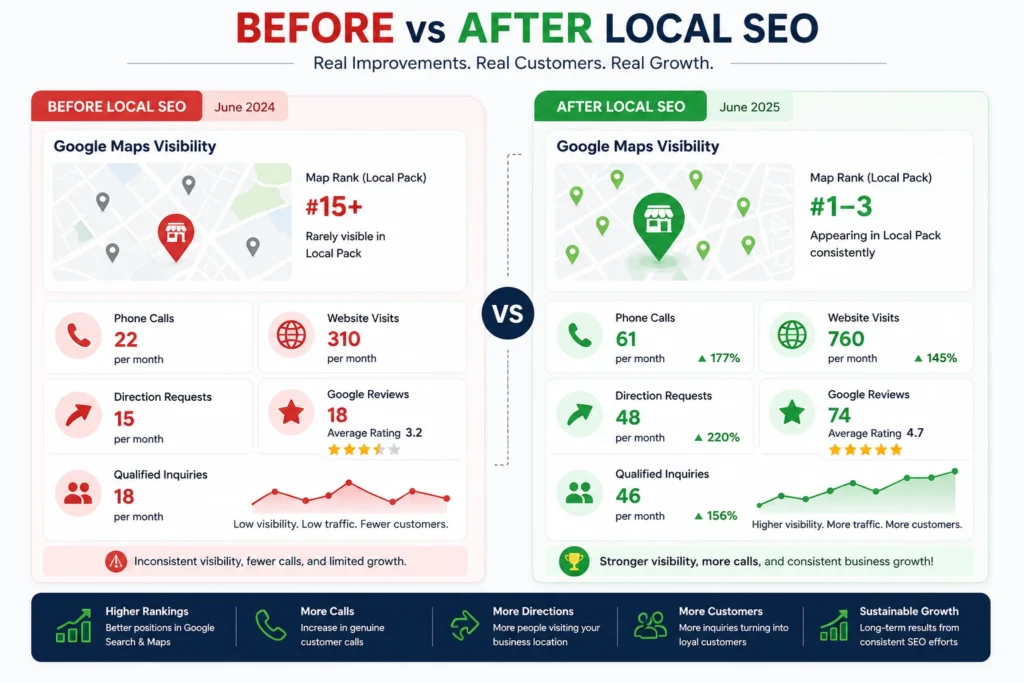
The following example illustrates how consistent optimization can improve business visibility over time.
| Metric | Before Optimization | After Several Months of Consistent Local SEO* |
|---|---|---|
| Google Business Profile Views | 850/month | 2,150/month |
| Phone Calls | 22/month | 61/month |
| Website Visits | 310/month | 760/month |
| Direction Requests | 15/month | 48/month |
| Customer Inquiries | 18/month | 46/month |
Frequently Asked Questions
Is Local SEO free?
Local SEO can be started with little or no direct cost. Creating a Google Business Profile, optimizing your website, requesting customer reviews, and publishing helpful local content are all activities you can do yourself. However, investing in professional tools or expert assistance can save time and accelerate results in competitive markets.
How long does Local SEO take to show results?
Most businesses begin seeing measurable improvements within 3 to 6 months, although the timeline depends on factors such as competition, your starting point, website quality, review profile, and the consistency of your optimization efforts.
Does every business need Local SEO?
No. Local SEO is most valuable for businesses that serve customers in a specific geographic area, such as restaurants, clinics, law firms, home service providers, gyms, hotels, and retail stores. Businesses that operate entirely online without a local audience may benefit more from traditional SEO.
Can I do Local SEO myself?
Yes. Many small business owners can handle the basics, such as setting up a Google Business Profile, keeping business information up to date, collecting customer reviews, and publishing local content. As your business grows or competition increases, professional help can save time and improve results.
How much does Local SEO cost?
Costs vary depending on your goals, industry, competition, and whether you manage Local SEO yourself or hire an agency. Some businesses only need occasional optimization, while others require ongoing management across multiple locations. Explore our Local SEO Pricing Guide to understand different service options and what they typically include.
What is the difference between Google Maps SEO and Local SEO?
Google Maps SEO focuses on improving your visibility in Google Maps and the Local Pack. Local SEO is a broader strategy that also includes website optimization, local content, reviews, citations, backlinks, and technical SEO.
Does Local SEO still work?
Yes. Local SEO is more important than ever because people use Google Search, Google Maps, AI-powered search, and voice assistants to find nearby businesses. A strong Local SEO strategy helps customers discover and trust your business.
Is Google Business Profile enough?
No. A Google Business Profile is important, but it works best when supported by a well-optimized website, positive reviews, consistent business information, helpful content, and local SEO best practices.
What are local citations?
Local citations are online mentions of your business name, address, and phone number on directories, business websites, and local listings. Accurate citations help search engines verify your business information.
How do I know if my Local SEO is working?
You can measure Local SEO by tracking website visits, phone calls, direction requests, customer inquiries, review growth, and your rankings in local search results.
Should I create separate pages for every city I serve?
Only if you genuinely serve those locations and can provide unique, valuable information for each area. Avoid publishing dozens of nearly identical pages with only the city name changed, as this creates a poor user experience and can weaken your overall website quality.
How often should I update my Google Business Profile?
Update your profile regularly by keeping your business information accurate, adding new photos, publishing posts, and responding to customer reviews. An active profile helps build trust and improve local visibility.
Need Help Improving Your Local SEO?
Many small businesses can achieve excellent results by following the fundamentals outlined in this guide.
If you have:
- A single location
- Limited competition
- Time to manage your marketing
- A willingness to learn
then a do-it-yourself approach is often a great place to start.
However, there are situations where working with an experienced Local SEO specialist can make a meaningful difference.
Professional support is often worthwhile if you:
- Manage multiple business locations
- Operate in a highly competitive industry
- Have recently experienced a drop in local visibility
- Need technical website improvements
- Require Local SEO alongside broader SEO and digital marketing strategies
- Have limited internal resources to manage ongoing optimization
An experienced consultant can help identify technical issues, improve your Google Business Profile, strengthen your website, develop a content strategy, and prioritize the activities most likely to improve your local visibility.
If you’d like an expert review of your current local presence, request a Free Local SEO Audit. A professional audit can uncover opportunities related to your Google Business Profile, website, local citations, reviews, and overall local search performance.
Learn more about our Local SEO Services and how we help businesses improve their visibility in Google Search, Google Maps, and AI-powered search experiences.

Mandeep Wraich
Digital Marketing Specialist and Content Strategist focused on data-driven growth, SEO, and performance-led content. At AIPulseInsights.com, articles explore how AI, analytics, and emerging digital trends influence marketing strategies, brand visibility, and business decision-making. With a strong foundation in content analysis, paid media, and strategic storytelling, the work shared on this platform converts complex industry shifts into practical insights that support marketers and businesses in achieving consistent, measurable growth. The goal is to simplify innovation and empower readers to stay ahead in a rapidly changing digital landscape.