A few years ago, ranking a local business often meant getting a website onto the first page of Google. Today, that is only one part of the equation.
When someone searches for a nearby dentist, electrician, accountant, restaurant, or law firm, Google may display a Local Pack, Google Maps results, AI-generated summaries, business profiles, reviews, photos, and suggested businesses before a traditional organic result appears. Voice assistants and AI-powered search experiences are also changing how customers discover local companies.
This shift has changed how businesses earn visibility. Success no longer depends only on website rankings. Google now evaluates a business as an entity by combining website authority, Google Business Profile quality, customer engagement, reviews, locaaudl relevance, and real-world trust signals.
Across Local SEO campaigns, one consistent pattern stands out. Businesses often focus on rankings instead of customer actions. They celebrate moving from position eight to position three while overlooking declining phone calls, fewer direction requests, or lower appointment bookings. Google’s local systems increasingly reward businesses that provide better user experiences, not simply better keyword optimization.
Another observation is equally important. Strong Google Business Profiles amplify website authority. When an optimized profile works alongside a technically sound website, consistent business information, positive reviews, and locally relevant content, every asset strengthens the others. This interconnected approach consistently produces stronger long-term results than isolated optimization efforts.
Artificial intelligence has accelerated this evolution. AI Overviews increasingly summarize local businesses, compare providers, answer location-based questions, and recommend services using information collected from multiple trusted sources. Businesses with clear entity signals, accurate business information, strong reputation, and consistent local authority are more likely to appear throughout Google’s expanding local ecosystem.
This guide brings those pieces together into a practical roadmap. You’ll learn how Local SEO works, how Google determines local rankings, how to optimize your Google Business Profile, improve Google Maps visibility, build geo-topical authority, and prepare your business for AI-powered local search. Whether you manage one location or hundreds, the principles remain the same: earn trust, demonstrate expertise, and make it easy for both customers and search engines to understand your business.
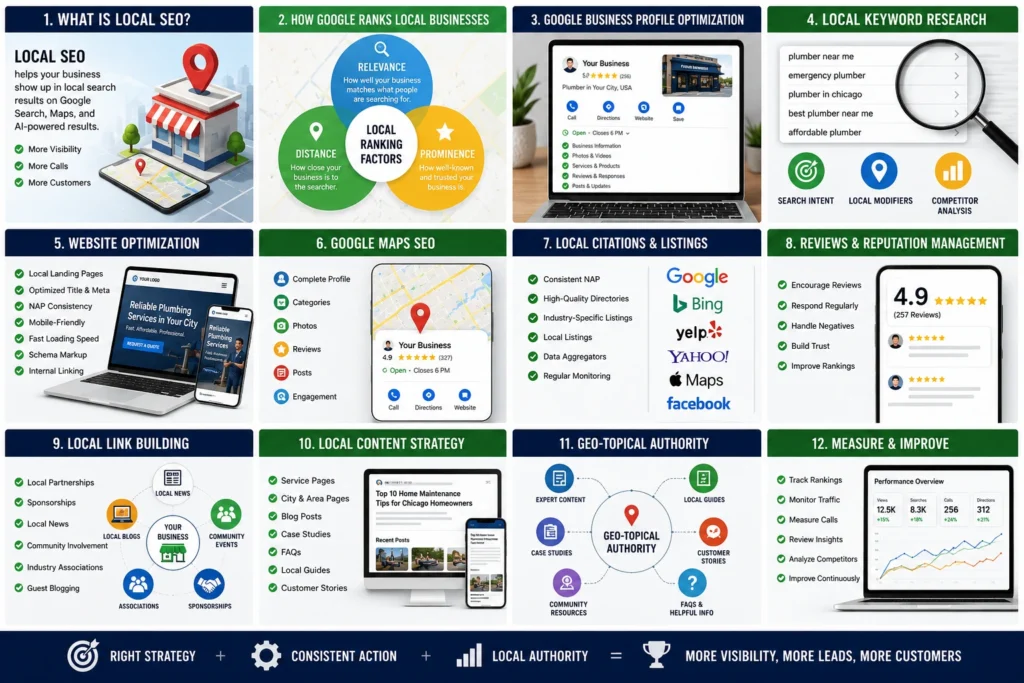
What Is Local SEO?
Local SEO is the process of improving a business’s visibility in location-based search results across Google Search, Google Maps, the Local Pack, AI-powered search experiences, and other local discovery platforms. It combines website optimization, Google Business Profile management, local authority signals, and customer engagement to attract nearby customers actively looking for products or services.
Unlike traditional SEO, which often targets national or global audiences, Local SEO focuses on geographic relevance.
For example:
- “Running shoes” is a broad SEO keyword.
- “Running shoe store in Austin” is a Local SEO query.
- “Running shoes near me” relies almost entirely on Google’s local ranking systems.
This distinction matters because Google’s evaluation process differs significantly between local and traditional search. Local algorithms consider physical proximity, business reputation, user behavior, and profile quality alongside website authority.
In 2026, Local SEO extends well beyond Google Maps. AI-generated answers, voice search, location-aware recommendations, and personalized search experiences all rely on accurate local business data. Businesses that ignore Local SEO risk losing visibility even if their websites rank well organically.
How Local SEO Works
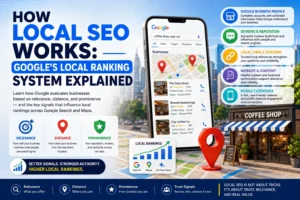
Google’s local ranking system revolves around three primary factors.
Relevance
Relevance measures how closely a business matches what someone is searching for.
Google evaluates numerous signals, including:
- Business categories
- Services offered
- Website content
- Products
- Business description
- Customer reviews
- Questions and answers
- Structured data
- Local content
A plumbing company with detailed service pages covering emergency repairs, leak detection, drain cleaning, and water heater installation provides stronger relevance signals than a profile with only a brief generic description.
Distance
Distance measures how close a business is to the person searching or to the location included in the search query.
For example:
- “Coffee shop near me”
- “Family lawyer in Dallas”
- “Electrician near Central Park”
Google attempts to recommend businesses that can realistically serve the user’s location. Even an exceptionally optimized business may struggle to appear for searches far outside its service area unless it has established relevance for those locations.
Service-area businesses present a unique challenge because customers may never visit a physical storefront. In these cases, Google’s systems rely more heavily on service areas, website content, reviews, and behavioral signals to determine geographic relevance.
Prominence
Prominence reflects how established and trusted a business appears online and offline.
Google considers factors such as:
- Review quantity
- Review quality
- Review freshness
- Local backlinks
- Brand mentions
- News coverage
- Business citations
- Website authority
- Customer engagement
- Historical reputation
Prominence is difficult to manufacture quickly because it develops through consistent business performance over time. Businesses that invest in customer satisfaction, community involvement, and useful content often build stronger prominence naturally than competitors relying on shortcuts.
Where Local SEO Appears
Many business owners associate Local SEO only with Google Maps. In reality, local visibility now spans several connected search environments.
Google Search
Traditional search results increasingly display local businesses alongside organic listings, FAQs, review snippets, and business information panels.
Google Maps
Google Maps remains one of the highest-converting discovery channels because users searching here usually have immediate purchase intent.
Local Pack
The Local Pack typically displays three businesses directly beneath the map within Google’s search results. Appearing here often generates significantly more calls, website visits, and direction requests than lower organic positions.
Local Finder
Selecting “More businesses” expands results into the Local Finder, where additional businesses compete using similar ranking signals.
AI Overviews
AI-generated responses increasingly summarize nearby businesses, compare providers, answer location-specific questions, and recommend services using trusted business information.
Rather than relying on one source, AI systems combine:
- Website content
- Google Business Profile information
- Reviews
- Business entities
- Trusted citations
- Authoritative local sources
This means Local SEO increasingly supports AI visibility as well as traditional rankings.
Voice Search
People searching through voice assistants typically ask conversational questions such as:
- Who is the best pediatric dentist nearby?
- Which plumber is open now?
- Where can I find an emergency vet?
Voice search favors businesses with complete information, strong reviews, accurate operating hours, and clear service descriptions.
“Near Me” Searches
Although users often type “near me,” Google primarily determines proximity using device location rather than the phrase itself.
Businesses should therefore optimize for genuine local relevance instead of excessively repeating “near me” throughout website content.
Benefits of Local SEO
A well-executed Local SEO strategy produces business outcomes that extend far beyond higher rankings.
Some of the most valuable benefits include:
- Increased visibility where customers are ready to buy
- Higher-quality website traffic
- More phone calls and appointment requests
- Better conversion rates from location-based searches
- Lower customer acquisition costs compared with many paid advertising channels
- Stronger brand credibility through reviews and local authority
- Greater visibility in Google Maps, AI Overviews, and voice search
- Long-term growth built on sustainable trust signals rather than short-lived ranking tactics
For many service businesses, Local SEO becomes the primary source of qualified inbound leads because it captures demand at the moment customers are actively searching for help.
As your strategy matures, website optimization, Google Business Profile improvements, review management, and local authority should work together rather than as isolated projects. This integrated approach forms the foundation of effective Local SEO Services, where every optimization reinforces the others and contributes to stronger long-term visibility.
How Google Determines Local Rankings
Understanding Google’s local ranking system helps explain why two businesses in the same city can produce very different results, even when they offer nearly identical services.
Google no longer ranks local businesses using a simple checklist. Instead, it evaluates hundreds of interconnected signals that measure relevance, trust, quality, user satisfaction, and real-world popularity. These signals work together to determine which businesses deserve visibility in Google Search, Google Maps, the Local Pack, AI Overviews, and other local search experiences.
One trend has become increasingly clear across Local SEO campaigns. Businesses with strong overall quality consistently outperform businesses that focus only on keyword optimization. Google wants to recommend businesses that users are most likely to contact, visit, trust, and recommend to others.
Google’s Three Core Local Ranking Factors
Google publicly identifies three primary ranking factors for local search.
Relevance
Relevance measures how well a business matches the user’s search intent.
Google analyzes multiple sources to understand what a business actually does, including:
- Google Business Profile categories
- Products and services
- Website content
- Business description
- Customer reviews
- Photos
- Questions and Answers
- Structured data
- Business attributes
- Local landing pages
For example, consider two HVAC companies.
The first lists only “HVAC Contractor” as its category and has a short homepage describing heating and cooling services.
The second business includes detailed pages covering:
- AC repair
- Furnace installation
- Heat pump replacement
- Emergency HVAC service
- Indoor air quality
- Commercial HVAC maintenance
Google gains a much stronger understanding of the second business, allowing it to rank for a wider range of searches.
Relevance is not created by repeating keywords. It comes from clearly demonstrating expertise across all business assets.
Distance
Distance determines how close a business is to the searcher’s location or the geographic area included in the query.
Examples include:
- Dentist near me
- Roofing contractor in Denver
- Family lawyer Chicago Loop
Distance is dynamic.
Two people searching the same keyword from different neighborhoods may receive different Maps results because Google’s systems prioritize businesses that can realistically serve each location.
For service-area businesses, Google also considers declared service areas, website location signals, customer reviews mentioning locations, and other geographic relevance indicators.
Businesses should avoid creating dozens of thin city pages solely to increase geographic coverage. Google’s systems have become much better at identifying genuine service areas versus artificial location targeting.
Prominence
Prominence represents Google’s confidence that a business is well established and trusted.
Unlike distance, prominence can be strengthened over time.
Google evaluates signals such as:
- Review volume
- Review quality
- Review freshness
- Website authority
- Local backlinks
- Brand mentions
- News coverage
- Business citations
- Historical performance
- Customer engagement
- Offline reputation
Businesses with strong local brands often rank beyond their immediate neighborhood because Google recognizes their broader authority.
Prominence also explains why well-known businesses sometimes outrank competitors located slightly closer to the searcher.
Additional Local Ranking Signals
Although Google highlights relevance, distance, and prominence, many additional signals influence local visibility.
Reviews
Reviews remain one of the strongest trust indicators.
Google evaluates:
- Quantity
- Average rating
- Review recency
- Review diversity
- Review keywords
- Owner responses
A business receiving steady authentic reviews each month typically performs better than one that collected hundreds of reviews years ago and then became inactive.
Primary and Secondary Categories
Choosing the correct primary category significantly affects ranking opportunities.
Secondary categories allow Google to understand additional services without diluting the business’s main focus.
Poor category selection remains one of the most common Local SEO issues encountered during audits.
Website Authority
Google still evaluates the website connected to the Google Business Profile.
Important factors include:
- Helpful content
- Technical SEO
- Internal linking
- Topic authority
- Page experience
- Structured data
- Mobile usability
Businesses often underestimate how much a strong website reinforces Google Business Profile performance.
Local Backlinks
Local backlinks provide geographic trust.
Examples include:
- Chamber of Commerce websites
- Local newspapers
- Community organizations
- Universities
- Local business associations
- Sponsorship pages
- Industry organizations
One high-quality local backlink often provides more value than numerous unrelated directory links.
Citations
Business listings help Google verify business identity.
Important elements include:
- Business name
- Address
- Phone number
- Website
- Categories
Consistency matters more than quantity.
Hundreds of inconsistent listings can create confusion rather than authority.
User Engagement
Google observes how users interact with local businesses.
Although Google never publishes every behavioral signal, campaign data consistently suggests that businesses generating stronger engagement often improve visibility over time.
Examples include:
- Calls
- Direction requests
- Website visits
- Appointment clicks
- Photo views
- Menu interactions
- Driving direction requests
These actions indicate that users find the business useful.
Behavioral Signals
Behavior reinforces Google’s confidence.
Signals may include:
- Click-through rates
- Repeat visits
- Branded searches
- Navigation requests
- Time spent exploring the profile
- Review activity
Businesses earning genuine customer interaction often sustain rankings more effectively than businesses relying on aggressive optimization alone.
Business Completeness
Complete profiles consistently outperform incomplete ones.
Important profile elements include:
- Categories
- Business description
- Services
- Products
- Photos
- Videos
- Attributes
- Business hours
- Holiday hours
- Appointment links
- FAQs
- Messaging
Every completed section gives Google additional context.
Local Ranking vs Organic Ranking
Although Local SEO and traditional SEO overlap, they rely on different ranking systems.
| Local Rankings | Organic Rankings |
| Google Business Profile is central | Website is central |
| Distance matters | Distance rarely matters |
| Reviews influence rankings | Reviews have indirect impact |
| Categories affect visibility | Keywords carry greater importance |
| Maps engagement matters | User engagement focuses on website |
| Business proximity influences results | Content authority drives visibility |
| Physical presence is important | Physical location is less significant |
Businesses performing well in one system do not automatically perform well in the other.
The strongest local brands optimize both simultaneously.
Local Pack vs Organic Search
| Local Pack | Organic Results |
| Displays three businesses | Displays webpages |
| Strong focus on nearby intent | Broader informational and commercial intent |
| Driven heavily by Google Business Profile | Driven primarily by website authority |
| Includes reviews, directions and calls | Includes titles, descriptions and rich snippets |
| High mobile engagement | Strong research visibility |
| Often appears before organic listings | Usually follows Local Pack for local queries |
For many service businesses, appearing in both areas creates significantly higher click share than relying on either one alone.
Local SEO vs Traditional SEO
| Local SEO | Traditional SEO |
| Geographic focus | National or global focus |
| Google Maps optimization | Website optimization |
| Google Business Profile | Website pages |
| Citations | Backlinks |
| Reviews | Content authority |
| Local relevance | Broad topical relevance |
| Nearby customers | Wider audiences |
The two strategies increasingly complement each other rather than compete.
Local Ranking Factors That Matter Most in 2026
The importance of ranking signals continues to evolve as Google incorporates AI-driven understanding and entity relationships.
| Priority | Ranking Signal | Impact |
| Very High | Google Business Profile optimization | Critical |
| Very High | Reviews and reputation | Critical |
| Very High | Website quality | Critical |
| Very High | Business relevance | Critical |
| High | Local backlinks | High |
| High | Entity consistency | High |
| High | Customer engagement | High |
| High | Local content authority | High |
| Medium | Citation consistency | Medium |
| Medium | Photo freshness | Medium |
| Medium | Business attributes | Medium |
| Supporting | Posting frequency | Low to Medium |
Rather than rewarding isolated tactics, Google’s local systems increasingly combine multiple trust signals before recommending a business.
For example, a law firm with an optimized website, a complete Google Business Profile, strong reviews, authoritative local backlinks, consistent citations, and active customer engagement creates a far stronger entity than a firm relying only on keyword-rich webpages.
This shift has become even more important with AI-powered search.
AI Overviews increasingly blend:
- Traditional organic authority
- Google Business Profile information
- Entity recognition
- Customer reviews
- Local reputation
- Behavioral engagement
- Trusted third-party references
Instead of asking whether your website ranks, Google’s AI systems increasingly evaluate whether your business deserves to be recommended.
That distinction is reshaping Local SEO. Businesses that build genuine authority across every digital touchpoint are becoming far more resilient than those chasing individual ranking signals.
Understanding Google Business Profile (GBP)
For most local businesses, no single digital asset influences local visibility more than a well-managed Google Business Profile (GBP).
Whether someone searches for “dentist near me,” “best coffee shop in Seattle,” or “emergency electrician open now,” Google frequently displays Business Profiles before traditional website listings. In many cases, customers decide whether to call, request directions, book an appointment, or visit a website without ever leaving Google’s interface.
That makes your Google Business Profile more than a directory listing. It is often your first interaction with potential customers.
Businesses that consistently improve their profiles tend to see increases in calls, website visits, direction requests, and customer engagement. During Local SEO audits, one recurring issue is that many businesses claim their profile but never fully optimize it. Missing categories, incomplete services, outdated hours, and poor-quality images all reduce Google’s confidence in the business.
A well-optimized Google Business Profile supports your website, strengthens entity recognition, and improves visibility across Google Search, Google Maps, AI Overviews, and voice search.
What Is Google Business Profile?
Google Business Profile is Google’s free business management platform that allows eligible local businesses to control how they appear across Google’s local search ecosystem.
A profile can display information such as:
- Business name
- Address
- Phone number
- Website
- Business hours
- Services
- Products
- Photos
- Videos
- Reviews
- Questions and Answers
- Appointment links
- Booking options
- Business attributes
When someone searches for your business by name, this information usually appears in the Knowledge Panel. For location-based searches, it contributes directly to your visibility in Google Maps and the Local Pack.
Rather than treating GBP as a standalone listing, think of it as Google’s primary source for understanding your local business entity.
Why GBP Is the Foundation of Local SEO
Your website explains your business.
Your Google Business Profile confirms your business.
Google uses both together.
A complete, accurate, and actively managed profile helps Google answer important questions:
- Is this business legitimate?
- What services does it provide?
- Where does it operate?
- Is it currently open?
- Do customers trust it?
- Is the information up to date?
- Does it actively serve local customers?
The stronger the answers, the greater Google’s confidence in recommending the business.
Across Local SEO campaigns, businesses that regularly update their profiles often outperform competitors with larger websites but neglected Business Profiles.
A strong profile also creates consistency across Google’s ecosystem by reinforcing:
- Website content
- Structured data
- Reviews
- Business citations
- Brand mentions
- Local backlinks
- Customer interactions
This unified entity profile becomes increasingly valuable as AI-powered search systems connect information from multiple trusted sources.
Creating a Google Business Profile
Creating a profile is straightforward, but accuracy from the beginning prevents future problems.
Check Eligibility
Google generally allows profiles for businesses that:
- Serve customers face to face
- Operate from a physical location
- Visit customers within defined service areas
- Have legitimate business operations
Businesses that exist only online without direct customer interaction are typically not eligible.
Claim or Create the Profile
Before creating a new listing:
- Search Google for your business.
- Search Google Maps.
- Look for existing listings.
- Claim an existing profile if one already exists.
Creating duplicate listings often leads to verification issues and ranking confusion.
Verify Ownership
Verification confirms that you manage the business.
Depending on the business, Google may offer methods such as:
- Video verification
- Phone verification
- Email verification
- Live video call
- Postcard verification in limited situations
Complete verification as soon as possible because many profile features remain unavailable until ownership is confirmed.
Manage Ownership Carefully
Many businesses lose access to their profiles because ownership remains with a former employee or marketing agency.
Best practices include:
- Assign a primary owner.
- Add trusted managers.
- Remove inactive users.
- Keep ownership within the business whenever possible.
Maintaining control protects one of your most valuable digital assets.
Completing Every Profile Section
Every completed field provides Google with additional context while improving the customer experience.
Business Name
Use your real-world business name.
Avoid adding:
- Keywords
- Cities
- Promotional phrases
- Marketing slogans
Keyword stuffing in the business name violates Google’s guidelines and may lead to profile suspension or ranking loss.
Categories
Your primary category carries significant ranking weight.
Choose the category that best represents your main service.
Then add relevant secondary categories to reflect additional offerings without creating confusion.
For example, a dental practice might use:
Primary category:
- Dentist
Secondary categories:
- Cosmetic Dentist
- Pediatric Dentist
- Dental Implants Provider
- Emergency Dental Service
The goal is accuracy, not quantity.
Business Description
Use the description to explain:
- Core services
- Experience
- Service areas
- Unique strengths
- Customer focus
Avoid excessive keyword repetition.
Write naturally for customers while clearly describing what the business offers.
Business Hours
Maintain accurate:
- Regular hours
- Holiday hours
- Temporary closures
Incorrect hours create poor customer experiences and may reduce trust.
Website Link
Always connect the most relevant landing page.
For many businesses, this is the homepage.
For specialized locations or services, linking directly to a well-optimized local landing page often improves conversions.
Phone Number
Use a local business number whenever possible.
Ensure it matches your website and major business listings.
Products
Retail businesses should showcase:
- Product names
- Images
- Prices
- Descriptions
These listings provide additional relevance signals and improve customer engagement.
Services
List each major service individually.
Rather than simply writing:
“Roofing”
Include services like:
- Roof inspections
- Roof replacement
- Roof repairs
- Storm damage restoration
- Commercial roofing
- Emergency roof repair
Detailed services help Google understand your expertise.
Attributes
Attributes vary by industry but may include:
- Wheelchair accessible
- Veteran-owned
- Women-owned
- Free Wi-Fi
- Outdoor seating
- Online appointments
- Same-day service
These attributes often influence customer decisions and local search filtering.
Messaging
If your team can respond promptly, enable messaging.
Slow response times create poor customer experiences, so only activate this feature when it can be managed consistently.
Appointment Links
Professional service businesses should include direct booking links whenever possible.
Reducing friction between discovery and conversion often improves lead quality.
Google Business Profile Features
Many businesses underuse Google’s built-in engagement features.
Posts
Share updates such as:
- New services
- Seasonal offers
- Community events
- Company announcements
Posts demonstrate activity, although they should support rather than replace broader content marketing.
Photos
High-quality images consistently improve engagement.
Include:
- Exterior
- Interior
- Team members
- Products
- Services
- Vehicles
- Office environment
- Before-and-after projects where appropriate
Fresh images also encourage customers to spend more time interacting with the profile.
Videos
Short videos showcasing your business, facilities, or services help build trust before customers make contact.
Questions & Answers
Monitor this section regularly.
Answer customer questions yourself before incorrect information appears from third parties.
Reviews
Reviews remain one of the strongest local trust signals.
Encourage genuine customer feedback, respond professionally, and address concerns constructively.
We’ll explore review management strategies later in this guide.
Bookings
Where available, integrate appointment scheduling directly into the profile.
This reduces the number of steps required for customers to become leads.
Messaging
Fast responses improve customer satisfaction and increase the likelihood of conversion.
Products and Services
Regularly update offerings to reflect your current business.
Removing outdated information helps maintain profile accuracy.
Common GBP Mistakes
Many Local SEO audits uncover the same recurring problems:
- Choosing the wrong primary category
- Using keyword-stuffed business names
- Inconsistent business hours
- Ignoring customer reviews
- Low-quality or outdated photos
- Missing services
- Duplicate listings
- Incorrect phone numbers
- Inconsistent business information across the web
- Neglecting profile updates for months at a time
None of these issues alone usually causes major ranking losses.
Combined, however, they reduce Google’s confidence in the business.
Google Business Profile Optimization Checklist
Use this implementation checklist to ensure your profile supports long-term Local SEO performance.
Profile Setup
- Claim ownership
- Complete verification
- Assign appropriate managers
- Remove duplicate listings
Business Information
- Accurate business name
- Correct primary category
- Relevant secondary categories
- Updated phone number
- Website link
- Service areas
- Business description
Customer Experience
- Accurate operating hours
- Holiday hours
- Appointment links
- Messaging enabled if actively managed
Trust Signals
- Upload high-quality photos regularly
- Add videos where appropriate
- Maintain current products and services
- Respond to every customer review
- Monitor Questions and Answers
Ongoing Maintenance
- Review profile monthly
- Update seasonal information
- Add new services
- Replace outdated images
- Monitor profile insights and customer actions
A fully optimized Google Business Profile should never be treated as a one-time task. It requires continuous improvement as your business evolves, customer expectations change, and Google’s local ranking systems become more sophisticated.
For a detailed implementation process, create a dedicated Google Business Profile Optimization Guide that expands each of these checklist items into step-by-step instructions and advanced optimization techniques.
Local Keyword Research
Keyword research for Local SEO is different from traditional keyword research.
Many businesses make the mistake of targeting only high-volume keywords such as “plumber,” “lawyer,” or “dentist.” While these terms may attract traffic, they rarely reflect how local customers actually search when they are ready to take action.
A person looking to hire a service often searches with location, urgency, or quality modifiers:
- Emergency plumber near me
- Best family lawyer in Austin
- Affordable accountant in Chicago
- HVAC repair open now
- Roofing contractor in Brooklyn
These searches reveal intent, and intent is what Google aims to satisfy.
Effective local keyword research identifies the language customers naturally use, maps those searches to the right pages, and ensures every location and service has a clear purpose within your website architecture.
Understanding Local Search Intent
Not every local search has the same objective. Understanding intent helps you create pages that match what users expect to find.
Transactional Intent
Transactional searches come from users who are ready to contact or hire a business.
Examples:
- Emergency electrician near me
- Book a dentist in Denver
- Same-day AC repair
- Roofing company open now
These keywords are best suited for:
- Service pages
- Google Business Profile
- Local landing pages
- Appointment pages
Commercial Investigation
These users are comparing businesses before making a decision.
Examples:
- Best SEO agency in Dallas
- Top personal injury lawyer Chicago
- Affordable wedding photographer Miami
Useful content includes:
- Comparison pages
- Service pages
- Testimonials
- Case studies
- Pricing guides
Commercial intent often converts well because users are evaluating options rather than simply gathering information.
Informational Intent
Informational searches occur earlier in the customer journey.
Examples:
- What does a chiropractor do?
- How much does roof repair cost?
- How often should HVAC be serviced?
These searches work well for:
- Blog articles
- FAQs
- Resource guides
- Educational content
Although they may not generate immediate leads, they help establish expertise and build topical authority.
Navigational Intent
Users already know the business they want.
Examples:
- ABC Dental Clinic
- Smith Law Firm reviews
- Green Leaf Plumbing phone number
Optimizing your Google Business Profile, branded pages, and review profiles ensures users quickly find accurate information.
Finding Local Keywords
Successful Local SEO combines multiple keywords research methods instead of relying on a single keyword tool.
Google Autocomplete
Google’s search suggestions provide valuable insight into real customer behavior.
For example, typing:
“Roof repair”
might generate suggestions such as:
- Roof repair near me
- Roof repair cost
- Roof repair company
- Roof repair emergency
- Roof repair Dallas
These suggestions often reflect high-demand searches.
People Also Ask
The “People Also Ask” section reveals common questions customers ask before making a purchase.
Examples:
- How much does roof repair cost?
- How long does roof replacement take?
- Can roof leaks be repaired in winter?
These questions are excellent opportunities for:
- FAQ sections
- Blog posts
- Service page enhancements
- AI Overview optimization
Answering them clearly also increases your chances of appearing in featured snippets.
Related Searches
The related searches at the bottom of Google’s results page often reveal additional keyword opportunities and closely related topics.
These terms help expand your content strategy while reinforcing topical relevance.
Google Maps
Google Maps is an excellent source of local keyword ideas.
Search for your primary service and observe:
- Business categories
- Popular service names
- Frequently used descriptors
- Competitor terminology
This exercise often uncovers industry language that traditional keyword tools overlook.
Google Search Console
Search Console shows the queries already generating impressions and clicks for your website.
Look for:
- High-impression, low-click keywords
- Emerging local searches
- City-specific queries
- Service variations
- Long-tail opportunities
Optimizing existing pages for these terms is often more efficient than creating new content from scratch.
Competitor Analysis
Study competitors that consistently appear in the Local Pack and organic search.
Review:
- Page titles
- Service pages
- Headings
- FAQs
- Google Business Profile categories
- Customer reviews
Reviews are particularly valuable because customers naturally describe services using everyday language. These phrases often become effective keyword targets.
Keyword Modifiers
Modifiers help align keywords with customer intent.
Some of the most effective include:
Quality Modifiers
- Best
- Top-rated
- Trusted
- Professional
- Experienced
Example:
Best roofing company in Phoenix
Price Modifiers
- Affordable
- Budget
- Cost
- Pricing
- Cheap (when appropriate)
Example:
Affordable family dentist in Orlando
Urgency Modifiers
- Emergency
- Same-day
- 24-hour
- Open now
- Immediate
Example:
Emergency plumber near me
Location Modifiers
Include:
- City names
- Neighborhood names
- Districts
- Suburbs
- ZIP codes where appropriate
Examples:
- HVAC repair Downtown Dallas
- Dentist Upper West Side
- Electrician South Austin
Service Modifiers
Expand primary services into specific customer needs.
Example:
Instead of:
Plumber
Use:
- Drain cleaning
- Water heater installation
- Pipe repair
- Leak detection
- Sewer inspection
This approach captures more qualified searches and supports better service page organization.
Service + Location Keywords
Combining services with geographic terms remains one of the strongest Local SEO strategies.
Examples:
| Service | Location Keyword |
| Personal Injury Lawyer | Personal Injury Lawyer Atlanta |
| Pest Control | Pest Control Tampa |
| Carpet Cleaning | Carpet Cleaning Scottsdale |
| Wedding Photographer | Wedding Photographer Nashville |
| HVAC Repair | HVAC Repair Charlotte |
For businesses serving multiple cities, avoid creating dozens of nearly identical pages with only the city name changed. Each location page should contain original, locally relevant information.
Hyperlocal Keyword Research
As Google’s understanding of geography improves, neighborhood-level optimization has become increasingly valuable.
Examples include:
- Coffee shop SoHo
- Dentist Capitol Hill
- HVAC repair North Dallas
- Pediatrician Mission District
- Roofing contractor West Loop
Hyperlocal searches often have:
- Lower competition
- Higher purchase intent
- Better conversion rates
Support these keywords with:
- Neighborhood landing pages
- Community guides
- Local case studies
- Customer testimonials
- Area-specific FAQs
This strengthens geographic relevance without relying on thin, repetitive content.
Keyword Mapping
Once keywords are collected, assign each primary topic to a specific page.
A simple keyword mapping template looks like this:
| Primary Keyword | Search Intent | Target Page | Supporting Keywords |
| Local SEO Services | Commercial | Service Page | Local SEO Company, Local SEO Agency |
| Google Business Profile Optimization | Informational + Commercial | Guide | GBP SEO, Google Business Profile SEO |
| Google Maps SEO | Informational | Guide | Google Maps Ranking, Maps Optimization |
| Local Citation Building | Informational | Guide | Business Listings, Citation Management |
| Local Keyword Research | Informational | Guide | Local Search Intent, Geo Keywords |
Each important keyword should have a clear destination.
Avoid targeting the same primary keyword on multiple pages, as this can create keyword cannibalization and weaken your site’s overall performance.
Local Keyword Research Mistakes
Several common mistakes reduce the effectiveness of Local SEO campaigns.
Targeting Search Volume Instead of Intent
High-volume keywords may attract visitors who are researching rather than buying.
Focus on searches that indicate genuine local demand.
Ignoring Neighborhood Searches
Many businesses optimize only for city-level keywords.
Customers frequently search using neighborhoods, districts, or well-known landmarks, creating valuable opportunities with lower competition.
Creating Duplicate Location Pages
Changing only the city name across dozens of pages provides little value.
Instead, create unique pages with:
- Local customer examples
- Area-specific FAQs
- Driving directions
- Community information
- Relevant testimonials
- Distinct service details
Forgetting Existing Rankings
Businesses often chase new keywords while overlooking pages that already rank on page two of Google.
Improving existing content is often faster than starting from scratch.
Not Updating Keyword Research
Local search behavior evolves.
New neighborhoods develop, industries change, and customer language shifts over time.
Review your keyword strategy regularly to ensure it reflects current search trends and business priorities.
Suggested Workflow Diagram
To help readers visualize the research process, include a simple workflow diagram in this section:
Customer Search Behavior → Search Intent Analysis → Keyword Discovery → Competitor Research → Keyword Clustering → Keyword Mapping → Content Creation → Performance Monitoring
This diagram reinforces that keyword research is an ongoing cycle rather than a one-time task.
For readers who want a deeper, step-by-step process, naturally link to your future Local Keyword Research Guide, where you can cover advanced tools, competitor gap analysis, search volume evaluation, and keyword prioritization in greater detail.
Optimizing Your Website for Local SEO
A Google Business Profile may help customers discover your business, but your website is where Google confirms expertise, relevance, and trust.
In many Local SEO audits, businesses with well-maintained Google Business Profiles still struggle to rank because their websites provide weak local signals. Common issues include generic service pages, missing location information, poor internal linking, slow loading times, and thin content that fails to answer customer questions.
Your website should support every stage of the customer journey. It should explain your services, demonstrate experience, answer common questions, encourage conversions, and reinforce the same business information that appears in your Google Business Profile.
When Google sees consistency across your website, GBP, structured data, and external references, it gains greater confidence in your business entity.
Local Landing Pages
Local landing pages help Google understand where you operate and which services you provide.
The right structure depends on your business model.
Single-Location Businesses
If your business serves one primary location, build a strong homepage supported by detailed service pages.
Example structure:
Homepage
│
├── Plumbing Services
├── Drain Cleaning
├── Water Heater Repair
├── Emergency Plumbing
└── Contact Page
Each service page should include:
- Detailed service information
- Local customer examples
- Frequently asked questions
- Service area information
- Contact options
Multi-Location Businesses
Businesses with multiple offices should create dedicated location pages.
Example:
Locations
│
├── Chicago Office
├── Dallas Office
├── Austin Office
└── Denver Office
Every location page should contain unique content, including:
- Office address
- Phone number
- Team information
- Office photos
- Local testimonials
- Nearby landmarks
- Driving directions
- Services available at that location
Avoid copying the same content across every city page.
Service-Area Businesses
Businesses that visit customers rather than serving them at a storefront require a different approach.
Examples include:
- Electricians
- Plumbers
- Pest control companies
- HVAC contractors
- Landscaping companies
Rather than creating dozens of nearly identical city pages, build location pages only for important service areas and enrich them with:
- Local case studies
- Customer reviews from that area
- Community references
- Service availability
- Frequently asked questions
Google increasingly rewards authentic geographic relevance over mass-produced location pages.
Optimizing Title Tags
Title tags remain one of the strongest on-page relevance signals.
A good local title includes:
- Primary service
- Primary location
- Brand name
Example:
Emergency Plumbing Services in Dallas | ABC Plumbing
Avoid stuffing multiple cities into a single title.
Poor example:
Plumber Dallas Fort Worth Arlington Irving Plano Best Plumbing Company
Write titles for users first while clearly describing the page.
Optimizing Meta Descriptions
Although meta descriptions are not direct ranking factors, they influence click-through rates.
A strong local meta description should include:
- Primary service
- Location
- Value proposition
- Clear call to action
Example:
Need emergency plumbing services in Dallas? Our licensed plumbers provide same-day repairs, leak detection, and water heater installation. Call today to schedule service.
Keep descriptions natural rather than keyword-heavy.
Header Structure
Organize content using a logical heading hierarchy.
Example:
H1
Emergency Plumbing Services in Dallas
H2
Our Plumbing Services
H2
Why Homeowners Choose Us
H2
Areas We Serve
H2
Frequently Asked Questions
H2
Contact Our Team
Well-structured pages help both users and search engines understand the content.
Internal Linking
Internal links distribute authority throughout your website while helping Google understand topical relationships.
For example:
Your homepage may link to:
- Plumbing Services
- Drain Cleaning
- Water Heater Repair
- About Us
- Contact
A plumbing service page can naturally link to:
- Emergency Plumbing
- Leak Detection
- Water Heater Installation
- Local service area pages
- Customer case studies
This creates a connected content ecosystem rather than isolated pages.
For businesses investing in topical authority, every important service should connect to relevant guides, FAQs, and supporting articles.
URL Structure
Simple URLs improve usability and crawling.
Examples:
example.com/plumbing-services
example.com/dallas-plumbing
example.com/locations/chicago
example.com/services/roof-repair
Avoid URLs filled with unnecessary parameters or repeated keywords.
Consistency is more valuable than complexity.
Images
Images improve both user experience and Local SEO when optimized properly.
File Names
Instead of:
IMG_4921.jpg
Use:
roof-repair-dallas.jpg
Describe the image accurately without forcing keywords.
Alt Text
Alt text should explain what appears in the image.
Good example:
Technician repairing a residential roof in Dallas.
Poor example:
Roof repair Dallas best roofing contractor affordable roofing services.
Alt text supports accessibility first.
Local Relevance
Whenever appropriate, include authentic local imagery such as:
- Office exterior
- Team members
- Company vehicles
- Completed projects
- Local landmarks
- Community events
Original photos generally provide stronger trust signals than generic stock photography.
Local Business Information
Your website should consistently display accurate business information.
Include:
- Business name
- Address
- Phone number
- Email address
- Business hours
- Service areas
- Contact form
- Embedded Google Map where appropriate
The information should match your Google Business Profile and major business listings.
Inconsistent business details create uncertainty for both users and search engines.
Mobile Optimization
Most local searches happen on mobile devices.
Customers often search while:
- Driving
- Shopping
- Traveling
- Comparing nearby businesses
- Looking for immediate assistance
A mobile-friendly website should include:
- Responsive design
- Readable text
- Fast loading pages
- Large tap targets
- Simple navigation
- Click-to-call functionality
If users struggle to contact your business on a phone, conversions will decline regardless of rankings.
Core Web Vitals
Page experience influences user satisfaction and indirectly supports SEO performance.
Focus on:
Largest Contentful Paint (LCP)
Ensure primary page content loads quickly.
Interaction to Next Paint (INP)
Pages should respond smoothly to user interactions.
Cumulative Layout Shift (CLS)
Avoid unexpected layout movement while pages load.
Improving these metrics often reduces bounce rates and increases engagement.
Conversion Optimization
Traffic only creates value when visitors become customers.
Every important page should make the next step obvious.
Examples include:
Click-to-Call Buttons
Essential for mobile users seeking immediate assistance.
Contact Forms
Ask only for necessary information.
Long forms frequently reduce conversion rates.
Appointment Buttons
Healthcare providers, consultants, law firms, and service businesses should provide clear scheduling options.
Trust Signals
Strengthen confidence with:
- Customer testimonials
- Review ratings
- Certifications
- Awards
- Industry memberships
- Case studies
- Before-and-after examples where appropriate
Clear Calls to Action
Each page should answer one question:
“What should the visitor do next?”
Examples include:
- Call today
- Schedule an inspection
- Book a consultation
- Request a quote
- Contact our team
Avoid presenting too many competing actions on the same page.
Website Audit Checklist
Use this checklist to evaluate whether your website supports strong Local SEO performance.
Technical Health
- Mobile-friendly design
- Fast page speed
- Secure HTTPS
- No broken links
- XML sitemap submitted
- Clean URL structure
On-Page Optimization
- Unique title tags
- Optimized meta descriptions
- Logical heading hierarchy
- Internal linking
- Local keywords used naturally
- Structured content
Local Signals
- Consistent business name, address, and phone number
- Google Map embedded where relevant
- Location-specific content
- Service area information
- Local testimonials
- Original business photos
User Experience
- Clear navigation
- Click-to-call buttons
- Appointment forms
- Visible contact information
- Trust-building content
- Accessible design
Content Quality
- Helpful service pages
- Frequently asked questions
- Case studies
- Educational blog articles
- Unique location pages
- Updated business information
A website audit should identify weaknesses before they affect visibility or conversions. Rather than focusing solely on rankings, evaluate how well your website supports the entire customer journey, from discovery to inquiry.
For businesses looking to perform a deeper technical and on-page evaluation, link naturally to your Website SEO Audit Guide, where readers can find a detailed framework for auditing crawlability, indexing, structured data, Core Web Vitals, local optimization, and conversion performance.
Google Maps SEO
For many local businesses, Google Maps generates more qualified leads than traditional organic search.
Someone using Google Maps is usually much closer to making a decision. They may be looking for the nearest restaurant, comparing nearby dentists, finding an emergency locksmith, or checking reviews before visiting a business. The intent is immediate, which makes Maps visibility one of the most valuable assets in Local SEO.
Unlike standard search rankings, Google Maps combines location, business quality, customer behavior, and trust signals to determine which businesses appear prominently. A business with a well-maintained Google Business Profile, positive reviews, strong website authority, and consistent customer engagement often earns greater visibility than competitors relying on one optimization tactic.
Google Maps SEO is therefore not a separate discipline. It is the practical application of every Local SEO principle working together.
How Google Maps Ranking Works
Google Maps uses the same three core principles discussed earlier:
- Relevance
- Distance
- Prominence
However, Maps places greater emphasis on real-world user behavior.
For example, two businesses may offer the same service in the same city. If one consistently receives more calls, direction requests, recent reviews, profile interactions, and customer engagement, Google has stronger evidence that users prefer that business.
Maps rankings evolve continuously because customer behavior changes every day.
Key Google Maps Ranking Factors
Google Business Profile Completeness
An incomplete profile limits Google’s understanding of your business.
Your profile should include:
- Accurate business information
- Primary and secondary categories
- Business description
- Services
- Products
- Business hours
- Appointment links
- Attributes
- High-quality photos
- Website URL
- Phone number
Every completed section helps Google better understand your business entity.
Review Quality and Freshness
Reviews influence both trust and visibility.
Google evaluates more than your average star rating.
Important signals include:
- Number of reviews
- Recent reviews
- Review diversity
- Review quality
- Owner responses
- Keywords mentioned naturally by customers
For example, reviews mentioning services such as “roof replacement,” “emergency plumbing,” or “kitchen remodeling” help reinforce business relevance.
Never encourage customers to insert keywords into reviews. Authentic language provides stronger long-term value.
Customer Engagement
Google observes how people interact with your Business Profile.
Examples include:
- Phone calls
- Website clicks
- Direction requests
- Appointment bookings
- Photo views
- Menu interactions
- Messaging
Higher engagement often indicates that users find the listing useful.
Businesses should therefore optimize not only for rankings but also for actions that help customers quickly connect with the business.
Website Authority
Maps rankings are influenced by the quality of the associated website.
Helpful content, local landing pages, internal linking, structured data, and topical authority all strengthen the overall business entity.
Google increasingly connects website quality with Business Profile confidence.
Local Backlinks
Links from trusted local organizations strengthen geographic authority.
Examples include:
- Local newspapers
- Business associations
- Chambers of Commerce
- Universities
- Community organizations
- Industry events
- Sponsorship pages
These links help Google associate your business with the communities you serve.
Business Consistency
Your business information should remain consistent across:
- Website
- Google Business Profile
- Social platforms
- Business directories
- Industry listings
Conflicting phone numbers, addresses, or business names reduce trust.
Behavioral Signals That Influence Maps Visibility
Although Google does not publish every ranking factor, long-term Local SEO campaigns consistently show the importance of behavioral engagement.
Businesses that earn meaningful customer interaction often experience stronger Maps performance.
Examples include:
Branded Searches
Customers searching directly for your business name demonstrate brand awareness.
Growing branded search demand often strengthens overall local authority.
Driving Direction Requests
Frequent requests for directions suggest genuine customer interest.
Click-to-Call Activity
Phone calls indicate that users believe your business matches their needs.
Website Visits
Customers often visit the website before making a purchasing decision.
A helpful, fast-loading website supports both conversions and local rankings.
Photo Engagement
Businesses with authentic, regularly updated photos often receive more profile interactions than businesses using only a handful of outdated images.
Preventing Google Maps Spam Issues
Google actively removes listings that violate its quality guidelines.
Common violations include:
Keyword-Stuffed Business Names
Avoid names such as:
Best Emergency Plumber Dallas 24 Hour Plumbing Services
Use your legal business name instead.
Fake Locations
Only create profiles for legitimate business locations that meet Google’s eligibility requirements.
Virtual offices, mailboxes, and temporary addresses frequently lead to suspensions.
Duplicate Listings
Duplicate profiles confuse both customers and Google’s ranking systems.
Merge or remove duplicate listings whenever possible.
Fake Reviews
Buying reviews or encouraging misleading feedback violates Google’s policies.
Authentic reviews from real customers create stronger and more sustainable trust.
Incorrect Categories
Selecting unrelated categories to capture additional traffic often weakens relevance rather than improving it.
Choose categories that accurately describe your services.
Google Maps SEO Optimization Checklist
Use this checklist to maintain strong Maps visibility.
Business Profile
- Fully verified profile
- Accurate business information
- Correct categories
- Updated services
- Products added where appropriate
- Current business hours
Visual Content
- Professional exterior photos
- Interior photos
- Team photos
- Project photos
- Service photos
- Short business videos
Customer Trust
- Generate reviews consistently
- Respond to every review
- Answer Questions and Answers
- Monitor customer feedback
Website Support
- Strong service pages
- Local landing pages
- Consistent contact information
- Internal linking
- Structured data
- Mobile-friendly experience
Local Authority
- Earn local backlinks
- Participate in community events
- Build local partnerships
- Maintain citation consistency
Google Maps SEO Best Practices
Businesses that perform well over the long term generally follow a consistent operating routine rather than occasional optimization.
A practical monthly workflow includes:
- Review Business Profile insights.
- Update photos.
- Publish relevant business updates where appropriate.
- Respond to new reviews.
- Verify business hours.
- Add new services if needed.
- Monitor competitor activity.
- Review customer questions.
- Check for duplicate listings.
- Measure calls, clicks, and direction requests.
This ongoing process keeps your profile active and accurate while supporting customer experience.
Local Citations & Business Listings
Before Google became highly sophisticated at understanding entities, Local SEO relied heavily on submitting businesses to hundreds of online directories.
While citations remain important, their role has changed.
Today, citations primarily help Google verify the identity and legitimacy of a business rather than acting as a major standalone ranking factor.
Quality, consistency, and accuracy matter far more than volume.
What Are Local Citations?
A local citation is any online mention of your business information.
Typically this includes:
- Business name
- Address
- Phone number
Often called NAP information.
Additional details may include:
- Website
- Business hours
- Categories
- Services
- Business description
Citations help search engines confirm that the same business exists consistently across the web.
Structured Citations
Structured citations appear on dedicated business listing platforms.
Examples include:
- Business directories
- Industry directories
- Chamber of Commerce listings
- Professional association directories
- Local business portals
These listings use predefined business fields, making them easy for search engines to interpret.
Unstructured Citations
Unstructured citations occur naturally within content rather than directory listings.
Examples include:
- Local newspaper articles
- Community websites
- Event sponsorship pages
- Blog posts
- Interviews
- Local business roundups
These citations often provide stronger trust signals because they result from genuine recognition rather than simple submissions.
Why NAP Consistency Matters
Google compares business information from many different sources.
Your:
- Website
- Google Business Profile
- Business directories
- Social media profiles
- Industry listings
should all present the same core business details.
Even small inconsistencies, such as different abbreviations, outdated phone numbers, or previous addresses, can create unnecessary uncertainty.
For example:
Website:
125 Main Street
Directory:
125 Main St.
These minor variations are generally understood by Google.
However, conflicting addresses, different business names, or multiple phone numbers should be corrected.
Citation Building Strategy
Instead of submitting your business to hundreds of low-quality directories, prioritize trusted sources.
Focus on:
- Major business directories
- Industry-specific directories
- Local business organizations
- Professional associations
- Chamber of Commerce websites
- Regional business portals
The objective is to strengthen entity verification rather than simply increase citation counts.
Citation Cleanup
Businesses that have relocated, changed phone numbers, or rebranded often accumulate outdated listings.
A citation audit should identify:
- Duplicate listings
- Incorrect phone numbers
- Old addresses
- Previous business names
- Broken website URLs
- Inconsistent categories
Cleaning these issues improves data consistency across Google’s local ecosystem.
Citation Maintenance
Citations should be reviewed periodically, especially after:
- Office relocation
- New phone number
- Website migration
- Rebranding
- New business hours
- Additional locations
Keeping business information synchronized across every platform helps preserve trust and prevents confusion for both customers and search engines.
Visual Suggestion: Include a Citation Ecosystem Diagram illustrating how the website, Google Business Profile, business directories, industry listings, social profiles, local news mentions, and community websites all reinforce the same business entity through consistent information.
For readers who want implementation details, naturally link to your future Local Citation Building Guide, where you can cover citation audits, priority directories, cleanup workflows, and ongoing maintenance in depth.
Online Reviews & Reputation Management
Reviews have become one of the strongest trust signals in Local SEO.
Years ago, businesses viewed reviews primarily as social proof for potential customers. Today, they influence much more than buying decisions. Google uses review signals to better understand business quality, customer satisfaction, service relevance, and overall reputation.
When comparing two similar businesses, customers almost always look at reviews before contacting either one. Google recognizes this behavior and increasingly rewards businesses that consistently earn authentic customer feedback.
One observation appears repeatedly across Local SEO campaigns. Businesses that build review systems into their daily operations usually outperform businesses that request reviews only occasionally. Consistency matters more than occasional spikes.
A business receiving five genuine reviews every month often develops stronger long-term authority than one receiving fifty reviews in a single week followed by months of inactivity.
How Reviews Influence Local Rankings
Google has never stated that reviews alone determine rankings.
Instead, reviews contribute to Google’s broader assessment of business quality.
Important review signals include:
- Total number of reviews
- Average rating
- Review freshness
- Review diversity
- Customer sentiment
- Owner responses
- Review relevance
- Overall engagement
Reviews also help Google better understand the services your business provides.
For example, a landscaping company may receive reviews mentioning:
- Lawn maintenance
- Irrigation installation
- Tree trimming
- Landscape design
- Outdoor lighting
These naturally occurring service references reinforce the business’s topical relevance without any keyword manipulation.
Why Fresh Reviews Matter
Customers want recent information.
A business with excellent reviews from five years ago but none in the past twelve months creates uncertainty.
Google appears to value businesses that continue earning positive customer feedback over time.
Fresh reviews demonstrate that:
- The business remains active.
- Customers continue choosing the business.
- Service quality is being maintained.
- The business is still trusted within the community.
This ongoing validation supports both rankings and customer confidence.
The Value of Owner Responses
Responding to reviews benefits both customers and search engines.
Responses show that the business:
- Values customer feedback.
- Monitors customer experience.
- Resolves issues professionally.
- Maintains an active online presence.
Respond to:
- Positive reviews
- Neutral reviews
- Negative reviews
Every response should remain polite, professional, and focused on the customer.
Avoid copying the same response across dozens of reviews.
Personalized replies build stronger trust.
Responding to Negative Reviews
Negative reviews are unavoidable.
Even outstanding businesses occasionally receive criticism.
The goal is not to eliminate every negative review but to demonstrate professionalism.
A useful response process includes:
- Read the review carefully.
- Acknowledge the customer’s experience.
- Avoid becoming defensive.
- Offer to continue the conversation privately if appropriate.
- Explain any corrective action when relevant.
- Thank the customer for the feedback.
Future customers often judge your response more than the original complaint.
Building a Review Generation Process
Many businesses depend on random customer reviews.
Successful businesses create repeatable systems.
A simple review workflow may include:
Step 1
Complete the service successfully.
Step 2
Confirm customer satisfaction.
Step 3
Request a review while the experience is still fresh.
Step 4
Provide a simple review link.
Step 5
Thank the customer regardless of whether they leave feedback.
The request should feel natural rather than forced.
Review Request Best Practices
Effective review requests are:
- Timely
- Simple
- Personalized
- Easy to complete
Good opportunities include:
- After completing a project
- Following a successful appointment
- After delivering a product
- During follow-up communication
Avoid requesting reviews before confirming that the customer is satisfied.
Practices to Avoid
Google prohibits:
- Buying reviews
- Offering incentives for positive reviews
- Posting fake reviews
- Asking employees to leave misleading reviews
- Filtering unhappy customers before requesting reviews
Short-term gains from these tactics often lead to long-term problems.
Authenticity builds stronger business reputation.
Creating a Review SOP
Every business should document a simple Standard Operating Procedure (SOP).
Example:
| Stage | Action |
| Service Completed | Confirm customer satisfaction |
| Follow-up | Send thank-you message |
| Review Request | Share direct Google review link |
| Review Received | Respond within a few days |
| Negative Review | Investigate and resolve professionally |
| Monthly Review | Analyze recurring customer feedback |
A documented process ensures consistency across the entire team.
Building a Reputation Strategy
Reviews represent only one part of online reputation.
A broader reputation strategy includes:
- Excellent customer service
- Consistent communication
- Fast issue resolution
- Helpful website content
- Active Google Business Profile management
- Community involvement
- Professional social media presence
- Transparent business practices
Strong reputations develop through hundreds of positive customer experiences rather than reputation management software alone.
Reputation Metrics to Monitor
Track metrics that influence both customer perception and Local SEO.
Examples include:
- Total review count
- Average rating
- Monthly review growth
- Response rate
- Response time
- Customer sentiment
- Review distribution across platforms
- Common customer compliments
- Recurring customer complaints
Patterns often reveal operational improvements that benefit both rankings and customer satisfaction.
Review Management Checklist
Review this checklist each month:
- Request reviews consistently
- Respond to every review
- Monitor new feedback
- Identify service improvements
- Update frequently asked questions based on customer feedback
- Share positive reviews internally
- Monitor competitor reputation trends
- Check for policy violations or spam reviews
Businesses that treat reviews as customer feedback rather than marketing assets usually build stronger long-term authority.
For readers seeking advanced implementation guidance, naturally reference your future Review Management Guide, where you can cover review acquisition systems, response templates, reputation monitoring, crisis management, and platform-specific best practices.
Local Link Building
Backlinks remain one of Google’s strongest trust signals, but Local SEO requires a different approach than national SEO.
A local roofing company does not need thousands of backlinks from unrelated websites around the world.
Instead, it benefits more from earning links that demonstrate genuine connections within its service area.
Google increasingly evaluates whether a business is recognized by trusted organizations inside the communities it serves.
These local relationships strengthen both entity authority and geographic relevance.
Why Local Links Matter
Local backlinks help Google answer important questions:
- Is this business known locally?
- Does the community recognize it?
- Is it associated with reputable organizations?
- Does it contribute to its local area?
A single mention from a respected local newspaper may provide greater local trust than dozens of unrelated directory links.
High-Quality Local Link Opportunities
Examples include:
Chamber of Commerce
Membership listings often include:
- Business information
- Website links
- Company descriptions
These organizations are highly trusted local entities.
Community Organizations
Support local:
- Charities
- Schools
- Nonprofits
- Community groups
Participation often leads to natural online mentions.
Local News Coverage
News stories provide both authority and brand visibility.
Potential opportunities include:
- Business milestones
- Community events
- Charity initiatives
- Industry expertise
- Local awards
These editorial mentions often carry significant trust.
Sponsorships
Supporting local events can produce valuable links from:
- Sports clubs
- Festivals
- Educational programs
- Business conferences
Choose sponsorships that genuinely align with your business rather than purchasing links solely for SEO.
Professional Associations
Industry organizations often maintain member directories.
These links reinforce both topical expertise and business legitimacy.
Educational Partnerships
Collaborating with schools, colleges, or universities may generate:
- Event listings
- Guest lectures
- Scholarship pages
- Career resources
Educational websites are generally considered highly authoritative.
Competitor Link Analysis
Study competitors that consistently rank in the Local Pack.
Look for:
- Local directories
- Community organizations
- Sponsorship pages
- Industry associations
- Local blogs
- News coverage
Rather than copying every backlink, identify opportunities that genuinely fit your business.
Community Involvement
Some of the strongest local links come from authentic participation.
Examples include:
- Hosting workshops
- Supporting local charities
- Speaking at community events
- Participating in neighborhood initiatives
- Collaborating with other local businesses
These activities generate brand recognition alongside valuable local mentions.
Local Digital PR
Digital PR extends beyond traditional press releases.
Consider:
- Publishing original local research
- Sharing market insights
- Commenting on industry developments
- Providing expert opinions to journalists
- Creating useful community resources
Businesses that consistently contribute valuable information naturally earn more editorial coverage.
Authority Ecosystem
Think of local authority as an ecosystem rather than a collection of isolated backlinks.
Each trusted mention strengthens your overall entity.
Your ecosystem may include:
- Google Business Profile
- Website
- Local newspapers
- Chamber of Commerce
- Industry associations
- Community organizations
- Local blogs
- Educational institutions
- Event sponsorships
- Customer reviews
Together, these signals help Google understand that your business is genuinely established within its market.
Visual Suggestion: Include an Authority Ecosystem Diagram showing the business at the center, connected to local media, community organizations, review platforms, industry associations, educational institutions, sponsorships, and the website. This visual reinforces how multiple trusted relationships contribute to stronger local authority.
Local Content Marketing Strategy
Many businesses believe Local SEO is primarily about optimizing a Google Business Profile, collecting reviews, and building citations.
Those activities are important, but they rarely create lasting competitive advantages on their own.
The businesses that consistently dominate local search usually have one thing in common: they publish useful, location-relevant content that demonstrates expertise, answers customer questions, and supports every stage of the buying journey.
Google increasingly rewards businesses that become trusted information sources within their local markets, not just businesses with well-optimized listings.
This is where content marketing becomes a core part of Local SEO.
Why Local Content Matters
Local content helps Google understand:
- What services you provide
- Where you provide them
- Which audiences you serve
- Why customers trust your business
- How your expertise connects to specific locations
Good local content also supports AI-powered search by giving Google’s systems clear, authoritative information to reference when answering location-based questions.
Instead of creating content for search engines alone, create resources that genuinely help local customers make better decisions.
Build Strong Service Pages
Every core service deserves its own dedicated page.
Avoid combining unrelated services onto a single generic page.
Instead of one page titled:
Our Services
Create pages such as:
- Local SEO Services
- Google Business Profile Optimization
- Google Maps SEO
- Citation Management
- Local Link Building
- Review Management
- Multi-Location SEO
Each page should explain:
- What the service includes
- Who it is for
- Common challenges
- Your process
- Expected outcomes
- Frequently asked questions
- Calls to action
These pages become the commercial foundation of your Local SEO strategy.
Naturally link readers to your Local SEO Services page whenever discussing implementation or professional support.
Create High-Quality City Pages
If your business serves multiple cities, create unique pages for each important location.
Each city page should contain:
- Location-specific introduction
- Services offered
- Customer testimonials from that city
- Local landmarks
- Service availability
- Driving directions where relevant
- Frequently asked questions
- Contact information
Avoid changing only the city name.
Google has become highly effective at recognizing duplicate location content.
Unique local information creates stronger geographic relevance and provides a better user experience.
Develop Neighborhood Pages
Large metropolitan areas often require neighborhood-level targeting.
Examples include:
- Downtown Chicago
- South Austin
- Brooklyn Heights
- Mission District
- Midtown Atlanta
Neighborhood pages should discuss:
- Local customer needs
- Area-specific projects
- Common service requests
- Nearby landmarks
- Community information
These pages support hyperlocal searches while expanding geographic coverage naturally.
Build Helpful FAQ Content
Customers repeatedly ask the same questions before making purchasing decisions.
Document those questions.
Examples:
- How much does Local SEO cost?
- How long does Local SEO take?
- Does Google Business Profile improve rankings?
- How often should citations be updated?
- What affects Google Maps rankings?
Answer each question clearly.
Well-written FAQs improve:
- User experience
- Featured snippet opportunities
- AI Overview visibility
- Voice search optimization
They also reduce repetitive customer inquiries.
Publish Educational Blog Content
A strong local blog should support both customers and your commercial pages.
Topics might include:
- Local SEO trends
- Google Business Profile updates
- AI Search developments
- Local ranking studies
- Industry case studies
- Local marketing tips
- Community news relevant to your audience
Educational content builds authority while creating opportunities for internal linking.
Use Case Studies
Case studies demonstrate real-world experience.
Include details such as:
- Initial challenges
- Strategy implemented
- Timeline
- Outcomes
- Lessons learned
Whenever possible, include:
- Local businesses
- Industry context
- Geographic relevance
- Practical insights
Case studies strengthen E-E-A-T because they show applied experience rather than theoretical knowledge.
Build Topical Clusters
Rather than publishing isolated articles, organize content into connected clusters.
Example Local SEO cluster:
Pillar Page
- The Complete Local SEO Guide
Supporting Articles
- Google Business Profile Optimization Guide
- Google Maps SEO Guide
- Local Keyword Research Guide
- Local Citation Building Guide
- Review Management Guide
- Local Link Building Guide
- Local Landing Page Optimization Guide
- Local SEO Website Audit Guide
- Local Content Strategy Guide
Every supporting article should link back to the pillar page while also connecting naturally to related resources.
This structure helps search engines understand topical relationships and distributes authority across the site.
Internal Linking Strategy
Internal links help Google understand content hierarchy.
Example:
Local SEO Guide
Links to:
- Local SEO Services
- Google Business Profile Optimization Guide
- Google Maps SEO Guide
- Local Keyword Research Guide
The Google Maps guide can link back to:
- Local Citation Building Guide
- Review Management Guide
- Local Link Building Guide
The result is a tightly connected knowledge hub rather than a collection of unrelated articles.
Information Gain: Building Geo-Topical Authority
One of the biggest changes in Local SEO over the past few years is how Google evaluates geographic expertise.
Previously, many businesses created hundreds of thin city pages by replacing one city name with another.
Examples:
- Plumbing in Dallas
- Plumbing in Austin
- Plumbing in Houston
The content was almost identical.
This approach produced short-term rankings years ago.
Today, it rarely creates lasting authority.
What Is Geo-Topical Authority?
Geo-topical authority is the combination of:
- Subject expertise
- Geographic relevance
- Demonstrated experience
- Community trust
- Helpful local content
Instead of proving only where your business operates, you also demonstrate why your business is a trusted resource within those locations.
Google increasingly rewards businesses that build meaningful topical coverage around the communities they serve.
How to Build Geo-Topical Authority
Rather than publishing repetitive location pages, create an interconnected content ecosystem that includes:
Service Expertise
Detailed pages explaining every core service.
Location Guides
Helpful resources discussing:
- Service availability
- Local regulations
- Neighborhood differences
- Seasonal considerations
Frequently Asked Questions
Answer common local customer questions using clear, concise language.
Customer Stories
Share authentic success stories from different locations.
Explain:
- The customer’s challenge
- Your solution
- The outcome
Community Resources
Create genuinely useful content such as:
- Local event calendars
- Business resources
- Homeowner guides
- Neighborhood recommendations
- Seasonal maintenance checklists
Case Studies
Demonstrate measurable outcomes from real projects.
These pages reinforce both expertise and local relevance.
Why Geo-Topical Authority Outperforms Thin City Pages
Google’s AI systems increasingly evaluate businesses as entities rather than collections of keyword-targeted pages.
A business with:
- Helpful service pages
- Local guides
- Community resources
- Case studies
- Educational articles
- Customer testimonials
- Frequently asked questions
creates far stronger trust signals than a website containing dozens of nearly identical location pages.
This approach also improves user experience because visitors receive genuinely useful information instead of repetitive content.
Over time, these interconnected resources strengthen both organic rankings and local visibility across Google Search, Google Maps, AI Overviews, and voice search.
Suggested Local Content Calendar
A sustainable publishing schedule might include:
| Week | Content Focus |
| Week 1 | Publish or update a core service page |
| Week 2 | Create a city or neighborhood guide |
| Week 3 | Publish an educational Local SEO article |
| Week 4 | Release a customer case study or FAQ resource |
This cadence steadily expands your topical authority while supporting commercial pages through strategic internal linking.
Schema Markup Recommendations
To help search engines interpret your content accurately, implement structured data where appropriate.
Recommended schema types include:
- Article Schema for blog posts and guides
- FAQ Schema for question-and-answer sections
- HowTo Schema for step-by-step instructional content
- Breadcrumb Schema for clear site hierarchy
- Organization Schema to define your business entity
- LocalBusiness Schema on relevant location pages
- Speakable Schema where suitable for voice-friendly content
Structured data does not guarantee higher rankings, but it improves Google’s understanding of your content and can increase eligibility for enhanced search features.
Final Thoughts
Local SEO in 2026 is no longer about optimizing a single ranking factor.
Businesses that consistently earn visibility across Google Search, Google Maps, AI Overviews, and voice search invest in the complete ecosystem:
- A fully optimized Google Business Profile
- A technically sound website
- Helpful local content
- Authentic customer reviews
- Trusted local backlinks
- Accurate citations
- Strong internal linking
- Clear entity signals
- Consistent customer engagement
The most successful businesses don’t chase algorithm updates. They build trust.
Google’s local ranking systems continue to evolve toward rewarding businesses that demonstrate expertise, provide accurate information, and create excellent customer experiences across every digital touchpoint.
If you’re building your own Local SEO strategy, use this guide as your roadmap. Start with strong fundamentals, measure results, improve consistently, and expand your authority over time.
If managing Local SEO becomes too complex or you want to accelerate growth, professional Local SEO Services can help you develop a strategy tailored to your locations, industry, and business goals while ensuring your website, Google Business Profile, and local content work together as one cohesive system.

Mandeep Wraich
Digital Marketing Specialist and Content Strategist focused on data-driven growth, SEO, and performance-led content. At AIPulseInsights.com, articles explore how AI, analytics, and emerging digital trends influence marketing strategies, brand visibility, and business decision-making. With a strong foundation in content analysis, paid media, and strategic storytelling, the work shared on this platform converts complex industry shifts into practical insights that support marketers and businesses in achieving consistent, measurable growth. The goal is to simplify innovation and empower readers to stay ahead in a rapidly changing digital landscape.