When someone searches for “dentist near me,” “best coffee shop in Chicago,” or “emergency plumber,” Google has only seconds to determine which businesses deserve to appear first. That decision is not random, nor is it based on a single ranking factor. Google’s local ranking system evaluates numerous signals that help it understand which businesses are the most relevant, trustworthy, and appropriate for each search.
Many business owners assume that creating a Google Business Profile alone is enough to rank well. In reality, Local SEO involves much more than maintaining a business listing. Your website, online reputation, business information, local authority, and overall user experience all work together to influence visibility.
In this guide, you’ll learn how Local SEO works, how Google’s local ranking system evaluates businesses, and what practical steps help improve long-term visibility across Google Search, Google Maps, the Local Pack, AI-powered search experiences, and other location-based results.
How does Local SEO work?
Local SEO works by helping Google understand which businesses are the most relevant, trustworthy, and geographically appropriate for a user’s search. Google evaluates many interconnected signals, including business relevance, distance, prominence, website quality, reviews, citations, and local authority, before determining which businesses appear in Google Maps, the Local Pack, and organic local search results.
Key Takeaways
- Google evaluates many ranking signals together rather than relying on one factor.
- Relevance, distance, and prominence remain Google’s three primary local ranking principles.
- A complete and accurate Google Business Profile helps Google understand your business but does not guarantee rankings.
- Your website strengthens local relevance through helpful content, technical optimization, and location-specific information.
- Reviews contribute to trust, customer confidence, and business credibility.
- Citations, local backlinks, and consistent business information reinforce authority.
- AI-powered search increasingly relies on trusted entities, structured information, and authoritative content.
What Is Local SEO?
Local SEO is the process of improving a business’s visibility in location-based search results across Google Search, Google Maps, and other local discovery experiences. It helps Google understand where a business operates, what services it offers, and why it should appear for nearby customers searching with local intent.
What Local SEO Means
Local SEO focuses on helping businesses appear when people search for products or services within a specific geographic area. Unlike traditional SEO, which often targets national or global audiences, Local SEO emphasizes relevance to a particular location.
For example, someone searching for:
- Coffee shop near me
- Family lawyer in Dallas
- Emergency electrician
- Best pizza in Brooklyn
- Hair salon open now
expects results that are close to their current location or chosen destination.
Google understands this intent and prioritizes businesses that best match both the search query and the user’s location.
Traditional SEO may help a company rank nationally for a topic like “best accounting software.” Local SEO, on the other hand, helps a nearby accounting firm appear when someone searches for “tax accountant near me.”
This distinction is important because Google’s evaluation process differs depending on whether a search has local intent.
Businesses that depend on customers from a specific city, neighborhood, or service area benefit the most from Local SEO. Examples include restaurants, medical clinics, law firms, home service providers, gyms, automotive repair shops, and retail stores. Service-area businesses, such as plumbers or cleaning companies, can also compete effectively without operating a customer-facing storefront when their profiles and websites accurately describe the areas they serve.
If you’re new to the topic, our complete What Is Local SEO? guide explains the fundamentals, including who needs Local SEO, how it differs from traditional SEO, and why it matters for location-based businesses.
How Google’s Local Search Works
Google’s local search process combines query understanding, location data, business information, and multiple ranking signals to determine which businesses are most relevant for a user’s search. Rather than relying on one metric, Google evaluates numerous factors together before displaying local search results.
When someone performs a local search, Google’s systems complete several evaluations within moments. Understanding this workflow helps explain why improving only one aspect of your Local SEO rarely produces lasting results.
The process typically follows this sequence:
User Search
      ↓
Intent Understanding
      ↓
Location Detection
      ↓
Business Matching
      ↓
Ranking Signal Evaluation
      ↓
Search Results
1. User Search
Everything begins with the search query.
Some searches clearly include a location:
- Dentist in Seattle
- Roofing contractor in Miami
Others imply local intent without mentioning a city:
- Pharmacy
- Pizza delivery
- Auto repair near me
Google has become increasingly effective at recognizing when users expect nearby businesses, even if they do not explicitly include geographic keywords.
2. Intent Understanding
Next, Google’s systems interpret what the user actually wants.
For example:
- “Best coffee shop” suggests someone comparing options.
- “Emergency locksmith” indicates urgency.
- “Pediatrician accepting new patients” reflects a very specific need.
Search intent influences which businesses receive greater visibility because Google attempts to satisfy the user’s objective rather than matching keywords alone.
3. Location Detection
Google then determines where the search should focus.
This may involve:
- The user’s current device location
- A city included in the search
- Saved location preferences
- Google Maps context
- Previous location settings
Location helps Google define the pool of businesses that may satisfy the search.
4. Business Matching
Google compares the query against verified business information, including:
- Google Business Profile categories
- Listed services
- Products
- Website content
- Business descriptions
- Structured data
- Customer reviews
Businesses whose information closely aligns with the user’s search become stronger candidates for ranking.
5. Ranking Signal Evaluation
At this stage, Google’s local ranking system evaluates many interconnected signals before determining the order of results.
These include the three documented principles of relevance, distance, and prominence, along with supporting signals such as website quality, citations, local authority, structured data, review activity, and overall business credibility.
No single factor guarantees a top position. Instead, Google’s systems balance these signals to produce results that best meet the user’s needs.
6. Search Results
Finally, Google may display results in several different formats depending on the query, device, and search intent:
- Google Maps for navigation-focused searches.
- Local Pack featuring a small group of highlighted businesses.
- Local Finder with expanded business listings.
- Organic search results featuring relevant local websites.
- AI Overviews, where available, summarizing trusted local information from multiple sources.
These experiences often overlap, meaning a strong Local SEO strategy supports visibility across multiple surfaces rather than focusing on only one.
Understanding Google’s Local Ranking System
Google’s local ranking system evaluates many interconnected signals to determine which businesses best satisfy a local search. Instead of relying on a single ranking factor, it combines search intent, geographic relevance, verified business information, website quality, reputation, and authority to deliver useful local results.
Although Google publicly highlights three primary ranking principles, its broader search systems consider numerous supporting signals that help measure trust, relevance, and user satisfaction. Understanding how these systems work together makes it easier to build a sustainable Local SEO strategy.
Query Understanding
Every search begins with Google’s attempt to understand what the user actually means.
For example, these searches may appear similar but require different results:
- Best Italian restaurant
- Italian restaurant open now
- Italian restaurant for large groups
- Italian restaurant with outdoor seating
The keywords differ only slightly, yet the intent changes significantly.
Google uses natural language processing and its broader search systems to interpret meaning instead of simply matching exact keywords. This allows businesses with detailed service information, helpful website content, and accurate Google Business Profiles to appear for a wider range of relevant searches.
Entity Recognition
Google increasingly views businesses as entities rather than collections of keywords.
An entity is a clearly identifiable business that Google understands through multiple trusted sources.
For example, Google may associate a dental practice with:
- Business name
- Address
- Phone number
- Website
- Business categories
- Services offered
- Reviews
- Images
- Social mentions
- Local citations
- Structured data
The more consistent these signals are across the web, the greater confidence Google has in understanding the business.
Entity recognition has become even more important as AI-powered search experiences continue to evolve. Rather than searching for isolated keywords, Google’s systems connect information from many trusted sources to build a complete picture of a business.
Geographic Relevance
Location remains one of the defining characteristics of Local SEO.
Google attempts to answer two questions:
- Is this business relevant to the user’s search?
- Is it relevant to the user’s location?
For businesses serving multiple cities, location-specific pages, clearly defined service areas, and accurate Google Business Profile settings help Google understand where services are actually available.
Simply mentioning dozens of cities throughout a website rarely improves visibility and can reduce content quality.
Instead, each service area should have meaningful, locally relevant information that genuinely helps users.
Business Verification
Verification strengthens Google’s confidence that a business exists and operates as described.
A verified Google Business Profile allows businesses to manage information such as:
- Business categories
- Opening hours
- Services
- Products
- Photos
- Contact details
- Website links
- Service areas
Verification alone does not improve rankings. However, it provides Google with trusted information that supports accurate local search results.
Search Quality Systems
Google’s broader search quality systems also influence local visibility.
These systems evaluate many aspects of a business’s online presence, including:
- Helpful website content
- Trustworthiness
- Expertise
- Website usability
- Spam detection
- Content quality
- Technical performance
This means Local SEO is closely connected with overall SEO best practices.
Businesses that publish genuinely useful information often strengthen both their organic rankings and their local visibility over time.
Understanding how these signals work together is the foundation of an effective Local SEO strategy, because improving one ranking factor rarely produces lasting results on its own.
Multiple Ranking Signals Working Together
One of the biggest misconceptions about Local SEO is that there is a single ranking factor responsible for success.
In reality, Google combines numerous signals before displaying results.
A business with excellent reviews but poor website quality may struggle against a competitor with stronger overall authority.
Likewise, a technically perfect website may not rank well if the Google Business Profile contains incomplete information or inconsistent business details.
Think of Google’s local ranking system as a puzzle rather than a checklist. Every accurate signal helps Google understand your business with greater confidence.
Simplified Local Ranking Workflow
Search Query
      ↓
Intent Analysis
      ↓
Business Relevance
      ↓
Location Evaluation
      ↓
Authority & Trust Signals
      ↓
Ranking Decision
Google’s Three Core Local Ranking Factors
Google officially identifies three primary principles that influence local rankings:
- Relevance
- Distance
- Prominence
These principles do not operate independently. Google evaluates them together while also considering numerous supporting signals.
Relevance
Relevance measures how closely a business matches what someone is searching for.
The more clearly Google understands what your business offers, the better it can determine whether your business deserves to appear for a specific search.
Several elements contribute to relevance.
Business Categories
Your primary business category sends one of the strongest signals about what your business does.
For example:
- Dentist
- Family Dentist
- Cosmetic Dentist
Although similar, each category reflects a different focus.
Selecting categories that accurately describe your business helps Google match you with appropriate searches.
Adding unrelated categories simply to target more keywords can reduce clarity rather than improve rankings.
Services and Products
Detailed service information helps Google understand exactly what your business offers.
Instead of listing only “Home Services,” a plumbing company should specify services such as:
- Drain cleaning
- Leak repair
- Water heater installation
- Emergency plumbing
- Pipe replacement
Specificity improves Google’s understanding of business relevance.
Website Content
Your website reinforces what your Google Business Profile communicates.
Helpful pages explaining your services, locations, pricing information, FAQs, and customer resources provide additional context that supports local relevance.
Google compares information from multiple sources rather than relying solely on your Business Profile.
Creating helpful service pages and location-specific content is one of the most effective ways to improve topical relevance, which is covered in more detail in our Local SEO Guide.
Search Intent Matching
Google also considers whether your content satisfies the reason behind the search.
Someone searching “roof repair after hail damage” expects different information than someone searching “roof inspection cost.”
Businesses that create content aligned with real customer questions often improve both user experience and local visibility.
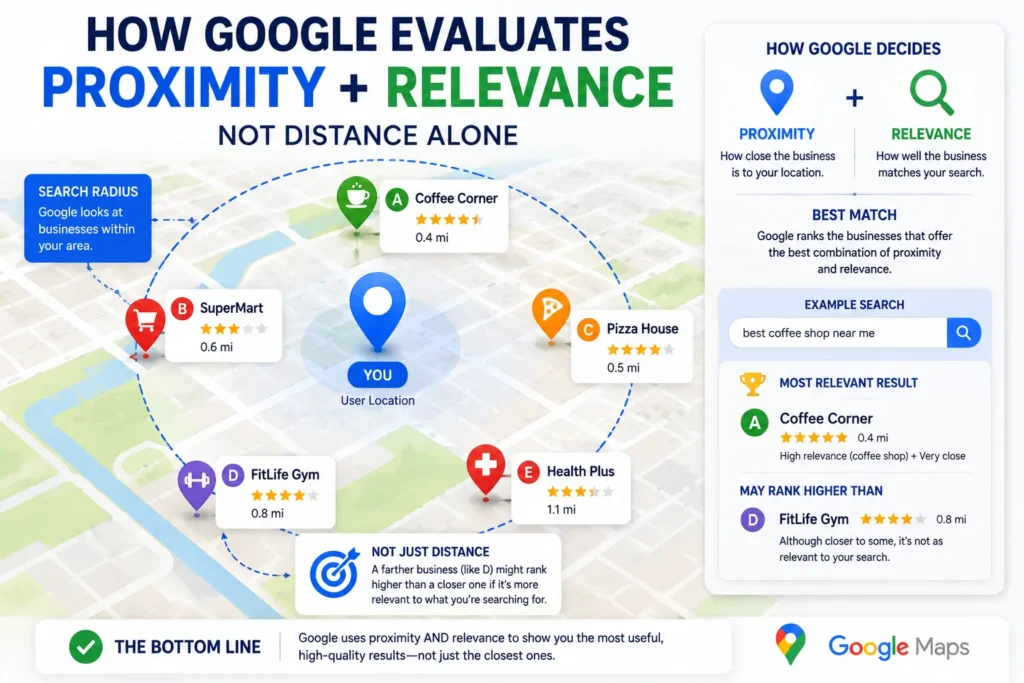
Distance
Distance measures how geographically appropriate a business is for a particular search.
Google compares:
- The user’s location
- The searched location
- The business location
- Service area information when applicable
For example, someone searching “coffee shop near me” will usually see businesses located close to their current position.
If someone instead searches “coffee shop in Denver,” Google focuses on businesses within Denver, regardless of the user’s physical location.
Service-Area Businesses
Many businesses travel to customers instead of operating storefronts.
Examples include:
- Electricians
- Plumbers
- Cleaning companies
- Mobile mechanics
- Pest control services
These businesses define service areas within Google Business Profile to indicate where they operate.
Service areas help Google understand geographic relevance, but they do not automatically expand ranking visibility across every listed city.
Supporting those areas with useful location-specific website content often provides stronger signals.
“Near Me” Searches
Google no longer depends on the exact phrase “near me.”
Instead, it understands that many searches imply local intent automatically.
Searches such as:
- Pharmacy
- Car wash
- Tire shop
often trigger nearby local results without users including any location keywords.
Google combines user location with business relevance to determine which businesses should appear first.
Prominence
Prominence reflects how well-known, trusted, and established a business appears both online and offline. Unlike relevance and distance, prominence is earned over time through consistent business activity, customer trust, and a strong digital presence.
Google’s documentation explains that prominence is based on information collected from across the web, not just from a Google Business Profile. This means your website, reviews, local citations, backlinks, media mentions, and overall reputation all contribute to how Google understands your business.
Think of prominence as Google’s confidence that your business is a credible choice for searchers.
Reviews
Customer reviews provide valuable information about real experiences with your business.
Google considers several aspects of reviews, including:
- Overall review quality
- Number of reviews
- Review recency
- Review diversity
- Business responses
For example, a business with 250 authentic reviews collected steadily over several years generally presents a stronger trust signal than one that suddenly receives dozens of reviews within a few days.
Responding professionally to both positive and negative reviews also demonstrates active business management. While responses alone do not guarantee better rankings, they improve customer trust and help maintain an accurate business profile.
Local Authority
Authority develops when trusted local organizations and websites consistently reference your business.
Examples include:
- Local newspapers
- Chamber of commerce websites
- Community organizations
- Local business directories
- Industry associations
- Educational institutions
- Event sponsorship pages
These references reinforce that your business has a genuine presence within the community.
Website Reputation
Google evaluates your website as another important source of business information.
A well-maintained website helps demonstrate credibility through:
- Helpful service pages
- Accurate contact information
- Local expertise
- Clear business information
- Fast loading pages
- Secure browsing
- Strong user experience
An outdated website filled with thin or duplicated content makes it more difficult for Google to confidently understand your business.
Links and Brand Mentions
Backlinks remain valuable because they act as independent references from other websites.
However, Local SEO emphasizes quality over quantity.
One link from a respected local newspaper may provide more value than dozens of unrelated directory links.
Similarly, mentions of your business without hyperlinks can help reinforce Google’s understanding of your brand when they come from reliable sources.
Offline Reputation
Google also recognizes that many well-established businesses have strong offline reputations.
Awards, professional certifications, industry recognition, and long-standing community involvement can contribute to overall business prominence when reflected across trusted online sources.
Although Google does not publicly explain the weight assigned to each signal, these indicators collectively help strengthen confidence in your business.
Comparison of Google’s Three Core Local Ranking Factors
| Ranking Principle | What Google Evaluates | Examples |
|---|---|---|
| Relevance | How well the business matches the search | Categories, services, products, website content, keywords that reflect search intent |
| Distance | Geographic relationship between the business and the search | User location, business address, service areas, city specified in the search |
| Prominence | Overall reputation and authority | Reviews, backlinks, citations, media mentions, business reputation, website quality |
No single column determines rankings by itself. Google balances all three principles while considering many supporting signals.
Additional Local Ranking Signals
Beyond relevance, distance, and prominence, Google evaluates many supporting signals that help verify business accuracy, improve user experience, and strengthen trust. These signals work together rather than independently, making consistency across every aspect of your online presence far more valuable than optimizing a single element.
Google has never published a complete list of local ranking factors, and rankings vary depending on the search, industry, and competition.
However, experience and Google’s official guidance show that several supporting signals consistently help Google better understand a business.
Google Business Profile Completeness
A complete profile provides Google with richer information about your business.
Important elements include:
- Primary and secondary categories
- Business description
- Services
- Products
- Opening hours
- Contact information
- Website URL
- Attributes
- Service areas where applicable
Completeness does not automatically improve rankings, but it increases Google’s confidence in understanding what your business offers.
A properly configured Google Business Profile supports Google’s understanding of your business, but it should always be part of a broader optimization strategy outlined in our Google Business Profile Guide.
Website Optimization
Your website remains one of Google’s most trusted information sources.
Helpful local websites typically include:
- Clear service pages
- Location-specific information
- Accurate contact details
- Fast page speed
- Mobile-friendly design
- Logical navigation
When your website supports the information shown in your Google Business Profile, Google gains additional confidence in your business.
Businesses that combine a strong website with technical optimization and location-focused content typically build stronger long-term visibility. Our Local SEO Services explain how these elements work together in competitive local markets.
Local Keywords
Modern Local SEO is no longer about repeating city names throughout every page.
Instead, naturally incorporate local context where it helps users.
For example:
- Service areas
- Local case studies
- Neighborhood references
- Frequently asked questions
- Community-specific resources
Google increasingly rewards helpful context over keyword repetition.
Citations
Business listings across trusted directories help verify important information such as:
- Business name
- Address
- Phone number
- Website
Consistency across these sources reduces ambiguity and helps Google confirm business identity.
NAP Consistency
NAP stands for:
- Name
- Address
- Phone Number
Even small inconsistencies can create confusion.
For example:
- ABC Roofing Ltd.
- ABC Roofing Limited
or
- Suite 201
- Ste. 201
While these differences may seem minor, maintaining consistency wherever possible strengthens business identity across the web.
Business Hours
Accurate operating hours improve user experience and help Google present reliable information.
Businesses should update:
- Holiday hours
- Seasonal schedules
- Temporary closures
- Special operating times
Incorrect hours often lead to frustrated customers and lower trust.
Photos
High-quality photos help customers understand your business before visiting.
Useful photo categories include:
- Exterior
- Interior
- Team members
- Services
- Products
- Completed projects
Fresh visual content also demonstrates that the business remains active.
Freshness
Google appreciates businesses that keep information current.
Regular updates may include:
- New photos
- Updated services
- Recent business posts
- Revised descriptions
- Current operating hours
Freshness alone is not a ranking factor, but regularly maintained profiles tend to provide more reliable information.
Review Velocity
Businesses naturally receiving reviews over time often demonstrate ongoing customer activity.
It is important to understand that review velocity should develop organically.
Attempting to manipulate review growth through incentives or fake reviews violates Google’s policies and may harm long-term trust.
Structured Data
Schema markup helps search engines interpret website information more accurately.
Useful schema types include:
- LocalBusiness
- Organization
- Service
- FAQ
- Breadcrumb
- Review where appropriate
Structured data supports Google’s understanding of your business but does not replace strong content or a well-optimized Google Business Profile.
Mobile Usability
Most local searches happen on mobile devices.
Your website should therefore provide:
- Responsive layouts
- Fast loading pages
- Readable text
- Clickable phone numbers
- Simple navigation
- Easy contact forms
A positive mobile experience supports both user satisfaction and overall website quality.
Why These Signals Matter Together
A business with an excellent website but inconsistent citations may struggle to build trust.
Another business may have hundreds of reviews but an incomplete Google Business Profile.
Likewise, a technically optimized website cannot compensate for inaccurate business information or poor customer experiences.
Google evaluates the overall picture. Businesses that maintain consistent, accurate, and trustworthy information across every touchpoint are generally better positioned to earn sustainable local visibility.
Why Your Website Still Matters
A website remains one of the strongest sources Google uses to understand a local business. While a Google Business Profile provides summary information, your website offers detailed context about services, locations, expertise, and customer experience, helping reinforce relevance, trust, and authority.
Some business owners believe they can rank well using only a Google Business Profile. While a Business Profile is essential, it works best when supported by a high-quality website.
Your website gives Google information that cannot fit inside a Business Profile, such as detailed service descriptions, location-specific content, customer resources, and technical signals that demonstrate credibility.
For businesses competing in crowded local markets, improving website quality alongside Google Business Profile optimization often delivers better long-term results. Learn more about our Local SEO Services and how we build location-focused SEO strategies.
Local Landing Pages
Businesses serving multiple cities or neighborhoods should create dedicated location pages when each page offers genuinely useful information.
An effective local landing page might include:
- Services available in that location
- Local customer testimonials
- Area-specific FAQs
- Driving directions
- Service availability
- Photos from completed local projects
- Contact information
Avoid creating dozens of nearly identical pages that only replace the city name. Thin location pages provide little value and may reduce overall website quality.
Internal Linking
Internal links help both users and search engines understand the relationship between pages.
For example:
- Your homepage should link naturally to service pages.
- Service pages should link to relevant location pages.
- Blog articles should connect to supporting guides and service pages where appropriate.
This creates a logical content structure that reinforces topical authority and improves crawlability.
Suggested Internal Link
Naturally reference your Local SEO Services page when discussing professional optimization and implementation.
Helpful Content
Google rewards content that genuinely answers customer questions.
Instead of publishing articles solely to target keywords, focus on solving real problems.
Examples include:
- Pricing guides
- Service comparisons
- Frequently asked questions
- Local regulations
- Seasonal maintenance advice
- Step-by-step tutorials
Helpful content strengthens both traditional SEO and Local SEO because it demonstrates expertise and builds user trust.
Technical SEO
Technical optimization makes it easier for search engines to crawl, understand, and index your website.
Important technical considerations include:
- Secure HTTPS connection
- Clean site architecture
- XML sitemap
- Logical URL structure
- Canonical tags
- Optimized images
- Crawlable navigation
Technical SEO does not replace strong content, but it provides the foundation that allows search engines to access and interpret your pages efficiently.
Schema Markup
Structured data helps search engines understand key business information.
Common schema types for local businesses include:
- LocalBusiness
- Organization
- Service
- FAQ
- Breadcrumb
- ImageObject
Schema does not directly improve rankings, but it reduces ambiguity and supports Google’s understanding of your business.
Mobile Optimization
Local searches frequently occur on smartphones while users are actively looking for nearby businesses.
Your website should make it easy to:
- Call your business
- Request directions
- Book appointments
- Complete contact forms
- Read important information without zooming
A frustrating mobile experience often leads to abandoned visits, regardless of ranking position.
Core Web Vitals
Google also evaluates aspects of page experience through Core Web Vitals.
These measurements assess areas such as:
- Loading performance
- Visual stability
- Responsiveness
Although Core Web Vitals are only one part of overall website quality, faster and more stable pages generally create a better experience for visitors.
Conversion Optimization
Ranking well only matters if visitors become customers.
Simple improvements can increase conversions, including:
- Clear calls to action
- Prominent phone numbers
- Online booking options
- Trust signals
- Customer testimonials
- Easy-to-use forms
A website that converts visitors effectively supports the overall value of your Local SEO efforts.
How Google Business Profile Supports Local SEO
A Google Business Profile helps Google understand essential information about a business, including its location, services, categories, and contact details. It supports local visibility by providing accurate business information, but it works best when reinforced by a trustworthy website and a consistent online presence.
Your Google Business Profile is often the first interaction customers have with your business in Google Search or Google Maps.
However, it should be viewed as one important component of a broader Local SEO strategy rather than a standalone solution.
Verification
Verification confirms that you have the authority to manage the business listing.
Once verified, you can update important information such as:
- Business hours
- Contact details
- Categories
- Services
- Photos
- Website links
Verification strengthens Google’s confidence in the legitimacy of your business but does not guarantee higher rankings.
Business Categories
Selecting the correct primary category is one of the most important profile decisions.
Your primary category should describe your main business activity as accurately as possible.
Secondary categories can provide additional context but should remain relevant.
Choosing categories simply because they have high search volume can confuse Google’s understanding of your business.
Services
Detailed service listings help Google better understand what your business offers.
Instead of using broad descriptions, specify individual services whenever possible.
For example, a law firm might list:
- Family law
- Divorce mediation
- Child custody
- Estate planning
These details improve topical relevance for relevant searches.
Products
Retail businesses and certain service providers can also showcase products directly within their Business Profile.
Well-organized product listings help customers understand available offerings before visiting your website.
Photos
Photos improve customer confidence while helping Google understand your business visually.
Useful images include:
- Exterior signage
- Interior spaces
- Team members
- Products
- Completed projects
- Customer-facing areas
Regularly updating photos also demonstrates that the business remains active.
Posts
Google Business Profile posts allow businesses to share:
- Company updates
- Events
- Promotions
- Educational content
- Announcements
Posts are not a shortcut to higher rankings, but they provide fresh information for potential customers and encourage engagement.
Messaging
Where available, messaging allows customers to contact businesses directly from their profile.
Quick and professional responses contribute to a positive customer experience.
Questions & Answers
The Questions & Answers section often addresses concerns before customers contact the business.
Common topics include:
- Parking availability
- Appointment requirements
- Payment options
- Service areas
- Accessibility
Providing accurate answers improves usability and reduces uncertainty for prospective customers.
Google Business Profile Supports Understanding, Not Rankings Alone
It is important to distinguish between supporting signals and guaranteed ranking factors.
A complete Google Business Profile helps Google understand your business more accurately.
However, rankings still depend on multiple interconnected signals, including website quality, reviews, citations, authority, relevance, and user experience.
Businesses with outstanding profiles but weak websites or inconsistent business information may struggle to compete against businesses with stronger overall local authority.
Reviews and Reputation Signals
Reviews help Google and potential customers understand how people experience your business. While reviews alone do not determine rankings, their quality, recency, authenticity, and the way businesses respond contribute to overall trust, credibility, and prominence within Google’s local ranking system.
Customer reviews influence more than purchasing decisions. They also provide Google with continuously updated information about your business, services, and customer satisfaction.
Rather than focusing solely on collecting the highest possible number of reviews, successful businesses build a consistent review strategy that reflects genuine customer experiences.
Quantity of Reviews
A healthy number of authentic reviews indicates that a business is active and regularly serving customers.
For example:
- A restaurant with 500 genuine reviews collected over several years provides Google with more historical customer feedback than a business with only five reviews.
- However, review quantity should always be viewed alongside quality and relevance.
Businesses should never purchase reviews or encourage fake feedback, as this violates Google’s policies and can damage long-term credibility.
Quality of Reviews
Google analyzes more than star ratings.
Reviews often mention:
- Specific services
- Staff members
- Products
- Customer experiences
- Service quality
Detailed reviews provide richer information than short comments such as “Great service.”
For example:
“The technician repaired our leaking water heater within two hours and explained every step of the process.”
This type of review naturally reinforces what the business actually does.
Review Recency
Recent reviews indicate that a business continues to operate and serve customers.
A business with hundreds of reviews from five years ago but none during the past year may appear less active than one that consistently receives authentic customer feedback each month.
Rather than requesting reviews only during promotional campaigns, encourage satisfied customers to leave feedback throughout the year.
Owner Responses
Responding to reviews demonstrates active customer engagement.
Effective responses should:
- Thank customers for positive feedback.
- Address concerns professionally.
- Avoid defensive language.
- Respect customer privacy.
- Show a willingness to resolve issues.
Professional responses build customer confidence and demonstrate that the business values feedback.
Third-Party Reviews
Google also encounters reviews from reputable third-party platforms, depending on the industry.
Examples include:
- Industry-specific review websites
- Professional associations
- Healthcare review platforms
- Hospitality websites
- Local business directories
These reviews help strengthen your overall online reputation, even when they are not displayed directly within Google Business Profile.
Customer Trust
Ultimately, reviews influence people as much as search engines.
A business with:
- Helpful responses
- Authentic customer stories
- Consistent ratings
- Recent activity
is generally more attractive to potential customers than one with outdated or limited feedback.
Trust earned through real customer experiences often leads to more enquiries, bookings, and repeat business.
Citations and NAP Consistency
Citations are online references to your business’s name, address, and phone number. Consistent citations help search engines verify business information across trusted sources, reducing confusion and strengthening confidence that your business details are accurate.
Before Google recommends a business, it wants confidence that the information it presents is reliable.
Citations help provide this confidence by confirming your business details across multiple trusted websites.
Structured Citations
Structured citations appear within organized business directories.
Examples include:
- Local business directories
- Chamber of commerce listings
- Industry directories
- Professional associations
- Mapping services
These listings usually contain standardized business information.
Unstructured Citations
Unstructured citations occur naturally within online content.
Examples include:
- Local newspaper articles
- Community blogs
- Event websites
- Sponsorship pages
- Press releases
Although they may not follow a directory format, they still help reinforce business identity.
Why NAP Consistency Matters
NAP stands for:
- Name
- Address
- Phone Number
Google compares this information across many sources.
For example, imagine the following listings:
Website:
Green Valley Dental
Google Business Profile:
Green Valley Dental Clinic
Directory:
Green Valley Dentistry
Phone numbers:
- (555) 123-4567
- 555-123-4567
- Old office number
Although people may recognize these as the same business, inconsistent information makes verification more difficult for search engines.
Consistency improves confidence.
Directory Accuracy
Quality matters more than submitting your business to hundreds of websites.
Focus on:
- Accurate information
- Trusted directories
- Industry relevance
- Local relevance
Review your listings periodically to ensure that changes to business hours, addresses, phone numbers, or website URLs are reflected everywhere.
Common Citation Mistakes
Businesses frequently encounter issues such as:
- Old phone numbers
- Previous addresses
- Duplicate listings
- Misspelled business names
- Broken website links
- Outdated operating hours
Correcting these inconsistencies improves overall data quality and reduces confusion for both customers and search engines.
Example
| Correct Information | Inconsistent Listing |
|---|---|
| ABC Plumbing | ABC Plumbing Services |
| 125 Main Street | 125 Main St. |
| (555) 987-1234 | Old phone number |
| https://example.com | Old website URL |
Even small differences can accumulate over time if listings are not maintained.
Local Links and Authority
Local backlinks help demonstrate that a business is recognized within its community. Links from trusted local organizations, relevant industry websites, and reputable publications strengthen authority because they provide independent evidence that the business is legitimate and respected.
Backlinks remain an important part of SEO, but Local SEO places greater emphasis on relevance than volume.
A handful of high-quality local links often provide more value than hundreds of unrelated backlinks.
Community Organizations
Many businesses naturally earn links through community involvement.
Examples include:
- Charity events
- Community projects
- Local sponsorships
- Educational initiatives
These relationships demonstrate genuine participation within the local area.
Chambers of Commerce
Membership in a local chamber of commerce frequently provides:
- Business listings
- Member profiles
- Local networking opportunities
These citations and links reinforce local authority while also increasing visibility within the business community.
Local Partnerships
Businesses often collaborate with complementary organizations.
Examples include:
- Landscapers partnering with garden centers.
- Wedding photographers partnering with event venues.
- Fitness trainers partnering with nutritionists.
These relationships sometimes lead to natural backlinks and valuable brand mentions.
Industry Associations
Professional organizations provide another source of trust.
Membership directories, certifications, and association profiles demonstrate professional credibility while creating additional opportunities for authoritative references.
Local Media Coverage
Positive coverage from reputable local publications helps strengthen prominence.
Examples include:
- Business awards
- Community involvement
- Charity work
- Company milestones
- New location openings
These mentions contribute to both customer awareness and Google’s understanding of business authority.
Focus on Relevance
Successful Local SEO is not about collecting the largest possible number of backlinks.
Instead, prioritize links that are:
- Relevant to your industry
- Relevant to your community
- Editorially earned
- Helpful for users
These links reinforce trust because they reflect genuine relationships rather than artificial link-building campaigns.
User Engagement Signals
User engagement reflects how people interact with your business across Google Search, Google Maps, and your website. While Google has not confirmed that any individual engagement metric is a direct local ranking factor, these interactions can provide useful signals about business relevance, popularity, and customer satisfaction.
Google’s goal is to recommend businesses that satisfy users. It is therefore reasonable to expect that various engagement signals help Google evaluate overall search quality, even though the exact weighting of these signals is not publicly disclosed.
Businesses should focus on improving the customer experience rather than attempting to manipulate engagement metrics.
Click-Through Rate (CTR)
A compelling business name, accurate categories, strong reviews, and helpful descriptions can encourage more people to click your listing.
CTR alone should never be viewed as a guaranteed ranking factor, but higher engagement often reflects listings that better match user expectations.
Driving Direction Requests
Direction requests indicate that users intend to visit a business.
For location-based businesses such as restaurants, clinics, retail stores, and gyms, these interactions may provide useful behavioral signals about customer interest.
Phone Calls
Many local businesses receive calls directly from their Google Business Profile.
Consistent customer enquiries suggest that searchers find the listing useful and relevant.
Website Visits
Your website provides another opportunity to satisfy user intent.
Visitors who quickly find the information they need are more likely to contact your business, request a quote, or schedule an appointment.
Google Business Profile Engagement
Other interactions may include:
- Viewing photos
- Reading reviews
- Checking business hours
- Exploring products
- Viewing services
An actively maintained profile generally creates a better customer experience than one with outdated information.
Review Activity
New customer reviews and thoughtful business responses indicate that the business continues to engage with its customers.
Remember that these interactions should develop naturally through excellent customer service rather than artificial tactics.
How AI Is Changing Local SEO
Snippet Definition (40–60 words)
AI-powered search is changing how Google discovers, understands, and presents local businesses. Instead of relying only on keywords, modern search systems increasingly combine entity understanding, structured information, helpful content, and trusted business signals to answer local questions more effectively.
Google’s AI features do not replace Local SEO fundamentals.
Instead, they increase the importance of providing accurate, trustworthy, and well-structured information across every customer touchpoint.
AI Overviews
AI Overviews summarize information from multiple trusted sources to answer certain searches.
For local businesses, this means:
- Accurate business information becomes more important.
- Helpful website content supports visibility.
- Strong entity signals improve Google’s understanding.
- Consistent business information reduces ambiguity.
Conversational Search
People increasingly ask questions naturally, such as:
- Who is the best family dentist nearby?
- Which HVAC company offers emergency repairs today?
- What coffee shop has outdoor seating and free Wi-Fi?
Businesses that answer these questions through helpful content are better positioned to appear in conversational search experiences.
Entity SEO
Rather than focusing only on keywords, Google increasingly connects information about businesses across multiple trusted sources.
Entity SEO strengthens these connections by maintaining:
- Consistent branding
- Structured business information
- Accurate citations
- Helpful website content
- Trusted mentions across the web
Helpful Content
Helpful content continues to support Local SEO by demonstrating expertise and addressing real customer needs.
Examples include:
- Local buying guides
- Service comparisons
- Maintenance tips
- Pricing explanations
- Frequently asked questions
E-E-A-T
Experience, Expertise, Authoritativeness, and Trustworthiness help Google evaluate content quality.
Local businesses strengthen E-E-A-T by:
- Publishing accurate information
- Showcasing real expertise
- Earning authentic customer reviews
- Maintaining trustworthy business information
Information Gain
Modern AI systems increasingly compare information from multiple sources before recommending businesses.
A business that consistently demonstrates expertise through its website, maintains accurate business information, earns positive customer feedback, and builds a trusted local reputation provides stronger evidence than one relying on a single optimization tactic.
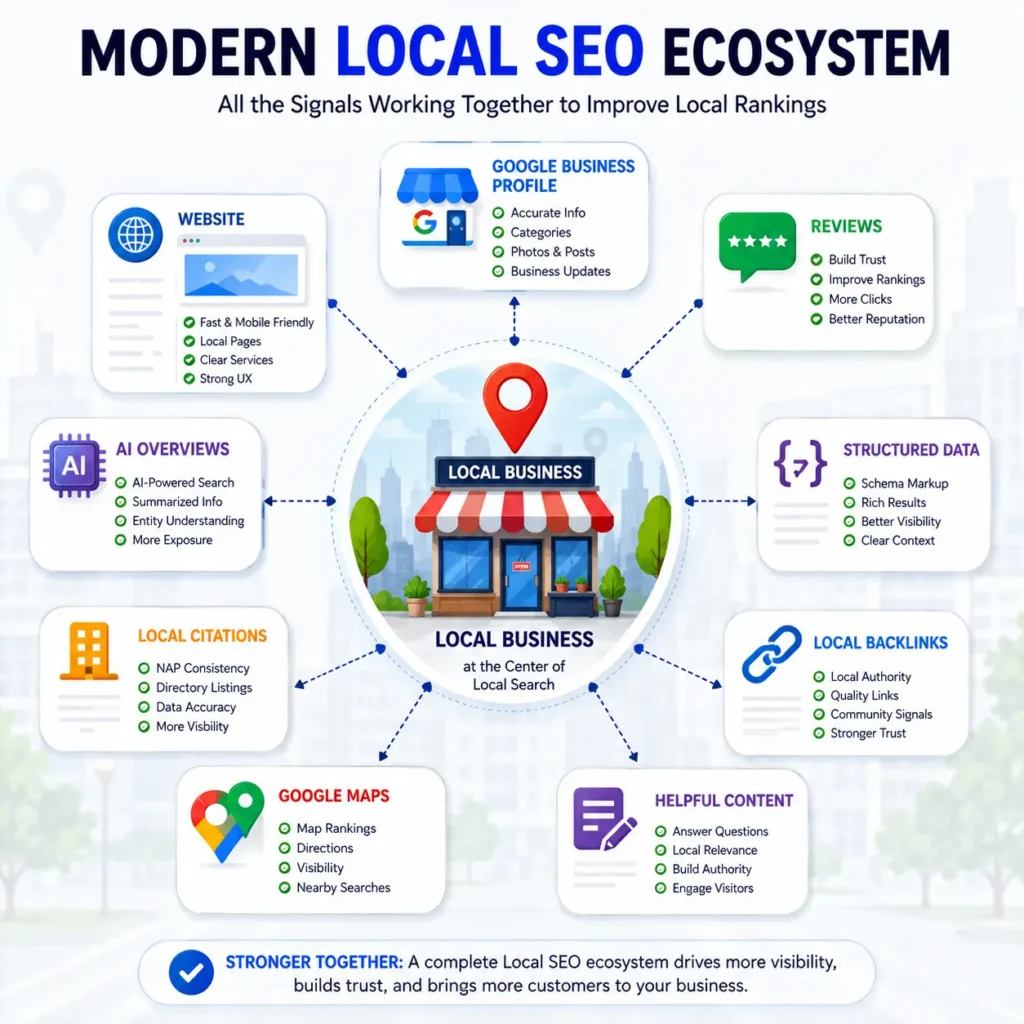
As AI-assisted search evolves, Local SEO becomes less about isolated ranking tricks and more about creating a complete, trustworthy digital presence.
Step-by-Step Local SEO Process
- Optimize your Google Business Profile.
- Improve your website’s quality and technical foundation.
- Research local keywords and customer questions.
- Create useful location and service pages.
- Encourage authentic customer reviews.
- Build accurate citations across trusted directories.
- Earn locally relevant backlinks.
- Publish helpful local content consistently.
- Monitor rankings, traffic, and customer enquiries.
- Continue improving based on real performance data.
Common Local SEO Mistakes
Avoid these common issues:
- Inconsistent business information across directories.
- Choosing inaccurate Google Business Profile categories.
- Creating duplicate business listings.
- Publishing thin location pages.
- Ignoring customer reviews.
- Stuffing keywords into business names or website content.
- Weak internal linking between related pages.
- Poor mobile usability.
- Outdated business hours.
- Neglecting website maintenance.
Frequently Asked Questions
How does Google decide which local businesses rank first?
Google evaluates relevance, distance, prominence, and many supporting signals such as website quality, reviews, citations, and business authority before determining rankings.
Does a website matter for Local SEO?
Yes. A website helps Google understand your services, locations, expertise, and overall credibility while supporting your Google Business Profile.
Is Google Business Profile enough?
No. A Google Business Profile is essential, but long-term success also depends on website quality, customer reviews, local authority, and accurate business information.
How long does Local SEO take?
Results vary depending on competition, your starting point, and ongoing optimization. Improvements often become noticeable over several months rather than days.
What is the Local Pack?
The Local Pack is the group of business listings that appears near the top of Google Search for many location-based queries, usually accompanied by a map.
What is the difference between Local SEO and Google Ads?
Local SEO focuses on earning organic visibility over time, while Google Ads provides paid placement for selected searches.
Do reviews affect Local SEO?
Reviews contribute to trust and prominence. Their quality, recency, and authenticity help Google better understand customer experiences.
Can service-area businesses rank without a storefront?
Yes. Service-area businesses can rank when they accurately configure their Google Business Profile and support it with a strong website and consistent local signals.
Does AI change Local SEO?
AI changes how information is interpreted and presented, but the foundations of Local SEO remain centered on relevance, trust, helpful content, and accurate business information.
What are the most important local ranking signals?
Google officially highlights relevance, distance, and prominence while also evaluating many supporting signals such as website quality, citations, reviews, structured data, and overall authority.
Want Higher Local Rankings?
Many small businesses can successfully manage the basics of Local SEO by maintaining an accurate Google Business Profile, publishing helpful website content, and encouraging authentic customer reviews.
However, as competition increases, Local SEO often becomes more technical. Multi-location businesses, companies operating in competitive industries, or organizations experiencing declining visibility may benefit from a professional audit to identify technical issues, content gaps, citation inconsistencies, and opportunities for improvement.
A detailed Local SEO audit provides a structured roadmap based on your business, market, and competitors rather than relying on assumptions.
Conclusion
Google’s local ranking system is designed to recommend businesses that best meet a user’s needs. It evaluates relevance, distance, prominence, website quality, business information, customer reputation, local authority, and many supporting signals together rather than relying on a single ranking factor.
Businesses that maintain accurate information, create genuinely helpful content, earn customer trust, and continually improve their online presence build stronger foundations for long-term visibility. As AI-powered search continues to evolve, these principles become even more important because search systems increasingly rely on trusted entities, structured information, and consistent signals across the web.
Instead of chasing shortcuts or isolated tactics, focus on building a complete local presence that serves customers well. That approach not only supports stronger visibility in Google Search and Google Maps but also prepares your business for the future of AI-assisted local discovery.

Mandeep Wraich
Digital Marketing Specialist and Content Strategist focused on data-driven growth, SEO, and performance-led content. At AIPulseInsights.com, articles explore how AI, analytics, and emerging digital trends influence marketing strategies, brand visibility, and business decision-making. With a strong foundation in content analysis, paid media, and strategic storytelling, the work shared on this platform converts complex industry shifts into practical insights that support marketers and businesses in achieving consistent, measurable growth. The goal is to simplify innovation and empower readers to stay ahead in a rapidly changing digital landscape.