Google is sending fewer clicks despite growing search activity.
That sentence summarizes what many publishers, SaaS companies, affiliate sites, and SEO teams started noticing across 2024 and 2025. Search Console impressions continued rising. Rankings stayed relatively stable. Yet traffic declined anyway.
For years, SEO operated on a simple equation:
Higher rankings = more clicks.
That relationship is weakening.
Google’s AI-generated answers now satisfy many searches directly inside the results page. Users often get enough information without visiting the source website. Informational searches that once produced reliable organic traffic now end inside AI summaries, featured snippets, People Also Ask boxes, and knowledge panels.
This is not a temporary fluctuation. It reflects a structural change in search behavior.
The impact reaches beyond publishers. SaaS companies are seeing blog traffic weaken at the top of the funnel. Affiliate websites are losing informational clicks. Media companies face advertising pressure as pageviews shrink. Even established brands are watching organic CTR decline across broad informational query groups.
SEO is shifting from ranking optimization to visibility optimization.
That shift changes how content should be created, structured, distributed, and measured.
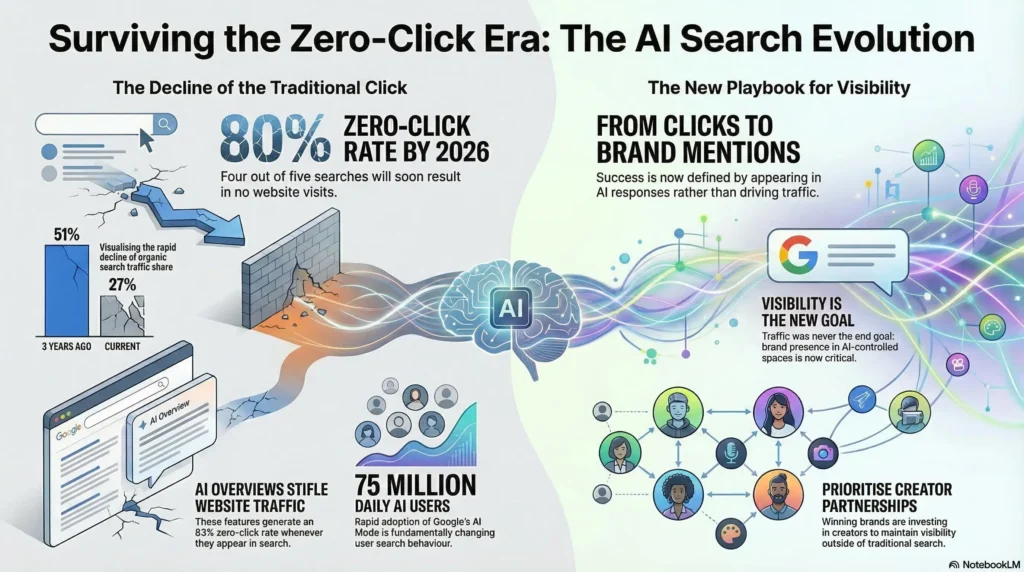
What Are AI Overviews?
Understanding Google AI Overviews
Google AI Overviews are AI-generated summaries that appear directly inside search results. They combine information from multiple sources and present synthesized answers before traditional organic listings.
Unlike featured snippets, which usually extract content from one webpage, AI Overviews aggregate insights across several sources simultaneously.
The system attempts to answer the user’s question immediately.
For example:
- “What is entity SEO?”
- “How does technical SEO work?”
- “Why is organic traffic dropping?”
Instead of showing only blue links, Google now generates a summarized response with citations to supporting websites.
This changes user interaction with search.
Many users no longer need to click through because the answer appears directly inside the SERP.
Evolution from SGE to AI Overviews
Google’s AI search evolution did not happen overnight.
Key milestones include:
| Year | Search Evolution |
| 2012 | Knowledge Graph expansion |
| 2014 | Featured snippets introduced |
| 2018 | BERT improves query understanding |
| 2021 | MUM enhances semantic interpretation |
| 2023 | Search Generative Experience (SGE) testing |
| 2024 | AI Overviews launch broadly |
| 2025–2026 | Expanded AI-assisted search experiences |
The progression shows a clear direction.
Google increasingly prioritizes answering queries directly instead of functioning only as a referral engine.
That creates tension between search usability and publisher traffic.
How AI Overviews Pull Information
AI Overviews rely on several underlying systems.
Entity extraction
Google identifies entities inside content such as:
- People
- Companies
- Products
- Topics
- Concepts
- Locations
Pages with strong entity clarity are easier for AI systems to interpret and cite.
Semantic understanding
Modern search systems evaluate meaning rather than exact keywords.
Google understands contextual relationships between concepts. This allows AI summaries to synthesize answers across multiple documents.
Source aggregation
AI Overviews rarely depend on one source alone.
The system pulls supporting information from several pages and combines them into one answer layer.
This reduces reliance on single-source attribution.
Query intent modeling
Google evaluates:
- What the user likely wants
- Whether a quick answer satisfies intent
- Whether deeper exploration is necessary
Informational queries are especially vulnerable because many can be answered immediately.
A visual diagram here comparing “traditional search flow vs AI Overview search flow” would help readers understand how clicks are intercepted before users reach publisher websites.
What Is Zero-Click Search?
Definition of Zero-Click Search
Zero-click search occurs when a user completes their search journey without clicking any website result.
The answer is delivered directly within the SERP.
This includes:
- Featured snippets
- Knowledge panels
- Local packs
- Weather widgets
- AI Overviews
- Instant calculators
- People Also Ask results
The user gets information without leaving Google.
That behavior has grown steadily for years, but AI Overviews accelerate the trend significantly.
Why Zero-Click Searches Are Increasing
Several behavioral and technological changes contribute to this shift.
Mobile behavior
Mobile users prefer fast answers with minimal friction.
Scrolling through multiple websites is slower than reading an instant summary.
AI summaries
AI-generated responses compress information into concise explanations. Users often trust the synthesized answer enough to stop searching further.
Voice search
Voice assistants naturally produce zero-click interactions because users hear answers directly instead of visiting webpages.
Instant answers
Modern search interfaces prioritize efficiency.
Google increasingly attempts to reduce the number of steps between question and answer.
That objective conflicts with the traditional publisher traffic model.
Types of Zero-Click Results
| SERP Feature | Click Reduction Potential |
| Featured Snippets | Moderate |
| Knowledge Panels | High |
| Local Packs | Moderate |
| AI Overviews | Very High |
| People Also Ask | Moderate to High |
| Instant Answers | Very High |
AI Overviews create the largest disruption because they synthesize complete responses across multiple sources.
Users often feel less need to verify information externally.
Why Organic CTR Is Declining
The Shift from “10 Blue Links” to AI SERPs
Traditional SEO was built around ranking pages inside a list of organic results.
That environment no longer exists consistently.
Modern SERPs contain:
- AI summaries
- Video carousels
- Forums
- Maps
- Shopping modules
- People Also Ask boxes
- Knowledge panels
- Short-form content
Organic listings are pushed further down the page.
Even when rankings remain stable, visibility weakens because the interface itself changed.
How AI Overviews Reduce Click Demand
AI Overviews reduce click demand by satisfying informational intent immediately.
Historically, users clicked websites to:
- Learn definitions
- Understand processes
- Compare concepts
- Get quick explanations
Now many of those answers appear directly inside search results.
The user’s need ends before a click occurs.
This explains why many websites observe:
- Stable impressions
- Stable average positions
- Falling CTR
- Declining sessions
The query still exists.
The click disappears.
Informational Queries Are Most Affected
Informational SEO faces the largest disruption.
High-risk query categories include:
- “What is…”
- “How does…”
- “Benefits of…”
- “Difference between…”
- “Tips for…”
These searches are easier for AI systems to summarize.
Commercial and transactional searches remain more resilient because users still need:
- Product comparisons
- Pricing
- Reviews
- Tools
- Demonstrations
- Trust validation
Users rarely purchase directly from an AI summary alone.
Rising Impressions But Falling Clicks
This pattern now appears frequently inside Google Search Console.
The paradox looks like this:
| Metric | Trend |
| Impressions | Rising |
| Rankings | Stable |
| Clicks | Declining |
| CTR | Declining sharply |
Many SEO teams initially misdiagnosed this issue.
They assumed ranking losses caused traffic drops.
But in many cases rankings remained relatively unchanged.
The real issue was SERP interaction behavior.
Several publishers also observed sharper informational traffic volatility following recent Google AI-focused ranking adjustments. Our analysis of the Google December 2025 Core Update and AI search changes explains how AI-assisted SERPs are influencing visibility and organic CTR patterns.
Users saw the result.
Users consumed the AI answer.
Users never clicked.
Industry datasets from Semrush, Ahrefs, Similarweb, and SparkToro increasingly support the observation that zero-click interactions continue expanding across informational query spaces.
This does not mean search traffic disappears entirely.
It means informational visibility no longer guarantees traffic acquisition.
That distinction matters.
How AI Search Is Changing User Behavior
Searchers Want Faster Answers
Search behavior increasingly prioritizes efficiency over exploration.
Most users are not looking for “content.” They are looking for resolution.
AI Overviews align with that behavior by compressing information into immediate summaries. Instead of opening five tabs and comparing sources manually, users can scan a synthesized response in seconds.
This is especially visible on mobile devices where screen space and attention spans are limited.
Informational searches that previously generated large amounts of organic traffic now often end after one interaction.
Examples include:
- “What is topical authority?”
- “How does schema markup work?”
- “Difference between SEO and SEM”
- “Best time to post on LinkedIn”
Historically, these queries produced predictable traffic flows for publishers and SaaS blogs.
Now many of them produce impressions without proportional clicks.
That behavioral shift is central to the current AI search traffic decline.
Trust Shift Toward AI Summaries
Users increasingly trust AI-generated summaries enough to stop researching further.
That trust does not mean AI answers are always correct. It means the perceived effort required to verify information has become higher than the perceived benefit.
This creates a major SEO challenge.
In traditional search, ranking on page one usually guaranteed at least some click-through opportunity.
In AI-assisted search, the SERP itself competes directly against the publisher’s content.
Google is no longer functioning only as a discovery engine.
It is functioning as an answer engine.
Conversational Search Is Growing
Search queries are becoming longer and more conversational.
Users increasingly type:
- “Why is my organic traffic dropping even though rankings stayed the same?”
- “How do AI Overviews affect SEO traffic?”
- “What kind of content still works after AI search?”
These queries resemble prompts used in AI assistants more than traditional keyword searches. This shift also aligns with the growth of conversational and voice-based queries, where users increasingly search using natural language patterns instead of short keywords. Our guide on voice search keywords and conversational search behavior explains how spoken search patterns are reshaping SEO strategy.
This matters because conversational intent favors synthesized responses.
AI systems are better equipped to answer nuanced multi-part questions directly.
As conversational search grows, extraction-ready content becomes more important than keyword repetition.
Search Journeys Are Becoming Shorter
Search funnels are compressing.
Previously, a user journey might look like:
- Search informational query
- Visit blog article
- Read multiple pages
- Compare solutions
- Return later to convert
Now the journey increasingly becomes:
- Search query
- Read AI summary
- Move directly toward a commercial or navigational search
Informational discovery stages are shrinking.
This creates pressure on publishers that relied heavily on top-of-funnel traffic.
Rise of Multi-Platform Search
Search behavior is no longer limited to Google.
Users increasingly distribute discovery across platforms including:
- OpenAI ChatGPT
- Perplexity AI
- TikTok
- YouTube
- Forums
- Community platforms
Conversational search behavior is also accelerating through AI assistants and voice interfaces. Businesses optimizing only for traditional keyword rankings risk missing emerging discovery channels. This breakdown of conversational SEO and AI assistants explains how search behavior is evolving beyond standard SERPs.
This diversification changes how visibility should be measured.
SEO is no longer just Google optimization. It is visibility optimization.
Brands that rely exclusively on traditional search traffic face increasing risk.
Industries Most Affected by AI Overviews
Not every industry experiences the same level of disruption.
The largest traffic declines are appearing in sectors dominated by informational content.
| Industry | Risk Level | Reason |
| Publishing | Very High | Heavy dependence on informational traffic |
| Affiliate websites | Very High | Product research summaries reduce clicks |
| SaaS blogs | High | TOFU educational queries intercepted |
| Health | High | Direct medical summaries inside SERPs |
| Finance | High | Definitions and explanations summarized instantly |
| Education | High | AI answers reduce informational visits |
| Ecommerce | Moderate | Commercial intent still drives clicks |
| Local services | Moderate | Maps and local packs dominate |
| Enterprise B2B | Lower | Complex decisions still require deeper research |
Publishing
Publishers are among the hardest hit.
Many media sites built scale around informational SEO:
- Definitions
- Explainers
- Trend articles
- Basic tutorials
AI Overviews can summarize much of this content directly inside search results.
This reduces:
- Pageviews
- Ad impressions
- Session depth
- Newsletter acquisition
- Affiliate clicks
The effect becomes severe when informational traffic represents the majority of revenue generation.
Affiliate Websites
Affiliate websites face pressure because AI systems increasingly summarize:
- Product comparisons
- Best-of lists
- Buying recommendations
- Pros and cons
Users may no longer need to visit the original review article to get basic purchasing guidance.
Simple affiliate content with little firsthand testing is especially vulnerable.
SaaS Blogs
Many SaaS companies invested heavily in top-of-funnel content strategies.
Examples include:
- “What is CRM?”
- “How to improve team productivity”
- “What is workflow automation?”
These articles historically generated awareness and nurtured leads.
AI Overviews now intercept many of these educational searches before users reach the SaaS website.
The impact is particularly noticeable for companies whose blogs relied on high-volume informational keywords rather than proprietary insights.
Health and Finance
Health and finance queries attract aggressive AI summarization because users want immediate answers.
Google increasingly surfaces direct responses for:
- Symptoms
- Definitions
- Financial calculations
- Tax questions
- Investment concepts
These sectors also involve strong authority requirements.
Brands without recognized expertise signals struggle more in AI-assisted search environments.
What Content Types Are Losing Traffic?
Simple Informational Articles
Basic informational content is increasingly commoditized.
Examples include:
- “What is SEO?”
- “What is cloud computing?”
- “Benefits of email marketing”
AI systems can summarize these topics easily because the information is widely available and repetitive across the web.
Pages offering no unique value face the highest risk.
Definition-Based Content
Definition-heavy articles are highly vulnerable to zero-click SERPs.
Users searching simple factual questions usually want concise answers, not long-form exploration.
AI Overviews satisfy this intent effectively.
Generic “What Is” Articles
Many SEO-driven publishing strategies overproduced generic educational content during the past decade.
Examples:
- “What is PPC?”
- “What is a backlink?”
- “What is machine learning?”
Most of these pages compete using similar structures and similar explanations.
AI systems can synthesize this information without requiring users to visit the source websites.
Low Originality SEO Content
Low originality content struggles because AI systems reward extraction efficiency and authority signals.
Common characteristics include:
- Rewritten competitor information
- Minimal firsthand insight
- Keyword stuffing
- Surface-level explanations
- Generic examples
Content built primarily to rank rather than inform becomes easier to replace with AI summaries.
AI-Generated Thin Content
Mass-produced AI content creates another problem.
Many publishers scaled content production rapidly without adding expertise, research, or unique observations.
This created large volumes of low-differentiation pages.
Ironically, AI search systems now reduce traffic to much of that content because it lacks distinct value.
Content Likely to Lose Traffic vs Survive
| Likely to Lose Traffic | More Likely to Survive |
| Generic definitions | Original research |
| Rewritten SEO articles | Firsthand case studies |
| Thin AI-generated posts | Expert analysis |
| Commodity tutorials | Interactive tools |
| Basic listicles | Community-driven insights |
| Surface-level explainers | Proprietary frameworks |
| Unbranded informational pages | Recognized brand content |
What Content Still Wins in AI Search?
First-Hand Experience Content
Experience-driven content remains difficult to commoditize.
Examples include:
- Real campaign breakdowns
- SEO recovery case studies
- Internal testing data
- Workflow documentation
- Product implementation lessons
AI systems can summarize general knowledge.
They struggle more with firsthand operational insight.
This is where genuine expertise becomes commercially valuable.
Case Studies & Original Research
Original data creates defensibility.
Examples:
- CTR studies
- Ranking correlation research
- AI Overview visibility analysis
- Industry benchmarks
- Conversion experiments
When a website becomes the origin source of information, it increases the likelihood of citations across both traditional and AI search systems.
Expert Insights
Subject matter expertise matters more in AI-assisted search environments.
Google increasingly evaluates:
- Author credibility
- Entity recognition
- Topical consistency
- Citation patterns
- Brand trust
Expert commentary creates differentiation that generic content cannot replicate.
Community-Based Content
Communities produce dynamic insights AI systems cannot fully standardize.
This explains why platforms like Reddit increasingly appear in search results.
Users often trust discussions containing:
- Real experiences
- Nuanced opinions
- Practical feedback
- Contradictory perspectives
Community-driven information feels less synthetic.
Interactive & Visual Content
Interactive content retains value because users need direct engagement.
Examples include:
- SEO audit tools
- ROI calculators
- Traffic estimators
- Templates
- Product configurators
- Interactive dashboards
- Visual workflows
AI summaries can explain concepts, but they cannot fully replace utility-driven experiences.
This distinction matters strategically.
The future of SEO increasingly favors assets users interact with rather than pages users merely read.
Visual content also improves survivability in AI search environments.
Examples include:
- Original charts
- Infographics
- Product walkthroughs
- Process diagrams
- Video demonstrations
These assets create information formats that AI systems often reference but cannot fully reproduce inside summaries.
Brand-Led Thought Leadership
Recognized brands gain disproportionate visibility advantages in AI search.
AI systems tend to trust and cite sources with:
- Strong entity recognition
- Consistent topical authority
- High-quality mentions
- Established audience trust
- Editorial credibility
This shifts SEO closer to digital PR and authority building.
The strongest-performing brands increasingly publish:
- Industry research
- Contrarian insights
- Executive commentary
- Market analysis
- Predictive observations grounded in evidence
Generic SEO content becomes replaceable.
Recognizable expertise becomes defensible.
Real Examples of Content That Still Performs
Content categories still generating strong engagement include:
| Content Type | Why It Still Works |
| Proprietary data studies | Unique information source |
| Benchmarks | Difficult to replicate |
| Product-led workflows | High practical utility |
| Technical deep dives | Requires expertise |
| Experience-driven tutorials | Adds operational insight |
| Video explainers | Better consumed visually |
| Community discussions | Real-world perspectives |
For example, a SaaS company publishing internal benchmark data on AI Overview CTR impact creates information unavailable elsewhere.
That type of content attracts:
- Links
- Citations
- Mentions
- Shares
- AI references
Originality becomes a ranking and visibility advantage.
SEO Strategies to Survive AI Overviews
Optimize for AI Citations
Traditional SEO focused heavily on rankings.
Modern SEO increasingly requires citation optimization.
AI systems often extract information from sources they perceive as:
- Clear
- Authoritative
- Structured
- Trustworthy
- Easy to interpret
To improve AI citation probability:
- Use direct answers early in sections
- Structure content semantically
- Define entities clearly
- Support claims with evidence
- Build recognizable topical expertise
This is where AI citation optimization becomes strategically important.
Build Entity Authority
Entity SEO is becoming central to search visibility.
Google increasingly evaluates entities instead of isolated keywords.
An entity can include:
- A company
- A person
- A product
- A concept
- A brand
Strong entity signals include:
- Consistent topical publishing
- Author transparency
- Structured schema markup
- External mentions
- Knowledge Graph associations
- Branded search growth
Brands with stronger entity authority are more likely to appear across AI-generated summaries.
Create Information Gain
Information gain refers to adding genuinely new value beyond existing search results.
This includes:
- Original observations
- New research
- Fresh examples
- Operational insights
- Proprietary frameworks
- Real testing
Many pages lose visibility because they simply restate information already available elsewhere.
AI systems compress repetitive content efficiently.
Unique information becomes harder to replace.
Improve Topical Authority
Topical authority now matters more than isolated keyword rankings.
Google increasingly rewards websites demonstrating deep subject consistency.
For example, a website publishing extensive expertise around:
- AI search
- Entity SEO
- Technical SEO
- Search behavior
- CTR analysis
is more likely to gain authority than a site covering unrelated subjects superficially.
Topical depth strengthens both traditional rankings and AI citation likelihood.
Focus on Commercial Intent
Commercial and transactional searches remain more resilient than pure informational queries.
Examples include:
- “Best CRM software for agencies”
- “SEO audit service pricing”
- “Best project management tool”
- “Enterprise analytics platform comparison”
These searches involve evaluation, trust, and purchasing decisions.
Users still click because they need deeper analysis before taking action.
This means many businesses should rebalance content investment toward:
- Mid-funnel content
- Commercial investigations
- Product comparisons
- Decision-stage resources
Pure informational SEO alone becomes less reliable as a traffic engine.
Increase Brand Searches
Brand demand creates insulation against zero-click erosion.
When users search directly for a brand, clicks remain significantly more stable.
Examples:
- “Ahrefs keyword research”
- “Semrush site audit”
- “HubSpot CRM”
- “Notion AI”
Branded searches indicate recognition and intent.
Google also interprets navigational demand as a trust signal.
This reinforces why modern SEO increasingly overlaps with brand marketing.
Optimize for Multi-Channel Discovery
Traffic diversification is becoming essential.
Brands relying entirely on Google organic traffic face growing vulnerability.
Strong visibility strategies now include:
- YouTube
- Email newsletters
- Communities
- Podcasts
- Reddit discussions
- Direct audience ownership
Multi-platform visibility improves:
- Brand recall
- Search demand
- Entity recognition
- Citation probability
This reduces dependence on one acquisition channel.
Create Click-Worthy Content
The content that survives AI search often gives users a reason to click beyond the summary.
Examples include:
| Click-Worthy Asset | Why Users Still Click |
| Templates | Immediate practical value |
| Tools | Requires interaction |
| Original research | Unique information |
| Calculators | Personalized outputs |
| Detailed case studies | Rich operational insight |
| Frameworks | Actionable systems |
| Videos | Better experiential learning |
If the SERP already answers the basic question, the page must offer something deeper.
That is now a fundamental SEO requirement.
How to Optimize Content for AI Overviews
Use Clear Semantic Structure
AI systems interpret structure aggressively.
Pages should use:
- Logical headings
- Clear hierarchy
- Concise explanations
- Focused sections
- Structured relationships between concepts
Semantic clarity improves extraction accuracy.
Messy formatting weakens machine interpretability.
Answer Questions Directly
Long introductions increasingly reduce effectiveness.
Users and AI systems both prefer immediate clarity.
Good structure:
Question: How do AI Overviews reduce organic traffic?
Direct answer: AI Overviews reduce organic traffic by answering informational queries directly inside search results, decreasing the need for users to click publisher websites.
Then expand with supporting analysis.
This structure improves:
- Featured snippet potential
- AI extraction compatibility
- Readability
- User satisfaction
Add Entity Relationships
Modern SEO increasingly depends on entity relationships rather than isolated keywords.
For example:
- AI Overviews
- zero-click SERPs
- entity SEO
- topical authority
- semantic search
- Answer Engine Optimization
These concepts should connect naturally throughout the article.
AI systems map relationships between entities to understand topical expertise.
Improve Readability
Readability affects both users and extraction systems.
Best practices include:
- Short paragraphs
- Clear transitions
- Active voice
- Specific examples
- Reduced filler language
Dense, bloated writing performs poorly in AI-assisted search environments.
Include Expert Quotes and Citations
Evidence improves trust signals.
Strong content increasingly includes:
- Research references
- Data points
- Expert commentary
- Source transparency
- Credible statistics
This improves perceived authority for both users and search systems.
Use Schema Properly
Structured data helps search systems interpret content more accurately.
Important schema opportunities include:
- Article
- FAQ
- Breadcrumb
- Organization
- Author
- Speakable
Schema does not guarantee AI Overview inclusion, but it improves machine readability and entity association.
For example:
- Organization schema reinforces brand identity
- Author schema strengthens expertise signals
- FAQ schema improves question-answer extraction
Well-structured schema supports visibility optimization beyond traditional rankings.
Strengthen Author Pages
Author transparency matters more in AI-assisted search.
Strong author pages should include:
- Professional expertise
- Industry experience
- Published work
- Areas of specialization
- Social or professional profiles
- Consistent topical focus
Google increasingly evaluates credibility at both page and entity levels.
Anonymous content with weak expertise signals faces growing disadvantages.
AI Overview Optimization Checklist
| Optimization Area | Priority |
| Clear semantic headings | High |
| Direct question-answer formatting | High |
| Strong internal linking | High |
| Original insights | High |
| Structured schema markup | Medium |
| Entity-rich language | High |
| Expert attribution | High |
| Fast page experience | Medium |
| Visual assets | Medium |
| Brand consistency | High |
Entity SEO & Topical Authority in 2026
What Is Entity SEO?
Entity SEO focuses on optimizing around recognized concepts rather than isolated keywords.
An entity can be:
- A business
- A person
- A technology
- A product
- A topic
- A location
Search engines increasingly organize information through entity relationships.
For example, Google understands connections between:
- SEO
- AI Overviews
- zero-click search
- semantic search
- topical authority
- search intent
This creates more advanced contextual understanding than traditional keyword matching.
Why Google Relies on Entities
Entity-based systems improve search quality because language is ambiguous.
Example:
“Apple” could refer to:
- The fruit
- Apple
- A music label
- A stock symbol
Entity understanding helps Google determine contextual meaning.
This becomes even more important inside AI-generated summaries where systems synthesize information across multiple sources.
Entity clarity also improves:
- Citation confidence
- Topical categorization
- Knowledge Graph association
- AI extraction accuracy
Building Topical Clusters
Topical clusters help reinforce authority signals.
Instead of isolated articles, websites increasingly need interconnected expertise ecosystems.
Example cluster:
| Core Topic | Supporting Topics |
| AI search | AI Overviews |
| AI search | zero-click SERPs |
| AI search | entity SEO |
| AI search | AI citation optimization |
| AI search | Answer Engine Optimization |
| AI search | semantic SEO |
This creates contextual depth.
Google increasingly rewards subject consistency over broad but shallow publishing.
Semantic SEO Relationships
Semantic SEO focuses on contextual relevance rather than repetitive keyword insertion.
For example, an article about AI Overview SEO naturally connects to:
- Search intent
- CTR decline
- semantic retrieval
- content extraction
- machine readability
- knowledge graphs
These relationships help search systems understand expertise breadth.
This is why modern SEO content should sound natural rather than mechanically optimized.
Internal Linking for Authority
Internal linking remains critical in AI-era SEO.
Strong internal structures help search systems:
- Discover related content
- Understand topical hierarchy
- Identify authoritative pages
- Map entity relationships
Effective internal linking strategies include:
- Connecting related topic clusters
- Using descriptive anchor text
- Supporting pillar pages
- Reinforcing semantic relationships
Internal links increasingly support contextual understanding, not just crawlability.
Why Brand Search Matters More Than Ever
Google Rewards Recognized Brands
Recognized brands gain visibility advantages because they reduce uncertainty.
Search systems increasingly trust entities with:
- Strong branded search demand
- Consistent mentions
- Established authority
- Positive reputation signals
- Broad digital presence
This explains why established brands often maintain stronger resilience against AI search disruption.
Brand familiarity influences both user behavior and algorithmic trust.
Navigational Searches Are More Stable
Navigational searches remain relatively resistant to zero-click behavior.
Examples:
- “Ahrefs login”
- “HubSpot pricing”
- “Notion templates”
- “Semrush keyword tool”
Users performing branded searches already intend to visit a destination.
AI summaries rarely eliminate the need for clicks in these situations.
This makes brand demand strategically valuable.
Building Demand Beyond Google
Modern SEO cannot depend entirely on passive search discovery.
Brands increasingly need direct audience relationships through:
- Email newsletters
- Communities
- LinkedIn audiences
- Podcasts
- Video platforms
- Direct subscriptions
Owned audiences reduce vulnerability to algorithmic changes.
This is especially important as informational traffic becomes less predictable.
Community & Audience Ownership
Audience ownership is becoming a strategic moat.
Platforms can reduce visibility overnight.
Owned channels create stability.
Examples include:
| Owned Asset | Strategic Benefit |
| Newsletter | Direct reach |
| Community | Recurring engagement |
| YouTube subscribers | Platform diversification |
| Podcast audience | Brand familiarity |
| LinkedIn following | Professional visibility |
Strong audience ecosystems improve:
- Brand recall
- Return traffic
- Search demand
- AI recognition signals
Is SEO Dying or Evolving?
The Death of Old SEO
Certain SEO models are weakening rapidly.
Examples include:
- Mass-produced informational content
- Low-quality affiliate publishing
- Keyword-stuffed articles
- Thin AI-generated pages
- Generic “what is” content farms
These strategies depended heavily on scalable click acquisition.
AI Overviews reduce the effectiveness of those approaches.
Why SEO Still Matters
Search demand itself is not disappearing.
People still need:
- Information
- Recommendations
- Research
- Products
- Services
- Validation
What changes is how users access that information.
SEO still matters because visibility still matters.
The difference is that visibility increasingly extends beyond traditional rankings.
SEO Is Becoming Visibility Engineering
Modern SEO increasingly combines:
- Search optimization
- Brand building
- Digital PR
- UX
- Semantic structure
- Entity development
- Audience growth
Visibility engineering is a more accurate description of modern organic strategy.
The objective is no longer just ranking pages.
The objective is becoming discoverable, trusted, cited, and remembered across search ecosystems.
Organic Search Will Change, Not Disappear
Every major search evolution created fear:
- Mobile-first indexing
- Featured snippets
- Voice search
- RankBrain
- BERT
AI search is more disruptive than previous changes, but it does not eliminate the need for authoritative information sources.
AI systems still require source material.
The competitive advantage shifts toward brands producing genuinely valuable information.
Future of SEO After AI Overviews
AI Agents and Personalized Search
Search increasingly moves toward personalized AI assistance.
Future systems may adapt results based on:
- Search history
- Context
- Preferences
- Workflows
- Behavioral signals
This reduces standardized SERP experiences.
Search Without Traditional SERPs
Traditional “10 blue links” interfaces may continue shrinking.
AI-generated conversational interfaces increasingly mediate discovery.
Users may interact with search more like assistants than search engines.
This changes optimization requirements significantly.
Predictive Search Experiences
Search systems increasingly anticipate needs instead of waiting for explicit queries.
Examples already appear through:
- Suggested searches
- Predictive recommendations
- Contextual prompts
- AI-generated follow-ups
Search becomes more proactive.
Rise of AEO
Answer Engine Optimization (AEO) focuses on improving visibility inside AI-generated answer systems.
This includes optimization for:
- AI summaries
- Conversational assistants
- Extraction systems
- Entity citation
- Semantic retrieval
AEO increasingly overlaps with technical SEO, semantic SEO, and brand authority development.
SEO + PR + UX + Brand Integration
SEO is becoming more integrated with broader business functions.
Successful organic visibility increasingly depends on coordination between:
- SEO teams
- Content strategists
- PR teams
- Product marketers
- UX specialists
- Brand teams
Why?
Because AI search systems evaluate broader trust signals beyond keyword targeting alone.
For example:
- PR drives mentions and authority
- UX improves engagement quality
- Brand strength increases navigational demand
- SEO improves discoverability
- Content establishes expertise
These disciplines now reinforce one another more directly than before.
The companies adapting fastest to AI search are treating visibility as an ecosystem rather than a rankings checklist.
Action Plan for Businesses & SEO Teams
Short-Term SEO Adjustments
Businesses should first identify where AI Overviews are affecting performance most aggressively.
Start by analyzing:
- CTR decline patterns
- Informational query groups
- Impression-to-click gaps
- Traffic loss by content type
- Queries triggering AI Overviews
Inside Google Search Console, many websites now observe:
| Metric | Common Pattern |
| Rankings | Stable |
| Impressions | Increasing |
| CTR | Falling |
| Clicks | Declining |
This pattern often indicates AI-assisted SERP interception rather than ranking deterioration.
Short-term actions include:
- Refresh low-performing informational content
- Add firsthand insights and examples
- Improve semantic structure
- Strengthen internal linking
- Consolidate overlapping thin content
- Prioritize commercial-intent pages
- Improve click differentiation in titles and descriptions
Many sites currently publish too much interchangeable informational content.
Reducing redundancy matters.
Mid-Term Content Strategy
The next stage involves restructuring content strategy itself.
High-performing strategies increasingly emphasize:
| Priority Area | Strategic Purpose |
| Original research | Unique information gain |
| Case studies | Experience signals |
| Product-led content | Commercial resilience |
| Topic clusters | Topical authority |
| Expert commentary | Trust reinforcement |
| Interactive tools | Engagement depth |
Businesses should also reconsider traffic assumptions.
Not every impression must become a click.
In AI-assisted search, visibility itself carries branding value.
Being cited or referenced repeatedly can influence:
- Brand recognition
- Trust development
- Assisted conversions
- Future navigational searches
This changes how SEO ROI should be evaluated.
Long-Term Brand Building
Long-term resilience increasingly depends on brand strength.
Strong brands generate:
- Direct traffic
- Branded searches
- Higher trust
- Better engagement
- Greater AI citation probability
This means businesses should invest more aggressively in:
- Thought leadership
- Industry visibility
- Expert positioning
- Community presence
- Consistent publishing identity
Brands with weak recognition face higher vulnerability because AI systems can replace commodity information easily.
Recognizable expertise is harder to replace.
Traffic Diversification
Traffic concentration risk is increasing.
Businesses heavily dependent on Google informational traffic should diversify acquisition sources.
Important channels include:
- YouTube
- Podcasts
- Newsletters
- Communities
- Referral partnerships
Diversification improves stability during search volatility.
It also strengthens entity visibility across the web.
AI systems increasingly observe cross-platform authority signals.
Metrics Beyond Traffic
Traffic alone is becoming an incomplete SEO KPI.
Businesses should increasingly monitor:
| Metric | Why It Matters |
| Visibility share | Broader SERP presence |
| Brand mentions | Authority signals |
| AI citations | Emerging visibility layer |
| Assisted conversions | Influence beyond last click |
| Engagement depth | User quality indicators |
| Returning visitors | Brand loyalty |
| Branded search growth | Demand creation |
SEO measurement itself is evolving.
The websites that adapt fastest are shifting from raw traffic obsession toward visibility quality and business impact.
FAQs
Are AI Overviews reducing organic traffic?
Yes. AI Overviews reduce clicks for many informational searches by answering questions directly inside search results. Many websites are seeing rising impressions but lower CTR and fewer clicks despite stable rankings.
What is zero-click search?
Zero-click search happens when users get the information they need directly from the SERP without clicking a website result.
Is informational SEO dead?
No, but informational SEO is becoming less click-driven. Generic educational content faces growing pressure, while original research, expertise, and experience-based content remain valuable.
Why are impressions increasing while clicks decline?
AI Overviews and expanded SERP features increase visibility opportunities but reduce click demand because users get answers directly inside search results.
What types of content are losing traffic fastest?
The highest-risk content includes:
Generic “what is” articles
Thin AI-generated content
Basic definitions
Rewritten SEO content
Commodity informational pages
What content still performs well in AI search?
Content with strong differentiation performs best, including:
Original research
Proprietary data
Case studies
Expert analysis
Interactive tools
Community-driven insights
What is AI citation optimization?
AI citation optimization focuses on increasing the likelihood that AI systems reference your content inside generated summaries and conversational responses.
What is entity SEO?
Entity SEO focuses on building recognition and authority around identifiable concepts such as brands, people, products, and topics rather than relying only on keyword matching.
Why does brand authority matter more now?
AI systems increasingly favor recognizable and trusted entities because they reduce uncertainty during information synthesis.
Are affiliate websites at risk?
Yes. Affiliate websites relying heavily on informational product comparisons are particularly vulnerable if they lack firsthand testing or unique value.
How important is topical authority in 2026?
Topical authority is becoming central to organic visibility because search systems increasingly reward deep subject expertise and semantic consistency.
What is Answer Engine Optimization (AEO)?
AEO focuses on optimizing content for AI-driven answer systems rather than only traditional rankings.
How can businesses recover declining SEO traffic?
Recovery strategies often include:
Improving originality
Building brand demand
Strengthening topical authority
Diversifying traffic sources
Focusing on commercial intent
Creating unique information gain
Will AI replace Google Search completely?
Unlikely in the near term. AI will continue reshaping how search functions, but users still need trusted sources, validation, and deeper exploration.
Does ranking number one still matter?
Yes, but rankings alone no longer guarantee traffic. Visibility inside AI-assisted SERPs now matters alongside traditional positioning.
Is SEO still worth investing in?
Yes. Search behavior is evolving, not disappearing. Businesses still need discoverability, authority, and demand generation across digital ecosystems.
Conclusion
AI Overviews and zero-click SERPs are changing the economics of organic search.
The biggest shift is not rankings.
It is click behavior.
Users increasingly consume answers directly inside search environments. Informational traffic that once flowed predictably to publishers and blogs is becoming harder to capture. Many businesses now face declining CTR despite stable visibility.
This shift changes what successful SEO looks like.
Generic informational publishing is weakening.
Originality, expertise, authority, and brand recognition are becoming more important.
Search visibility now extends beyond traditional rankings into:
- AI citations
- Entity recognition
- Brand demand
- Cross-platform authority
- Audience ownership
The future of SEO belongs to businesses that produce information worth referencing, not just pages worth indexing.
The future belongs to brands that become trusted sources, not just optimized pages.

Mandeep Wraich
Digital Marketing Specialist and Content Strategist focused on data-driven growth, SEO, and performance-led content. At AIPulseInsights.com, articles explore how AI, analytics, and emerging digital trends influence marketing strategies, brand visibility, and business decision-making. With a strong foundation in content analysis, paid media, and strategic storytelling, the work shared on this platform converts complex industry shifts into practical insights that support marketers and businesses in achieving consistent, measurable growth. The goal is to simplify innovation and empower readers to stay ahead in a rapidly changing digital landscape.